More than two decades after the initial release of The Legend of Heroes: Trails in the Sky (Eiyuu Densetsu: Sora no Kiseki), developer Nihon Falcom is taking us back to where the Trails JRPG series began. Trails in the Sky 1st Chapter is a remake of the very first title of the series, one of humble beginnings that started a series eventually spanning more than a dozen games of a looooong epic. This also makes for the first time Trails in the Sky has been released for home consoles in English rather than being locked to just PlayStation handhelds and PC. So it’s time to put our Strega sneakers back on and go with the wind once more.
Stepping Out
Trails in the Sky 1st Chapter is designed for series newcomers to be able to experience the beginning of the Legend of Heroes: Trails (Kiseki) series from the beginning, but with a more modern touch. It plays a lot closer to the Trails games since Daybreak. Make no mistake though, this game does not require any prior knowledge of anything Trails (or Legend of Heroes, for that matter).
Full disclaimer: I’ve played the entire series up to this point. My aim with this review is to try to analyze how much this game stacks up both for series veterans looking to revisit it and people who are considering playing Trails in the Sky for the first time through this version. Some degree of comparison and bias is essentially inevitable, given all the time I’ve put into this series. As is usual, this is as story spoiler-free a review as I can reasonably make it.
For the sake of consistency, any time I use the term “Sky FC” I’m referring to the original 2004 game, while “1st Chapter” refers to this remake.
Light and Dark
Trails in the Sky 1st Chapter is something of a slow-burn storywise. It’s not uncommon for the first game of a Trails arc to take a while to ramp up, but Sky especially takes its time. Most of the game is a journey from city to city where you complete missions and go through a series of narrative vignettes in each chapter, while hints of something grander start to build over time. Much of the story is less about the “what” and more about the “who” here.
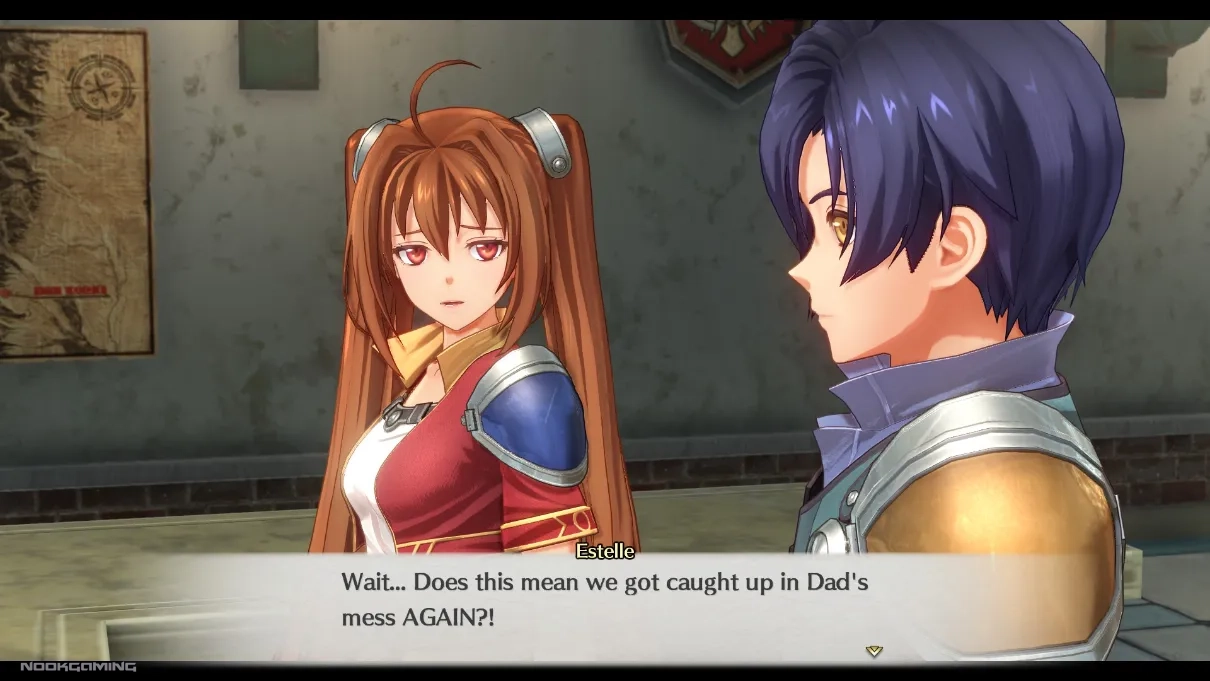
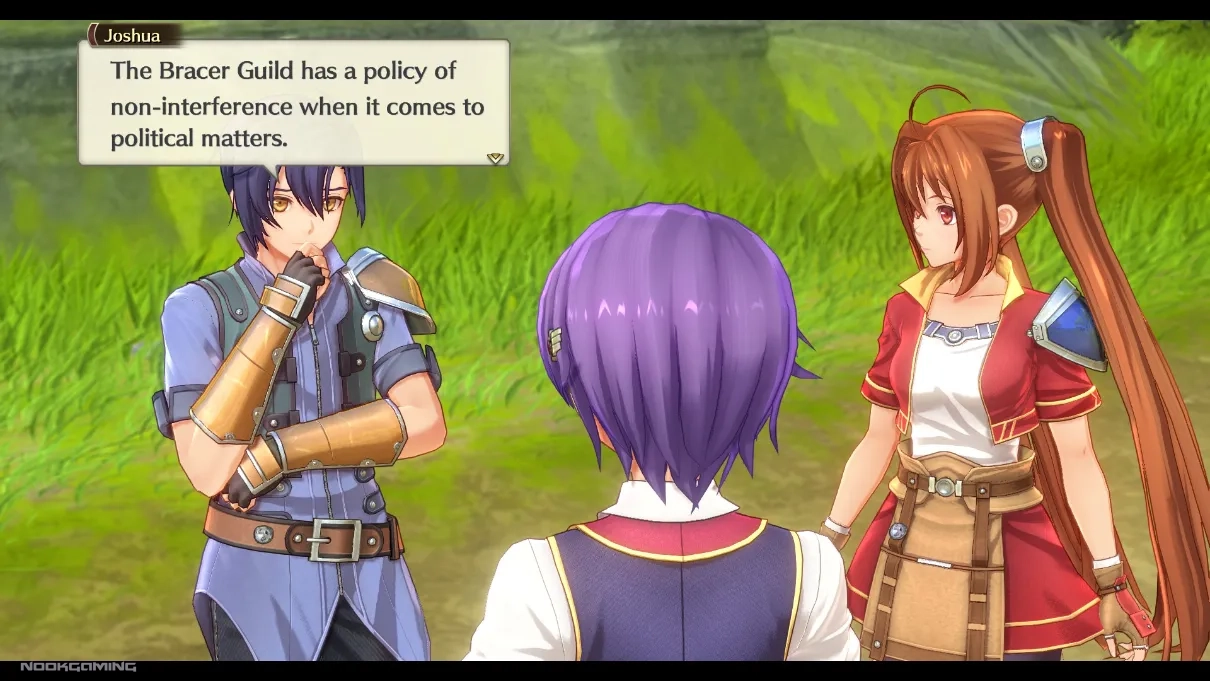
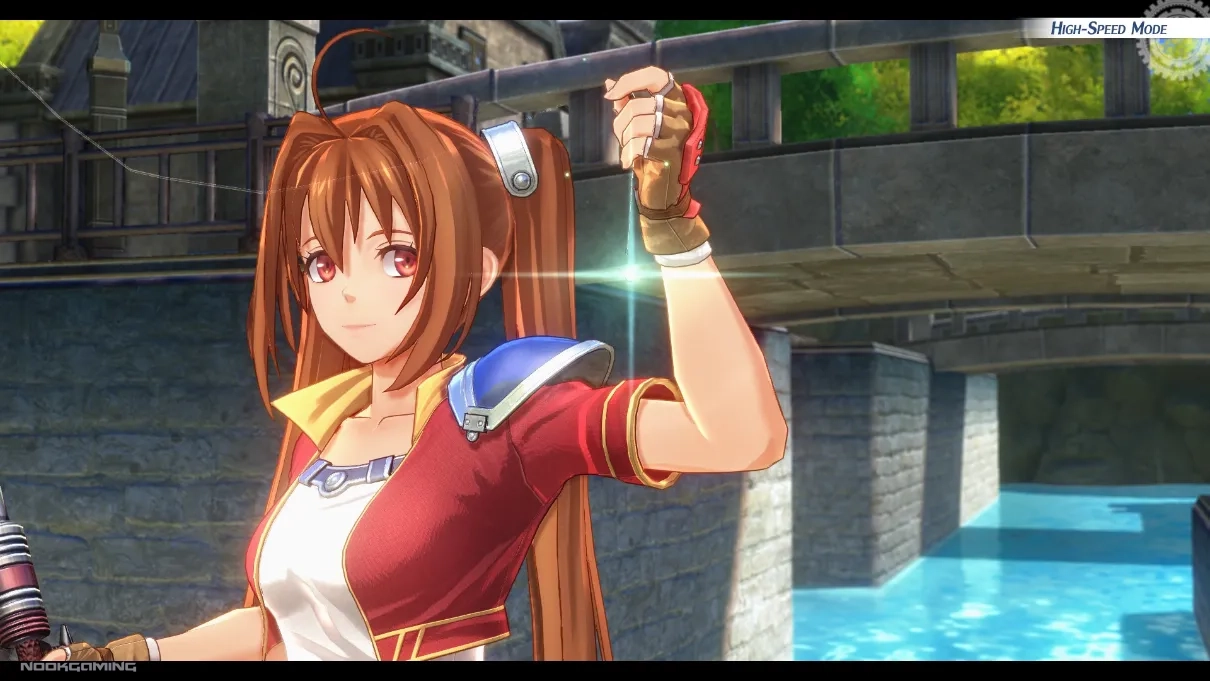
Trails in the Sky 1st Chapter is, more than anything, about the story of our main characters Estelle and Joshua Bright. Joshua enters Estelle’s life through a strange encounter one night where the mysterious boy, injured, is brought into her household (and adopted) by her father Cassius. After five years of growing up together, the two decide to follow in Cassius’s esteemed footsteps and join the Bracer guild, a sort of NGO that goes around doing various odd jobs and helping/protecting people. The pair must journey around the country to collect recommendations from each city’s branch to graduate from junior to senior Bracers, usually by solving significant incidents there.
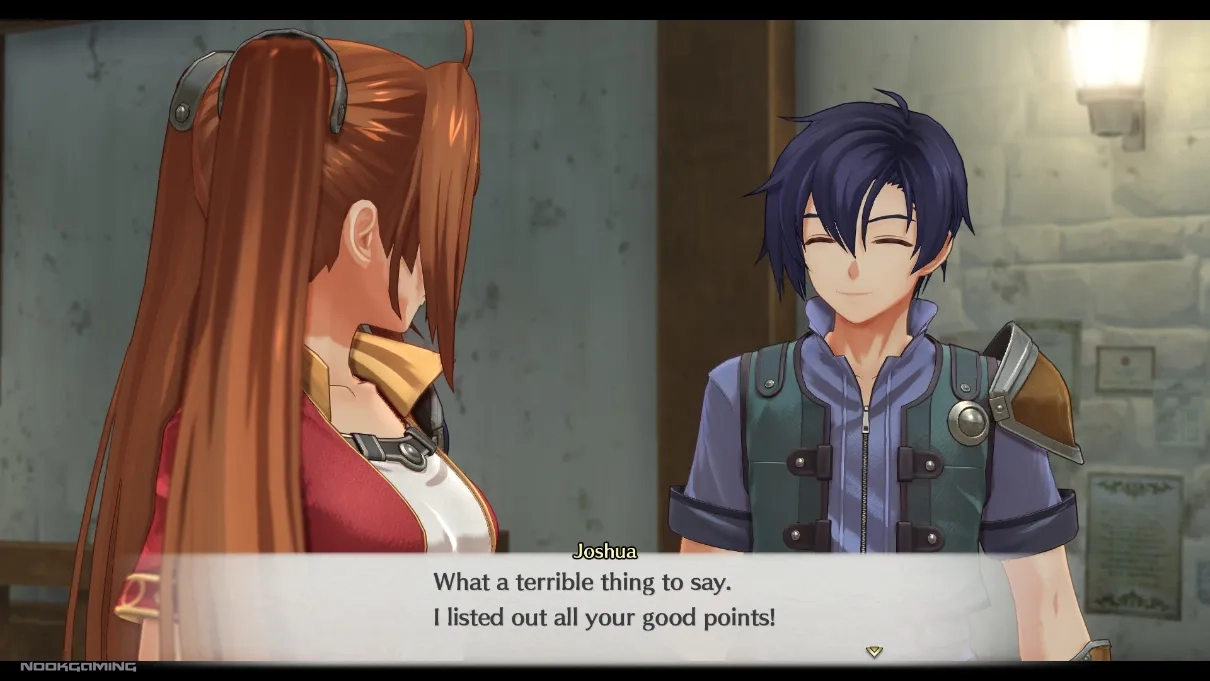
A good chunk of the story is about the journey of our pair of protagonists around the time of their coming of age. And I say “protagonists”, because while Estelle is ostensibly the more focal one of the two, they really work like a 1A/1B in this game given the two are nigh-inseparable throughout.
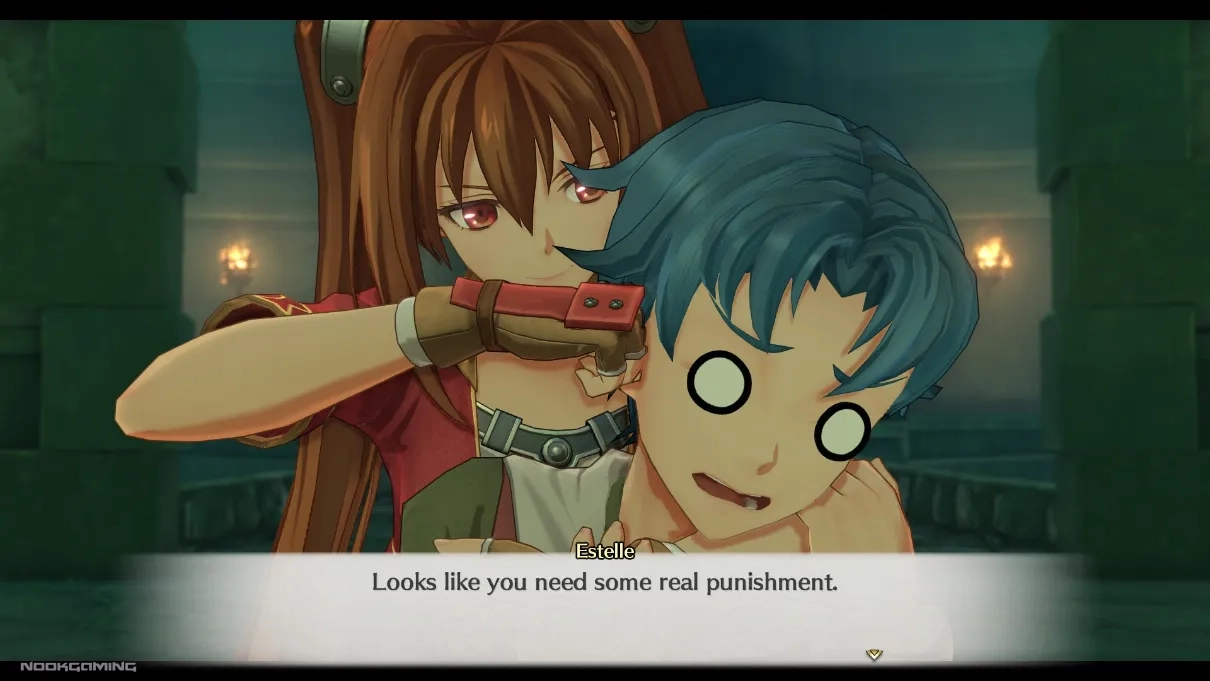
Estelle is very much a hot-headed country girl who wears her heart on her sleeve, a quality that makes her endearing to many but can cause issues in her more professional line of work. Joshua is a far more levelheaded boy who often has to keep Estelle in check, and while he sometimes comes off as a bit colder, he is nonetheless still a sweetheart underneath with plenty of dry wit and snark of his own as well.
If there is anything I hope this remake accomplishes, it’s getting more people to fall in love with these characters and get invested in their journey as much as I have. The two are a fantastic pair who complement each other beautifully. They have quite a lot of chemistry as their dialogue and banter all throughout is delightful and often hilarious, but you can tell how much they care for one another. Estelle is a walking ball of sunshine and energy, but her journey is also a fair bit about coming out of her father’s massive shadow and becoming her own person, something many on her journey (including Joshua) help her with. Joshua may come off as the more mature of the two, but there’s also clearly something off about the guy that seems to relate to his past which comes to resurface more and more. While characters with mysterious pasts that get revealed as time goes on are a common archetype in fiction, I feel Joshua is handled particularly well because the player is given plenty of reasons to care about him and see how he is in a variety of situations separate from that.
Whereabouts of Liberl
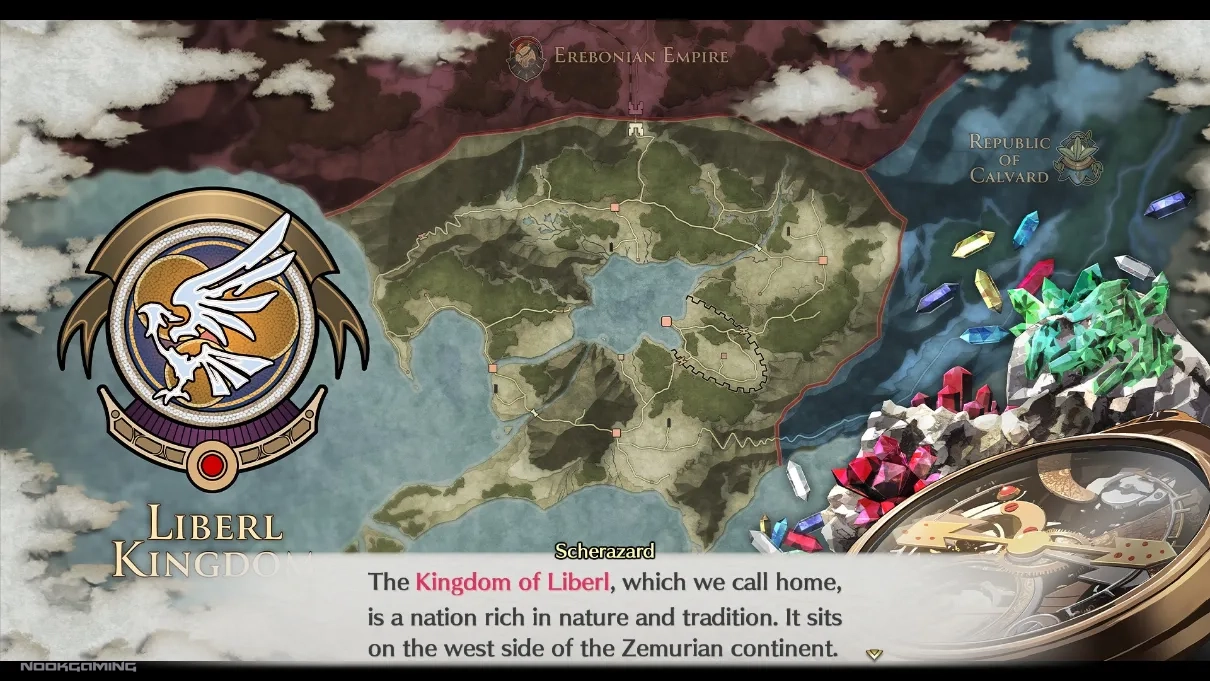
Trails in the Sky 1st Chapter is an extended journey around the Brights’ home country of Liberl, a modest-sized nation on the in-universe continent of Zemuria, located next to the two superpowers of Erebonia and Calvard (which you can see much more in-depth in the Cold Steel and Daybreak games, respectively). And it is quite a journey.
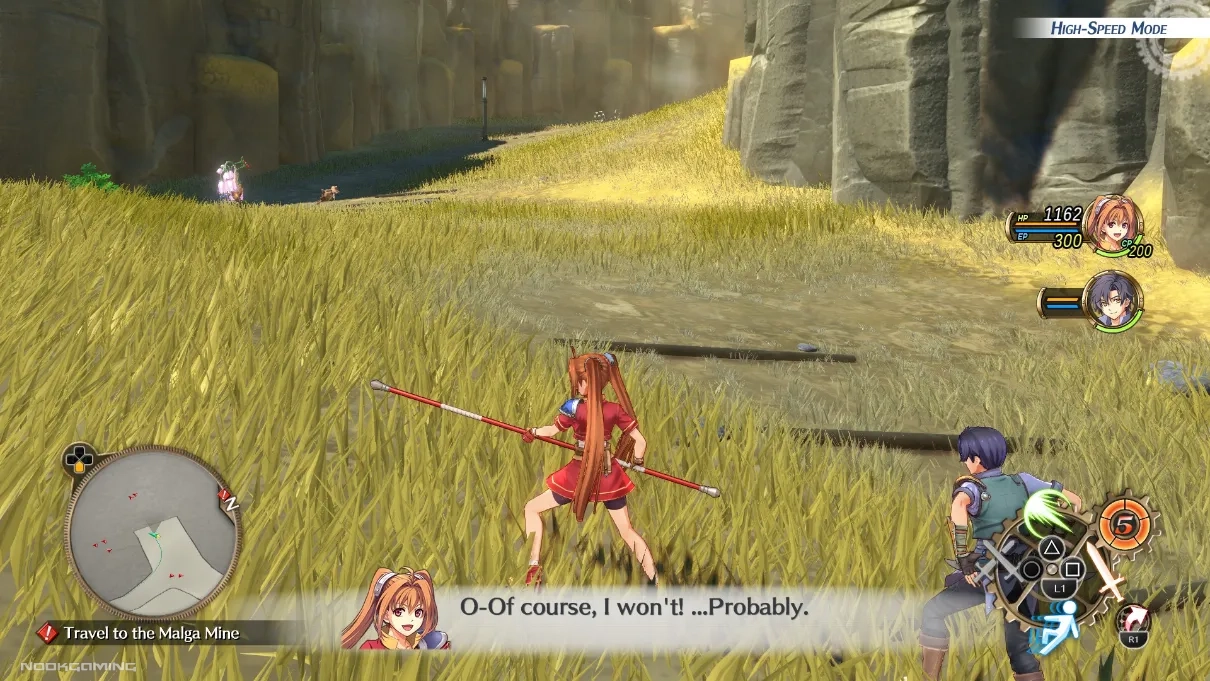
For a game that was originally made with sprites and pixellated backgrounds well into the 2000s, the original Trails in the Sky FC was remarkably full of life and expression, something that any remake needed to be more than just “animated in 3D” to truly capture what made it so captivating. Thankfully, 1st Chapter has done quite well in this regard. While the game noticeably shares graphical features with Trails Through Daybreak, it features a comparatively more vibrant color palette, one with a somewhat stylized look that gives it a touch of personality. Cutscene choreography, both for action and comedic scenes, is also quite animated and enjoyable. I also have to note the use of the original walking sprites from FC as the loading icons, which is an extra cute touch. The game looks and feels so smooth too. I played the game on PC, and the PC version is excellent performance-wise.
The journey through Liberl is made all the more enjoyable by the fantastic accompanying and dynamic soundtrack. The Sky games have always had lush and enjoyable soundtracks full of memorable leitmotifs and perhaps quirky choices of instrumentation (e.g. using horns as the main instrument of the game’s standard battle and boss themes) to give it character, and this remake keeps this up. The word I’d use to describe the tunes in this remake’s score is “tasteful”; they’re a bit more layered than the originals but seldom anything near a re-imagining of the original tune. About the only track I was let down by was the rendition of Silver Will, a track tied to a particular recurring enemy, which is admittedly tough to live up to given it’s literally my favorite piece of video game music ever. Thankfully, if you want to go with something different, 1st Chapter features the option to play with the original soundtrack from Sky FC as well as the arranged score from Sky FC Evolution (the PlayStation Vita version that only released in Asia).
Rounding Out
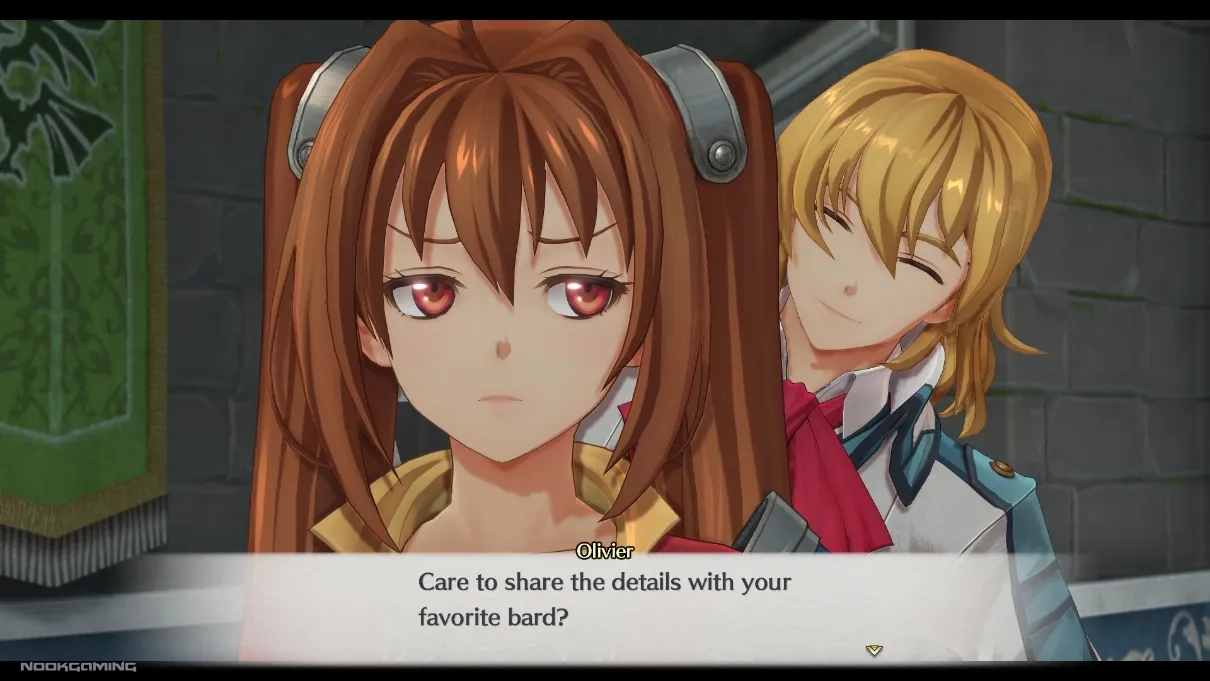
As Estelle and Joshua trek across the country, they will naturally come across a great many faces. Trails in the Sky 1st Chapter has six additional supporting party members. Several of these are other bracers of varying backgrounds, including a woman named Schera who trained under Cassius and is something of an older sister figure to Estelle. Others happen to intersect them on their paths, such as the mysterious bard Olivier (an absolute freaking goober and a fan favorite) or the adorable little cinnamon roll of an engineer named Tita.
While I like all of the other party members, by and large, they are friends tied to a given section of the game and who come and go. Their personalities and roles within the story are fine, but their arcs and backstories aren’t quite there just yet, left to be more thoroughly explored in the games to come and thus might come off as initially a bit simple to newcomers. They mostly function in support of the main two’s journey, both literally and metaphorically.
Each place you go will have plenty of NPCs to talk to. Like most Trails games, their dialogue constantly updates and there are plenty of conversations to have that really make the cities of Liberl feel lived in. There’s lots to do in every new town, from exploring the various food outlets to finding new recipes, to doing a variety of sidequests. While I don’t quite find myself as engrossed in the day-to-day mundane dialogue as I was with the original FC, it’s still a lot more engaging worldbuilding than with many JRPGs.
While Trails in the Sky 1st Chapter takes awhile to really get to the payoff for its budding narrative intrigue, the game’s actual pacing along the way goes by fairly briskly, especially by the standards of the series. The game can be a slow burn, but it didn’t feel bloated. While 1st Chapter has some additional content compared to the original FC, it’s not exactly a game-changing amount. With each new chapter comes a series of increasingly big hints that something bigger is brewing, which eventually leads to the game’s climax. Once Sky does eventually get going, there’s actually a rather interesting plot to how things end. While the buildup is fairly indirect for a while, it works well, especially given how many things tie back to the Bright family.
And while Sky 1st Chapter has a lot that it leaves set up for its sequel, I also think the main antagonist of this particular game is one of the best the series has ever had. Their motives are quite grounded, understandable, and very human in a way I haven’t seen a lot of.
Twirlin’ the Big Stick
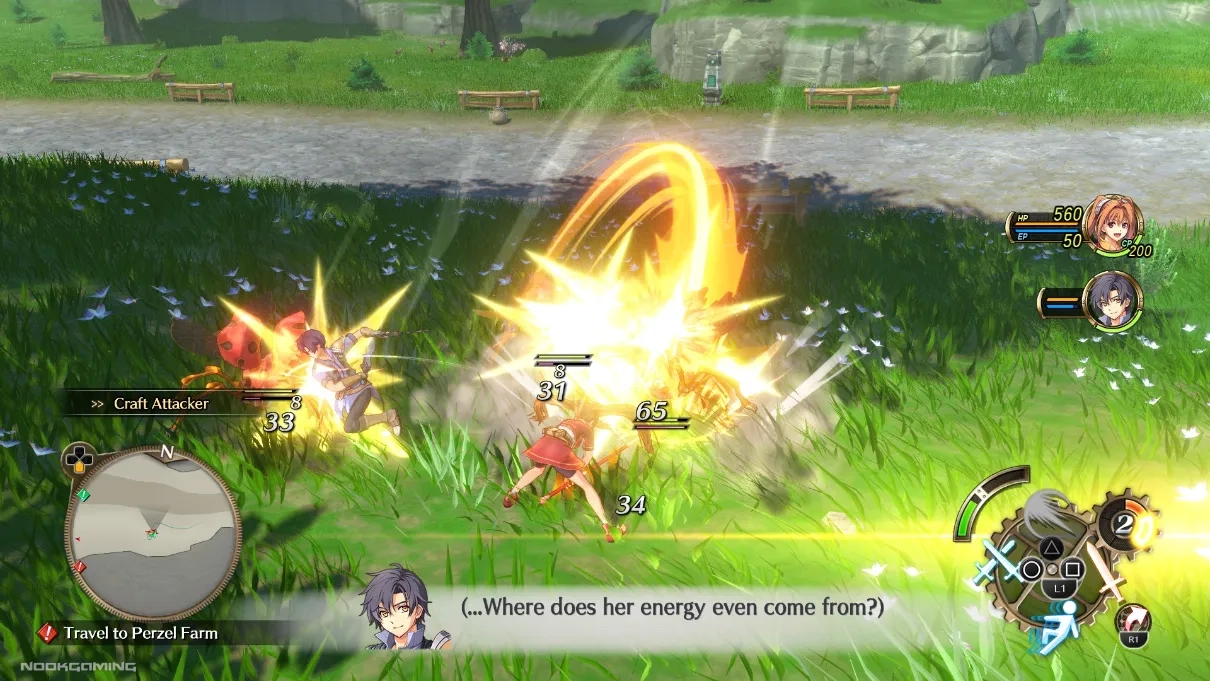
Trails in the Sky 1st Chapter most resembles Trails through Daybreak in its combat system, though it’s a slightly simplified form more fitting of a remake of the first game in the series.
There are two modes of battle: real-time action combat (this time called Quick Battles instead of Field Battles) and turn-based combat (called Command Battles). Like with Daybreak, I’m somewhat ambivalent and still fairly underwhelmed with the Quick Battle system. I think this system allows it to be a touch more exciting out of the gate than Sky FC is for its first couple of hours. On the other hand, it can quickly feel button-mashy. It doesn’t help that the presence of this style of gameplay means that enemies on the overworld really pose little to no obstacle while you’re traversing and are thus extremely avoidable. While Trails has never had much in the way of friction with its field encounters, they used to at least be something you had to be more mindful of.
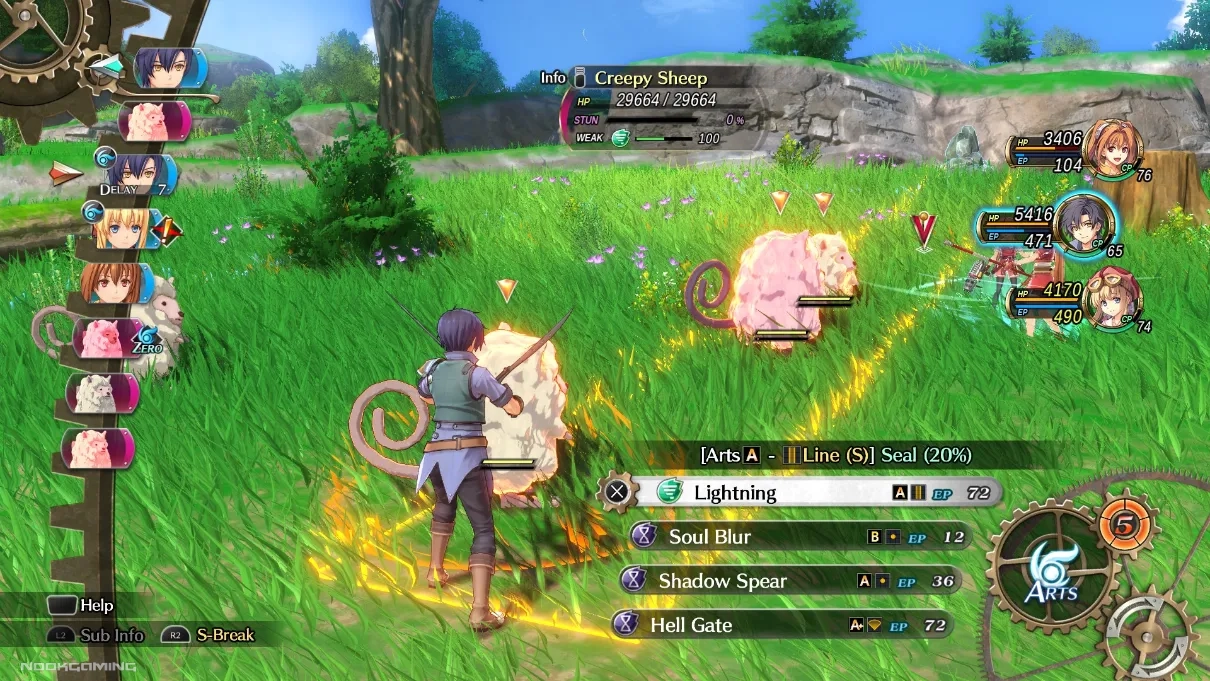
Once again, Quick Battles are more in service of transitioning to Command Battles, as you generally get more EXP out of those. Almost all boss encounters in this game will be Command Battles, and these are really fun. Rather than the grid system of Sky FC (and up through Azure), battles are in a circle around the enemies. You are able to position yourself around the field during your turn before taking an action. Many abilities have to be aimed in a specific way to get the most use out of them, as some have a limited area of effect or fire in a straight line. You can attack, use items, guard, and of course use crafts and arts.
Arts are spells which are determined by the various elemental quartz you give your characters’ orbments (a form of in-universe magitech). Similar to the original Sky FC, each character has up to 6 slots they can put elemental quartz to grant them different spells to use, although some characters have layouts on their orbments more conducive towards getting stronger arts. Crafts on the other hand are unique to each character and are learned by leveling up, often providing unique buffs or area-of-effect attacks. While arts use elemental points (EP, the game’s standard magic points resource), crafts use craft points (CP), which are mainly built up by taking or dealing damage.
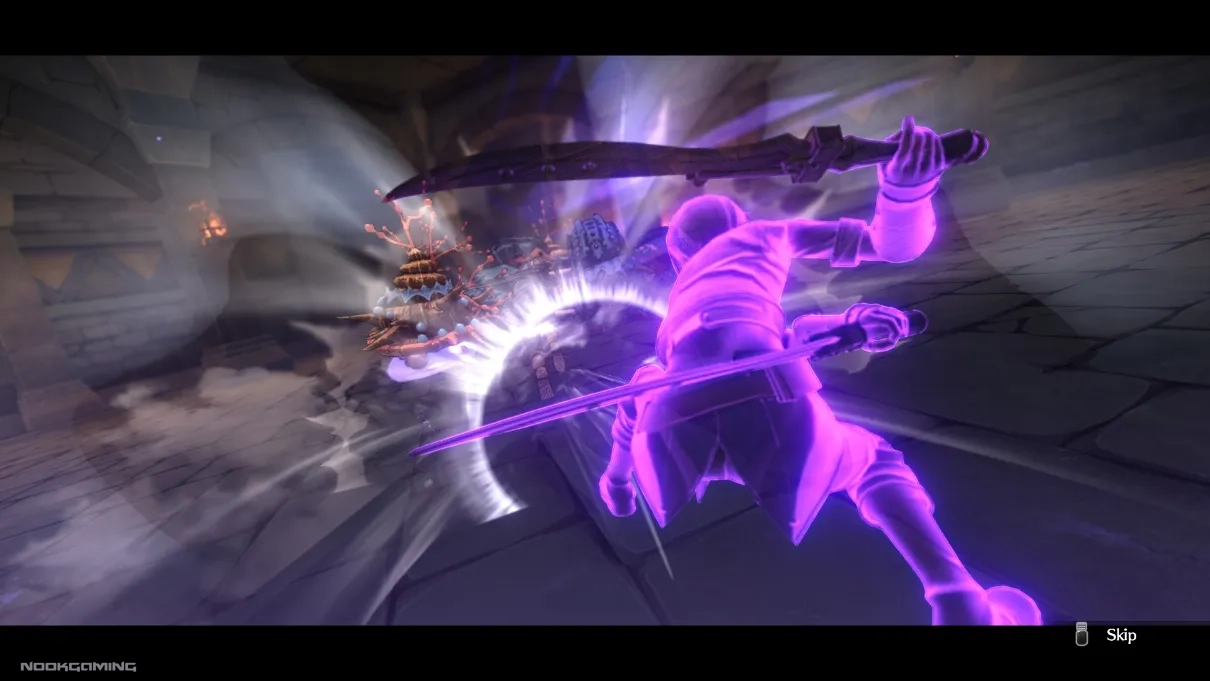
At 100CP, a character can perform an S-Break, in which you can interrupt the turn sequence to perform a character’s powerful S-Craft. These are quite potent, though thankfully not as overtuned as some other games in the series, and they have the drawback of adding a significant delay to a character’s next action. In Trails games, combatants get turns in the sequence based on things such as their speed stat and how much delay each action they perform has attached to it, meaning it’s possible for a party member or an enemy to get several in a row or take a long time between actions. You often have to make decisions that carry a bit of risk based on how long a particular action will take. This risk-analysis is a part of why I enjoy this type of turn-based combat so much.
One particular choice I’ve been wanting Falcom to make for a long time that they finally did is in how S-Crafts work when you have over 100CP. In games prior to Daybreak, you get a bonus (usually 50% damage/potency) to your S-Craft only when you max out at 200CP. In 1st Chapter, every 20CP above 100 enhances the potency of S-Crafts by 10% up to a maximum of 50%. This is a small change that is nonetheless quite a fun shake-up of the system because I no longer feel nearly as discouraged from using crafts while at max CP given it’s not all-or-nothing.
Difficulty
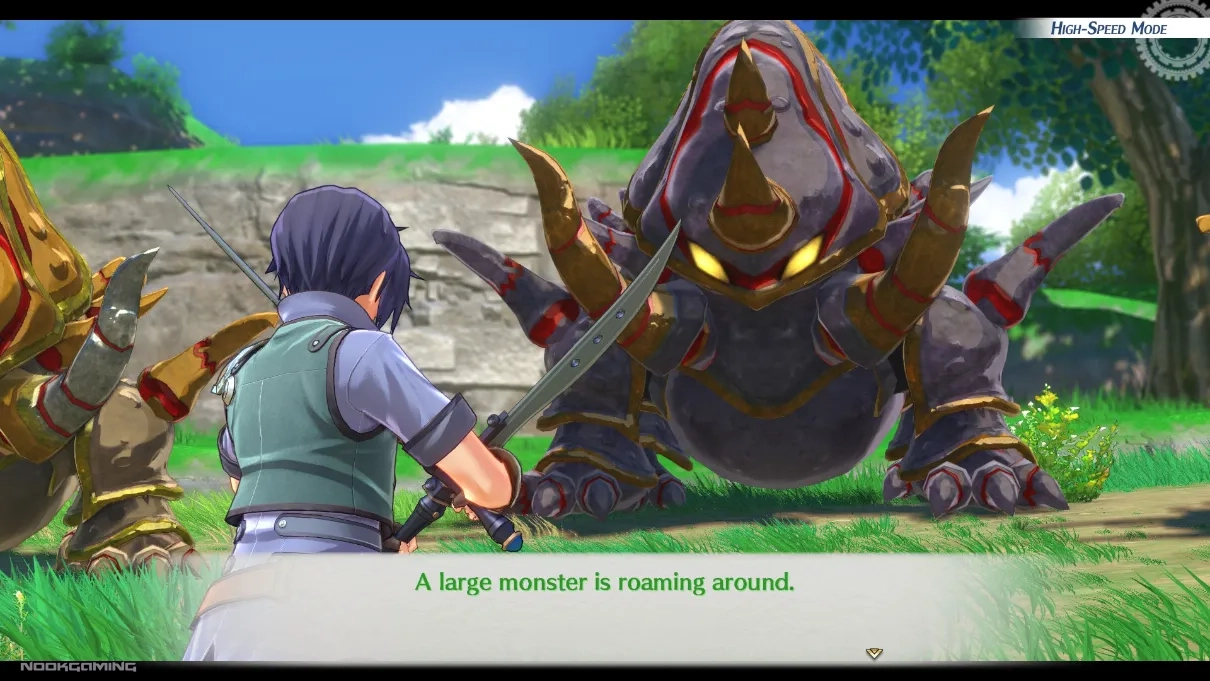
I played Trails in the Sky 1st Chapter on Nightmare difficulty, something I’ve done in pretty much every game since Trails to Azure. It wasn’t an especially difficult experience for me, but I’m also someone with a lot of experience and who does pretty much every sidequest and seeks out every chest, so your mileage will vary a bit. From my experience, even with some of this game’s more powerful options at my disposal, several fights (especially in the game’s final chapter) gave me a fair bit of trouble and I had some game overs along the way (especially in a certain optional fight). Still, Sky FC was always a fair bit easier than the two games that followed it, and it’s meant to be an introduction to the series, so 1st Chapter’s difficulty is in line with what I expected. To note as well, there are some pretty exploitable mechanics which I didn’t take full advantage of during my playthrough.
There are some new mechanics present that make things easier, and while I don’t love all of them, some of them do make the game more fun at least.
Like with later games enemies have stun meters, which when filled up render them momentarily dazed in Quick Battles and cause them to miss their next turn in Command Battles. This isn’t typically a huge factor in whether I win or lose a boss fight, but it can offer something to make meaningful decisions around. Sadly, they don’t really make Quick Battles all that much more interesting.
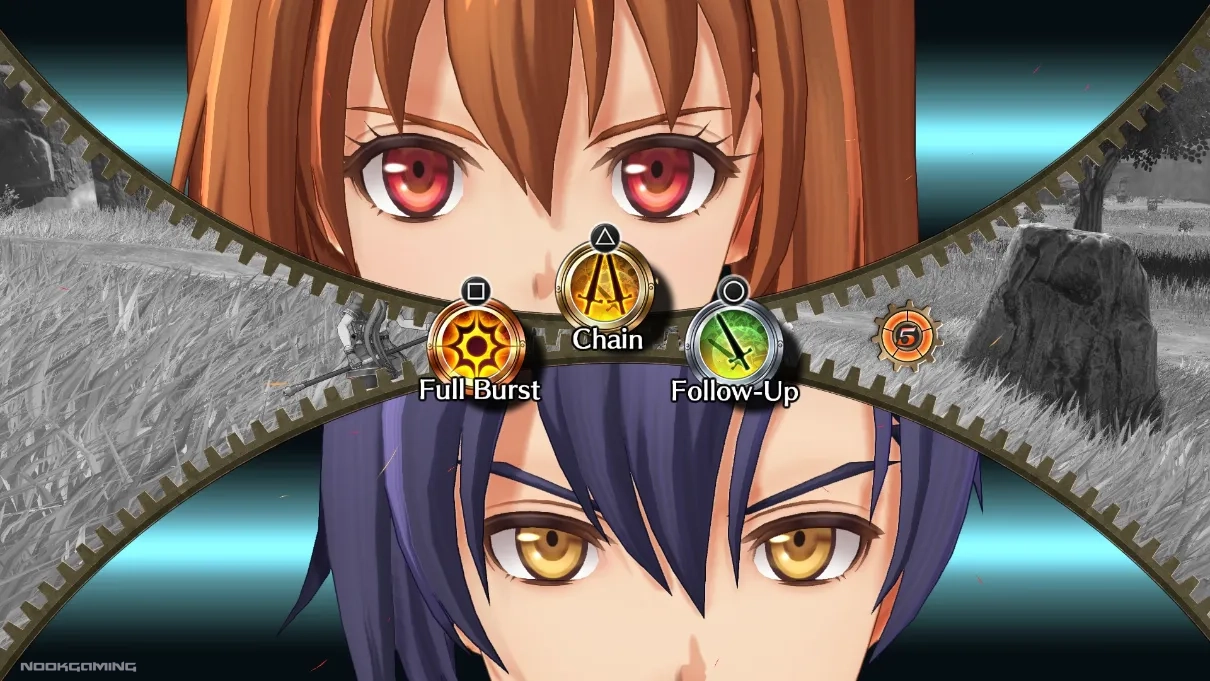
The game also features a Brave Attack system, a modified version of the one found in Trails of Cold Steel. Every time you score a crit or hit a stunned enemy, you can either perform a follow-up hit for a little bit of damage which gives you a Brave Point, or you can expend a few Brave Points to do a bigger burst of damage. This is thankfully kept simple and never felt completely overpowered, and it made the early game more fun.
The game has what are called Support Abilities, which you gradually unlock more of by using your party members a lot. Several of these provide some fairly potent buffs fairly regularly. Buffs in general have been tweaked a fair bit, e.g. Estelle’s “Morale” craft does a lot more than it used to.
There’s also Overdrive, which can be activated mid-battle. It makes a character’s next two attacks automatically trigger a Brave Attack, but it also makes that party member immune to status effects for those turns and cleanses them of any status effect they currently have. Status effects in Trails games (and most JRPGs on the whole if we’re honest) have always been quite annoying, so this is actually a kind of neat feature to have around, and it doesn’t completely invalidate the really powerful status effects that prevent you from taking an action.
Trails in the Sky 1st Chapter has fast travel, and it’s quite robust. On one hand, while you can’t freely use it everywhere you go, I feel like it makes several areas a bit easier than they should be since you can just quickly warp back to a hotel to heal rather than have any incentive to tough it out in a dungeon. On the other hand, by God does it cut down on the amount of time-consuming foot traffic, which I appreciate. Also unlike the original, this remake adds quest markers to your minimap to notify you of available sidequests and sub-events. While this arguably takes some of the discovery out of it, Sky FC was pretty infamous for easily missable sidequests you’d have no idea about without constantly scouring the map, so this makes it a lot easier if you want to complete all the quests without using a guide.
The More Things Change…
Trails in the Sky 1st Chapter is the first Trails game to have a simultaneous worldwide release. GungHo Entertainment is publishing it internationally, who outsourced localization and voiceover to different companies than the previous Trails games. I don’t typically talk about English localizations of Trails games at all in my reviews for a laundry list of reasons, but given this game has an English script already to compare to, I think it’s worth at least mentioning this time.
For what it’s worth, Trails games have massive amounts of text, and I think they did okay with making a good amount of it readable and feel natural and not stiff. I don’t think the script is as overall tight or punchy as that of XSEED’s version of Sky FC that’s on Steam right now, though it’s worth noting that that version had improvements from the original release I played on PSP. Still, despite the shoes it has to fill, the script is generally pretty functional and several of the emotional scenes still got me as good as ever.
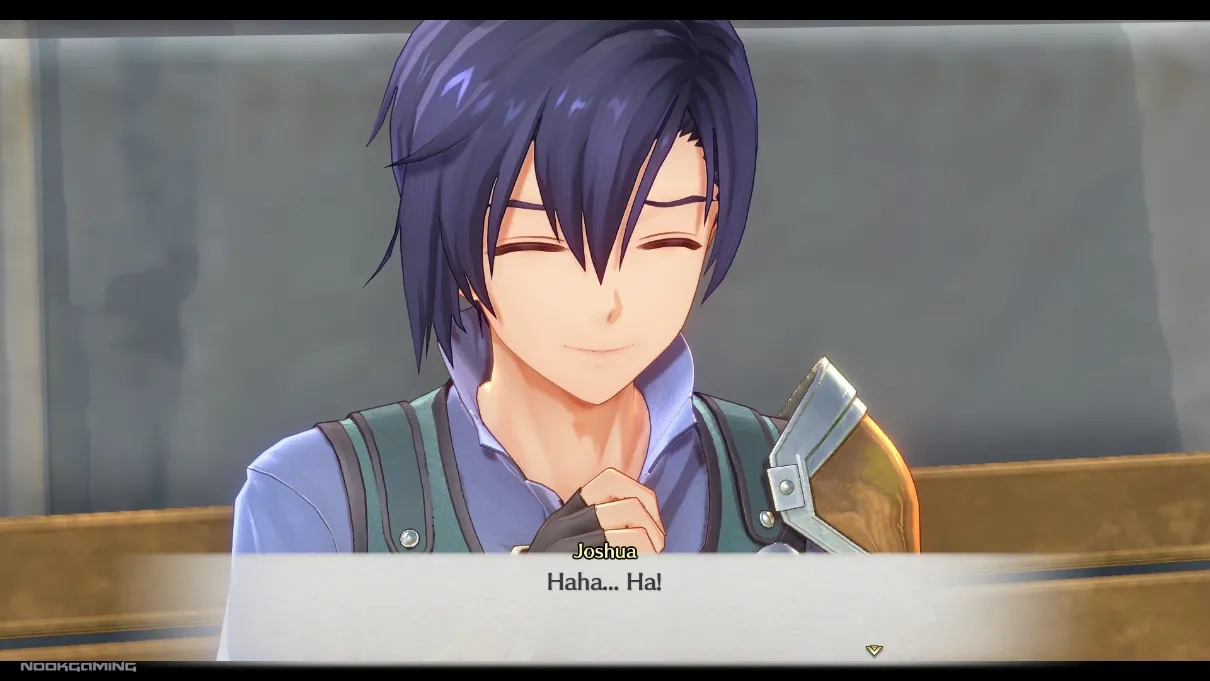
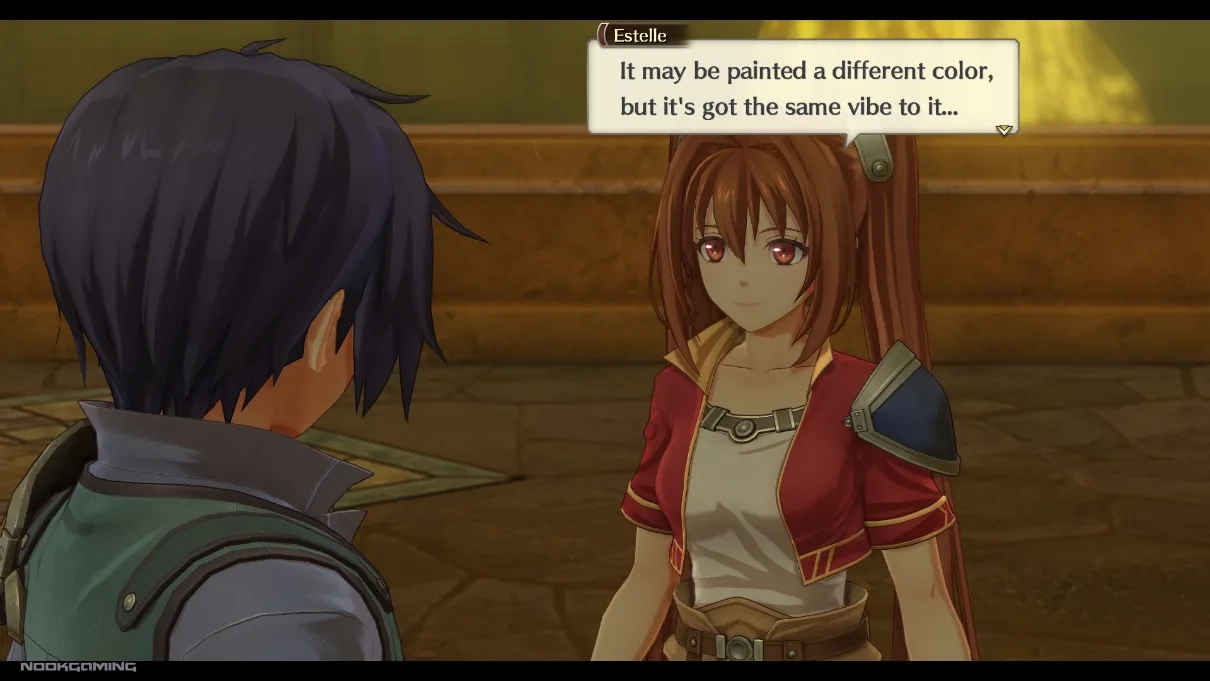
There are some signs of the text having been rushed, however. Some of the side text outside the main scenario could use a bit more editing/touching up, and a couple of voice line takes in the English dub are either slightly flubbed or don’t quite match the subtitles. A few lines in the script just read or sound odd in their word choice, and they regularly pronounce the names “Liberl” and “Zin” differently from how previous Trails releases have, leading to a sense of inconsistency. The names of certain things were changed in localization text as well, and while most of these really aren’t that big of a deal, there are some odd inconsistencies such as “Esmelas Tower” still showing up in the game’s tutorial despite it being renamed to Jade Tower in this translation. I don’t think the changes and issues ruin the script, but I think they could have been a bit more polished.
Speaking of the English dub, the majority of English voices are back with noticeably minimal recasting, continuity I definitely appreciate. There are a couple of characters I felt had underwhelming performances here, which similarly felt like production/voice direction might have been somewhat rushed. That said, many of the voice actors still did pretty well in their performances. Special shoutouts especially to Johnny Yong Bosch and Matt Mercer as Joshua and Olivier respectively, who I honestly adore in these roles and am so glad they still keep doing them.
The Japanese voice cast has almost entirely been recast from their previous iterations. I can’t say I was a particular fan of this decision. While the new actors generally did well in the scenes I watched in Japanese for comparison, there are a couple of casting decisions I found to not quite work as well for me as their originals. Naturally though, this comes down to preference, and the fact that there’s a fully voiced Trails in the Sky with dual audio at all is a welcome enough feature already. Overall, I’m a fair bit more positive on the voice acting than negative, even if it’d be nice if they’d stop having scenes where one character is voiced and others aren’t (which has been the case since Cold Steel).
Verdict
As a fan of Sky FC, Trails in the Sky 1st Chapter feels like a rather lovingly made remake. It lines up with the modern Trails games while not compromising too hard on keeping true to the original in areas where it mattered most, and there are plenty of changes I openly welcome. Trails in the Sky has always been one of my favorite games thanks to its characters, world, music, and combat systems, and I had a blast coming back to Liberl. While it is quite a different way to play through the first chapter of Estelle and Joshua’s journey, it is nonetheless one that keeps a lot of the heart. I don’t see it as a replacement for the original, and it is inevitably going to draw comparisons, but I think this version suffices in capturing much of the same spirit of the game that got me into this behemoth of a series. There are plenty of spots I wish would have been more polished, but 1st Chapter got a good amount of the most important areas right.
As this is but one side of the coin, I look forward to Sky’s Second Chapter, just as much as I look forward to hopefully seeing this game impact new players the way the original did for me.
TRAILS IN THE SKY 1ST CHAPTER IS HIGHLY RECOMMENDED

General Tips and Tricks Guide: Click Here
Bonus BP Guide and Quest Tips: Click Here
If you’d like to check out the previous games in the series, here are our reviews for Nihon Falcom titles. If you are looking for another JRPG, you should check out our review of Tales of Graces f Remastered.
Thanks to GungHo Entertainment for providing a PC review code for Trails in the Sky 1st Chapter.
Been playing games since my papa gave me an NES controller in the early 90’s. I play games of almost all genres, but especially focus role-playing, action, and puzzle-platform games. Also an enjoyer of many niche things ranging from speedrunning to obscure music from all over the world.