Patapon 1+2 Replay is a 2025 remaster of the first two titles of the Patapon series, which are rhythm games originally released in English for the PlayStation Portable back in 2008. The series is well-known for incorporating army-building strategies into a four-beat rhythm game sequence and for using French artist Rolito’s memorable and cute anthropomorphic eyeball designs.
For those who recognize the little critters, the Patapon series is a very nostalgic title. It reminds me of my childhood; the pleasant experience of struggling against the bosses’ gameplay mechanics while doing my best to maintain a steady rhythm is something that I still find myself looking for every now and then. While there are now a number of rhythm games that incorporate battle mechanics that have since been released (Crypt of the NecroDancer, BPM: Bullets Per Minute, Ratatan), none of them hit quite like Patapon’s army-building boss-bashing musical adventure back in the day.
But how good of a game is Patapon compared to today’s rhythm/action hybrids really? Is the love for the series all nostalgia without any weight? Let the drum beats guide us to the answer as we dive into Patapon 1+2 Replay!
![[PATAPON 1+2 REPLAY] - Hatapon encounters the Almighty](https://nookgaming.com/wp-content/uploads/2025/07/PATAPON-12-REPLAY-Screnshot-1-Hatapon-encounters-the-Almighty.webp)
Flat Earth Propaganda? Eye Think Not!
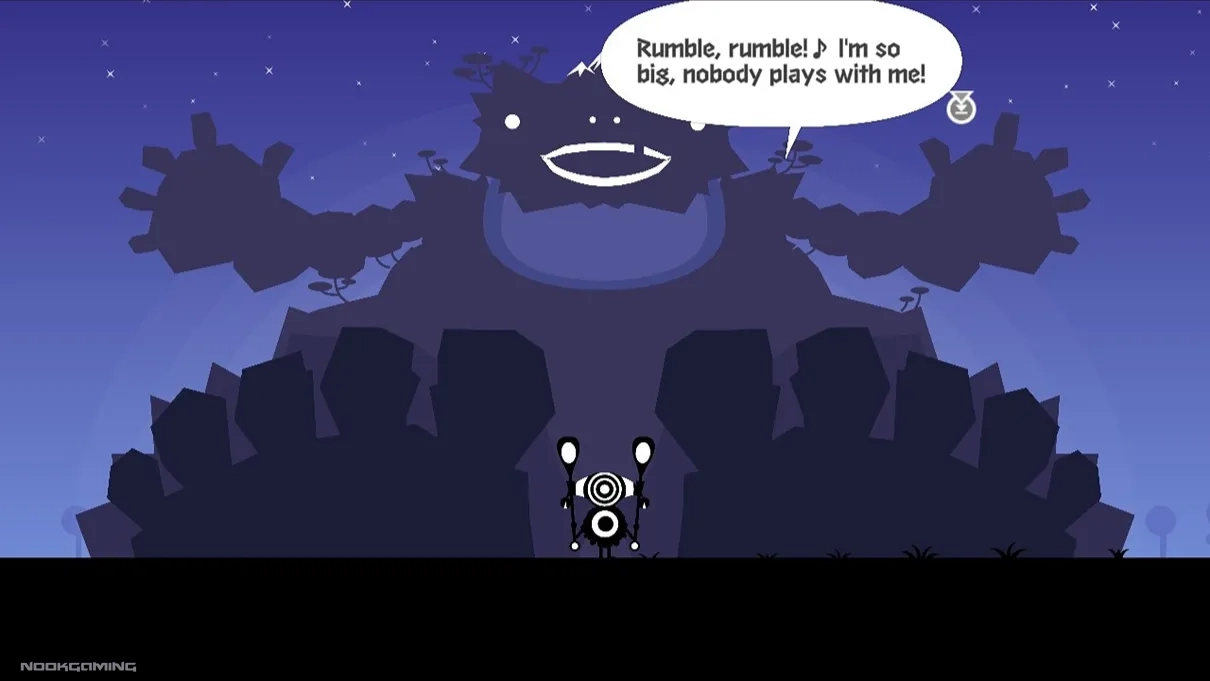
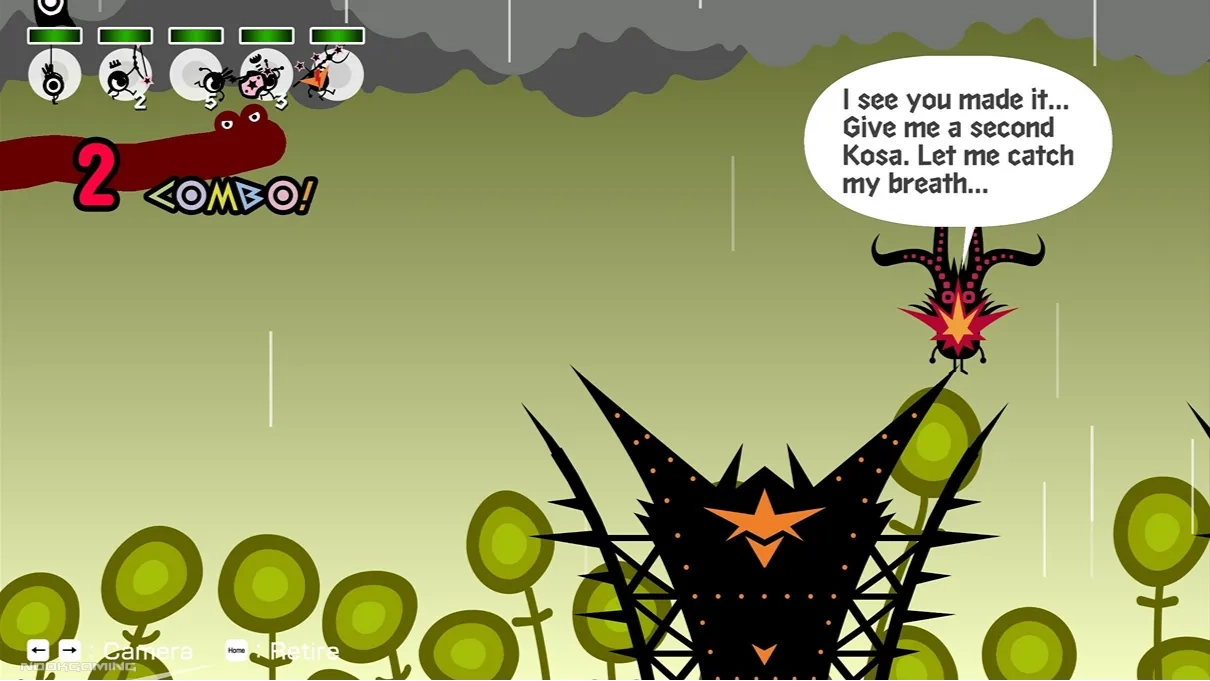
Patapon 1+2 Replay follows the tribe of the Patapons, a group of anthropomorphic eyeball creatures who have a one-track mind focused on getting to their promised land called Earthend. The tribe is famous for being unbeatable and is spoken of in legends as the harbingers of disaster and doom. At the beginning of the first game, however, the Patapons barely resemble their legendary selves, being reduced to a tribe too weak to venture outside of their own city, Patapolis. The player, called the Almighty (or Kami) by default, returns to the Patapons as an invisible deity who watches over them to provide guidance through harsh landscapes using their four divine drums. Along the way, creatures of all shapes and sizes hinder the Patapons in their journey, and it is up to the player to help them traverse the dangers that await. There are also rival tribes that make it their mission to prevent the Patapons from reaching their goal, all with their own unique motivations that push them to do so. But nothing will stop the mighty Patapons from reaching eternal contentment at Earthend!
In terms of story, Patapon 1+2 Replay is the very definition of barebones. While there’s technically an underlying lore behind the Patapon’s journey in both games, it’s barely expanded upon, serving more as afterthoughts for stage progression instead of a solid plot that the player is encouraged to follow. I do appreciate the dialogue they’ve incorporated into the story stages though; it feels like a good compromise to still be able to establish a semblance of a plot without having to drift away from the game’s main gameplay loop. It makes the events feel a lot more present as well, with your own decisions and the strength of your army dictating the pace at which each in-stage story segment progresses. Because of its simplicity and lack of spotlight however, it still feels negligible overall and functionally serves more like flavor text.
Beating Some Sense into the Enemy
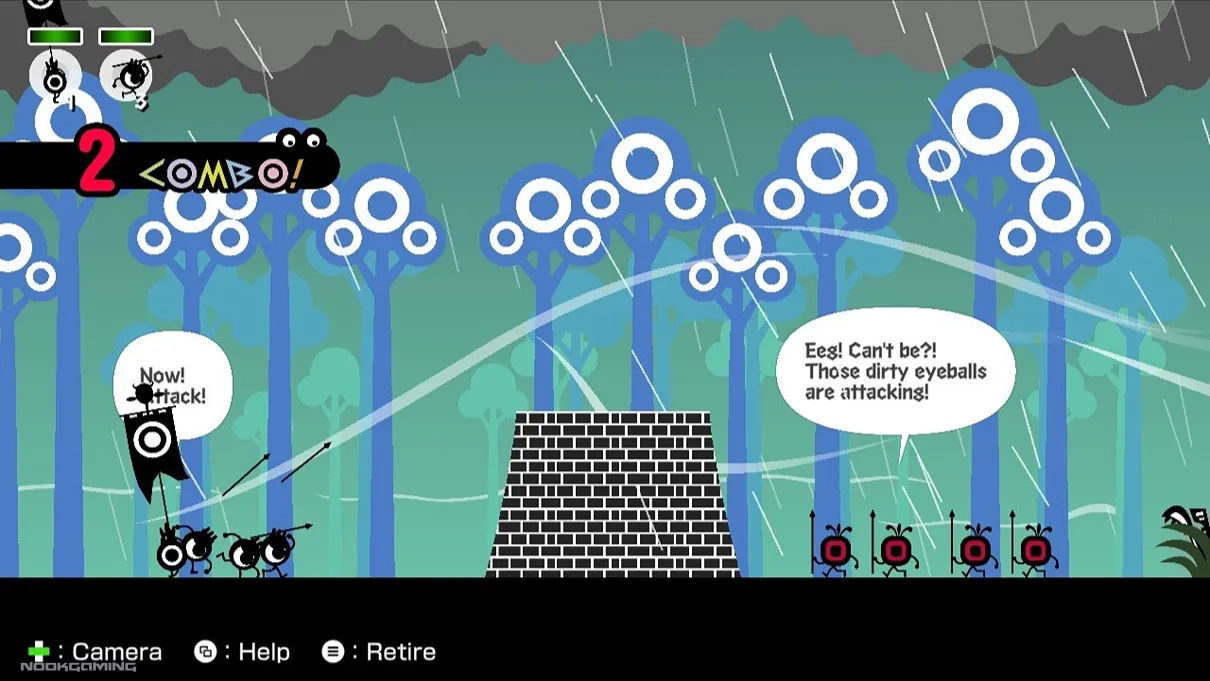
Patapon 1+2 Replay is a rhythm game that makes use of a four beat sequence to administer commands to the Almighty’s Patapon army. Using four drums that serve as the onomatopoeic base for the game’s soundtrack, the player is tasked with hitting specific drum sequences to administer appropriate commands given the current situation the Patapons are facing in a fight. The sounds are unique and easy to remember because they are composed of single words; PON, PATA, CHAKA, and DON, which all correspond to one button on the right side of the controller. While it is possible to use keybinds to play the game on the keyboard, the in-game features recommend the use of a controller to take advantage of the simple controls.
The use of drum beats as the main bread and butter of the Patapon series, while basic and repetitive, offers an easy to learn set of controls with their own strategic depth once combat sequences are considered. Patapon’s enemies either have a wind-up animation or follow a set amount of beats/measures prior to unleashing devastating attacks. This allows the game to incorporate the challenge of pattern recognition without having to overcomplicate the gameplay loop. Overall, the ease with which you can understand what to do makes it an encouraging title for both beginners and veterans to try out for themselves. The ability to change difficulties also allows the player to tune their experience to their preference, whether they like to play the game for casual fun or for challenging encounters.
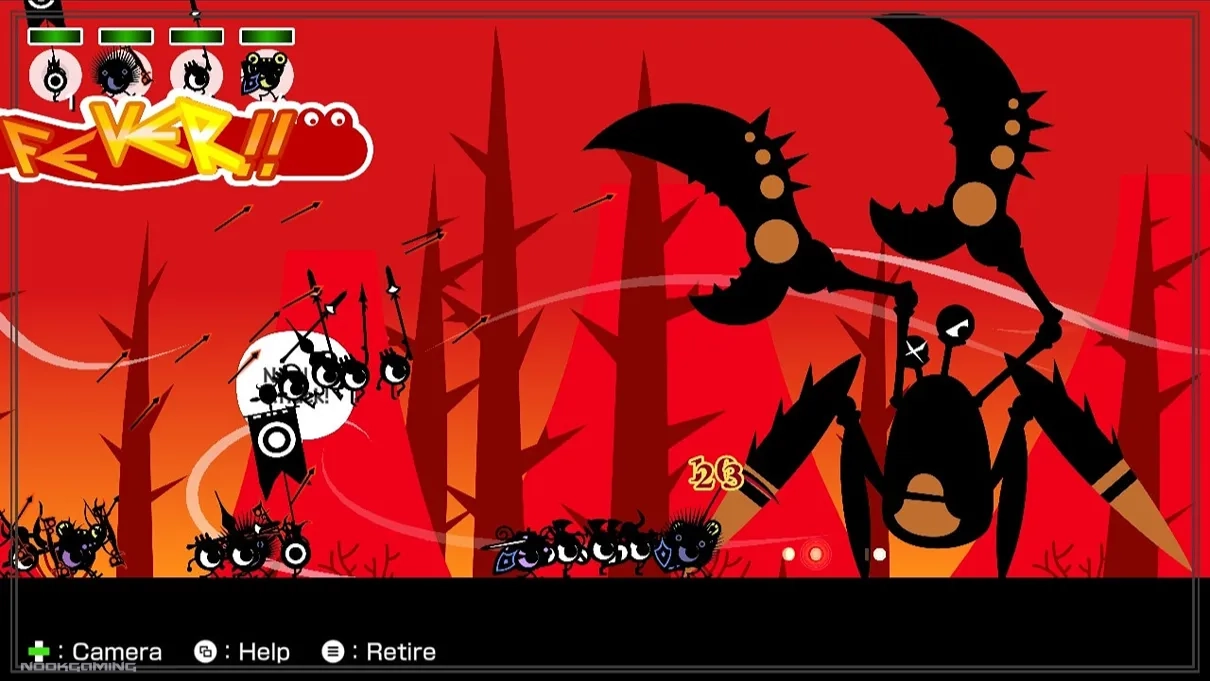
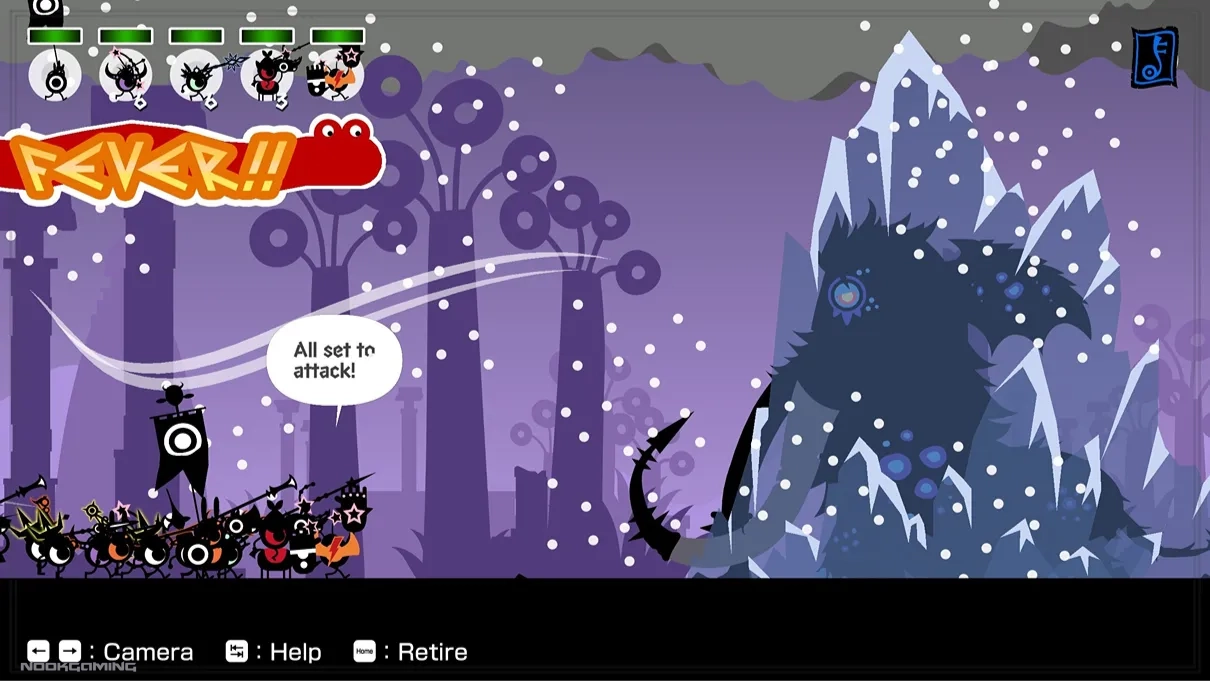
As a rhythm game, Patapon 1+2 Replay rewards players who can consistently hit the proper rhythm for their commands. Upon entering three perfectly timed commands consecutively (or up to ten depending on the overall accuracy of the command beats’ rhythm), the Patapons enter Fever mode, a state where their responses stop being repetitions of the commands but instead become a sort of freestyle that fits the current stage’s BGM. In this mode, Patapons get enhanced effects, such as stronger attacks, tougher defenses, piercing, and even the ability to inflict status effects. For some stages, it becomes a must to remain in Fever as the onslaught of attacks from the enemy units often become unmanageable otherwise. Fever is also just very satisfying to enter because of the incredible back to forth of the drum beats, the Patapon’s ad-libs, and the stage BGM. It’s so fun to listen to that I just bob my head back and forth when playing!
The game also rewards well-timed adaptive measures and patience; for every four beat measure that the player issues a command in, they have to wait another four beat measure for the Patapons to sing and react to it. If you enter a command too early or too late, it ends their chain of actions, exposing your units to being attacked. So despite being relatively easy to pick up, there are ways in which the mechanics can punish you hard for making a mistake. It was fun trying to figure out how to best navigate a boss fight, especially with the special characteristics they give each boss later on. It’s a pretty endearing gameplay system that just grows on you the more you play it because of how cohesive it makes the entire game feel. For reference, it’s so easy to get swallowed into its pace that I repeatedly found myself sinking 3-hour sessions into it without noticing the time!
A One-Eye Army
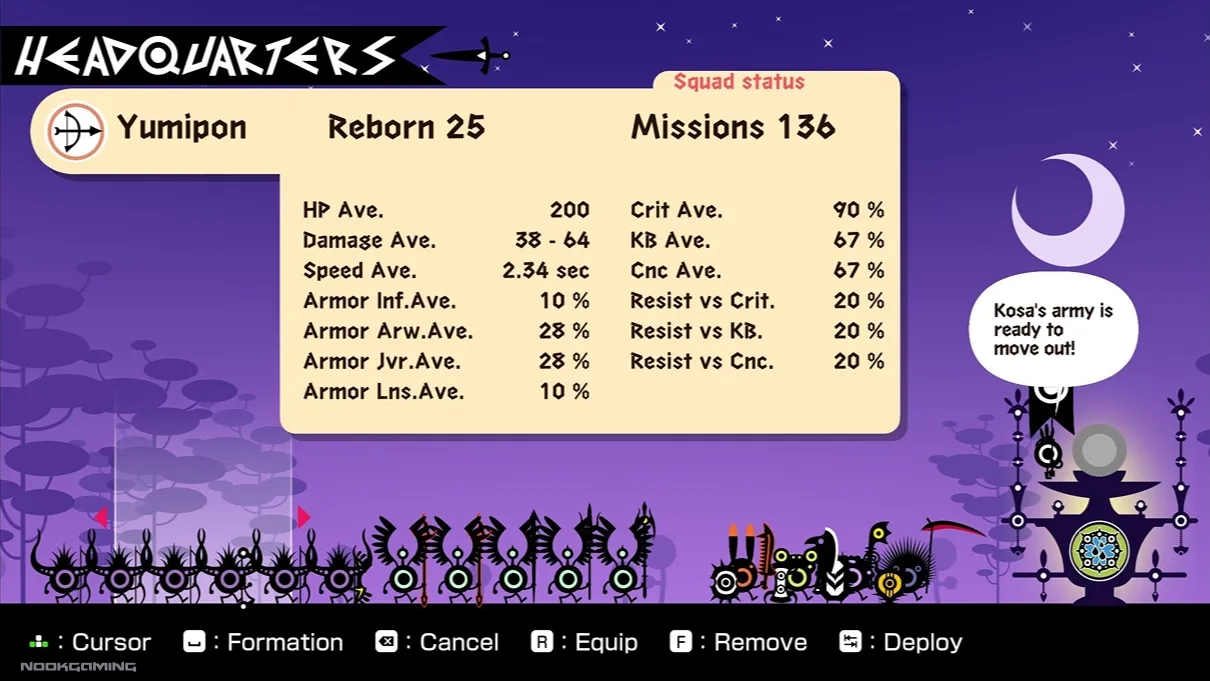
Patapon 1+2 Replay’s battle sequences are fought with armies made up of three classes or platoons that the player selects before starting a stage. Each platoon is made up of a specific kind of Patapon whose attack mechanics and position are based on their type—the Tatepons, for instance, are units that occupy the frontmost position in an army that utilize short-range attacks whose specialization shines when playing the Lament of Defense (CHAKA-CHAKA-PATA-PON). Depending on the boss, there are some combinations of units that might work well or fail horribly against their mechanics. The classes do not determine your overall performance, however, as another gameplay element further modifies the properties of a platoon: the Rarepons.
Rarepons can be considered as the various evolved forms a Patapon can take as the player continues to upgrade them. Depending on the Rarepon, special abilities can be bestowed on a unit such as resistance to specific status effects, an enhanced crit modifier, or larger base stats such as HP or ATK. The inclusion of Rarepons as a possible option for building your army gives a lot of freedom when it comes to lineups; depending on a player’s preference, they can tinker with the army’s average characteristics to reflect the kind of playstyle they want to have. And the best part? They all look cute as hell! Each Rarepon adds an animal motif to a Patapon, which makes them sometimes look like cute fluffy eyeballs or miniature demonic cyclopes. I found it really ingenious that instead of equipment crafting, it’s the units themselves that you have the ability to really play with to overcome challenging stages.
Blindly Grinding for Sharper Eyes
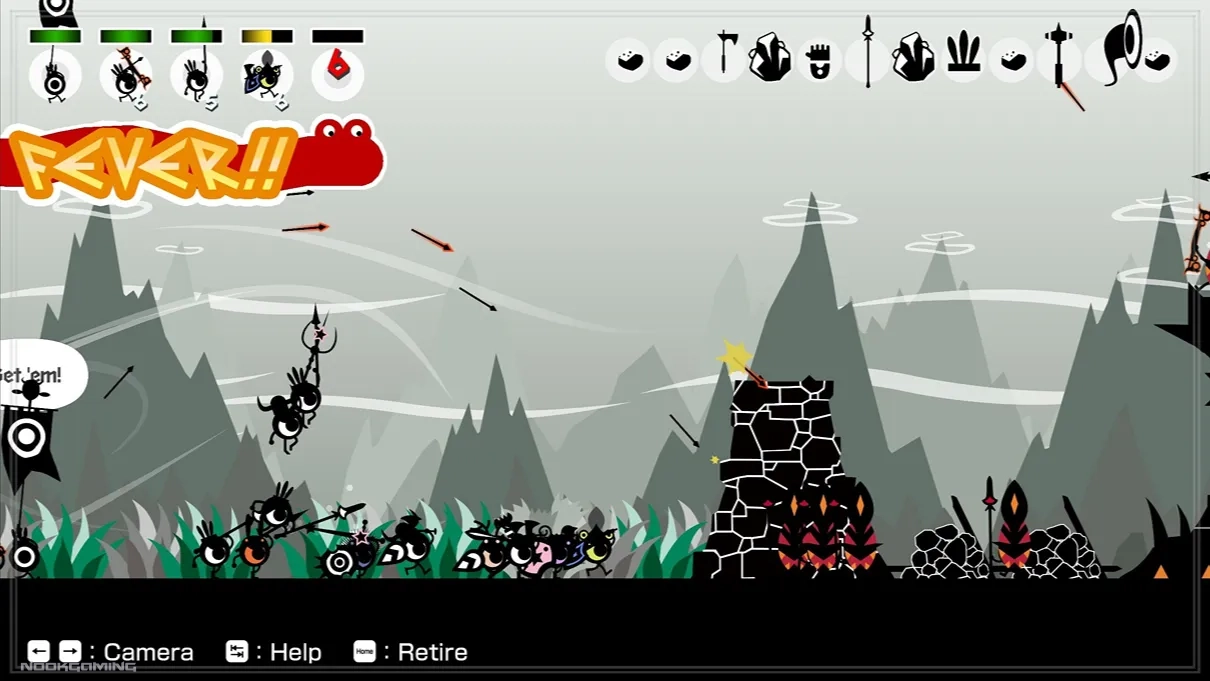
To grind for equipment and materials, players are encouraged to repeatedly challenge quests that involve either beating a boss or sieging an enemy fort. Every time these stages are beaten, they get incrementally stronger and yield better (or more) loot the next time. This is not assured, however, because the chance to drop items from these stages is mostly random aside from a specific mechanic introduced in Patapon 2. This makes it so that grinding for a specific setup, for example one that specializes in igniting enemies, may feel a little bit frustrating because of the uncertain amount of time that it might take to complete.
Theoretically, the design feels a little bit off as if given enough unlucky outcomes, a player may get inadvertently stuck in their progress because of the lack of usable drops to progress their army’s status. The list of drops for each stage is unavailable in-game as well, which makes it necessary for the player to refer to external sources to craft a plan to efficiently grind something. It’s not exactly uncommon for games to ask the player to figure these out for themselves, but for something as grindy as Patapon, it feels counterintuitive to deprive the user of this feature, given that the game actively encourages you to grind to become stronger. It’s a lot less frustrating when it comes to Rarepon material because they drop in large numbers, but for grinding specific equipment, aside from craftable ones, it feels like a losing battle most of the time.
Feet Rock (or do they?)
As a sort of respite from grinding the game, Patapon 1+2 Replay includes minigames that reward important mats for crafting Rarepons. Depending on the minigame, specific kinds of materials can be provided for a minor cost. All of them make use of some form or iteration of either pattern repetition or matching a taiko-like set of notes, upon which the successful completion of gives you varying amounts of rewards corresponding to your performance. They’re usually short, not exceeding 2–3 minutes of playtime, and can be repeated as many times as you want as long as you can pay the cost.
While the minigames are very useful as a stopgap measure to eliminate the need to rerun the easier stages for basic mats, their lack of variation across each run makes them exhausting to continuously run. Thankfully, you can get rid of the tedium by incorporating boss runs every now and then, but that beats the purpose of having them in the first place. This could have been easily remedied by incorporating a set number of variations the minigames can run through for each stage, but as it stands, the first time you experience a minigame will be no different from how you’ll experience it for the last time. To engage with this aspect of the game, you’ll have to not only triumph against the minigame gimmick, but against the monotony of the feature itself as well.
In the Eye of the Storm (and Rain, and Blizzard, and Wind)
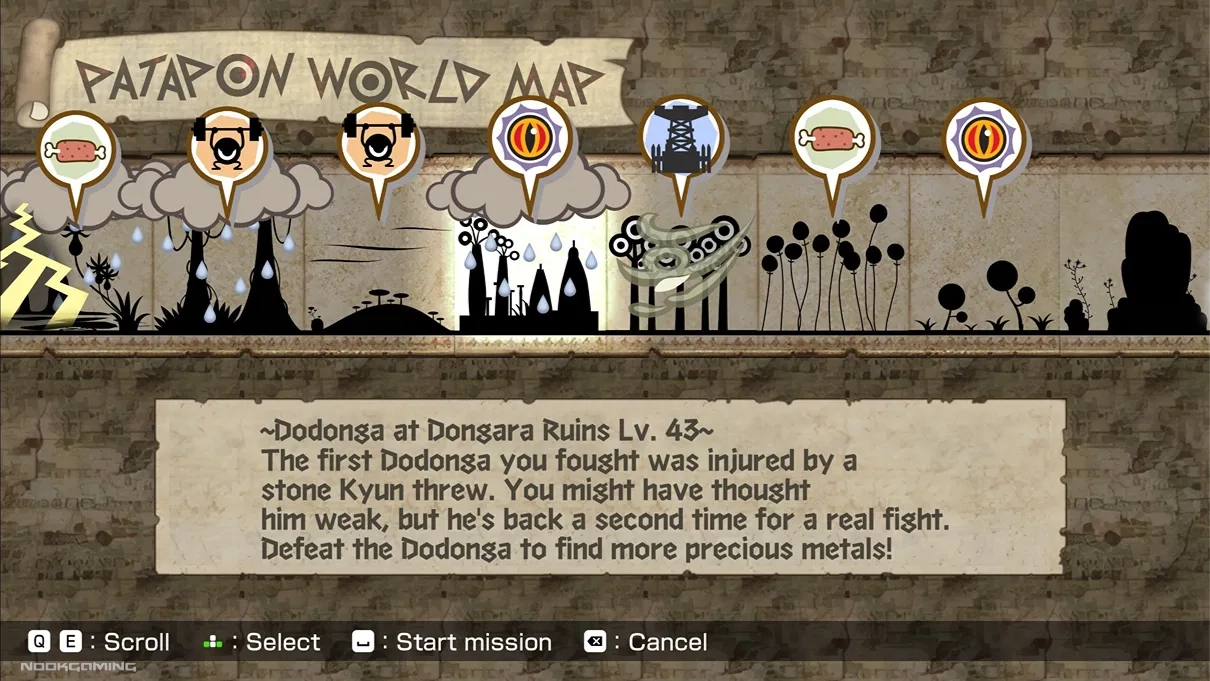
Patapon 1+2 Replay makes use of a World Map to display the various stages the Patapons encounter in their journey to Earthend. Represented by one continuous strip of aged paper, it’s a creative way of illustrating their one-track journey to their goal without losing the motif of the Patapons being a “legend” in the process of being written. Each stage is represented by icons that identify what type of quest they are, such as boss fights, training, sieges, and hunts. There are also descriptions accompanying each of these stages, with some containing vital information that helps players deal with their special gimmicks better. The current stage level is also indicated beside its name to better advise players about its current difficulty. Unfortunately, this does not include story stages, which would have been great to have given how challenging some of them were.
To incorporate a dynamic element into these static stages, Patapon 1+2 Replay makes use of a weather system to incorporate environmental effects that influence the flow of a fight. Things such as storms, snow, rain, and tailwinds can rotate on specific stages, with some containing boss variations, rare creatures, or even secret items given a specific weather condition. This is usually indicated in the description, which is why it isn’t terribly frustrating to explore. If you do fail the stage without having saved beforehand though, it can make you a tiny bit mad since you have to wait for the next time it comes around.
Besides the weather, the stages also level up the more you clear them; this gives you quests that scale alongside your army’s strength. The stronger your enemy becomes, the higher your chance for rarer items to drop in the stage, which makes repeat clears still feel somewhat rewarding. What diminishes this benefit, however, is the innate randomness of the item drops. Because you aren’t actually guaranteed drops of the rare items after a certain amount of runs, you can bash your head repeatedly against the same boss and still be gated from your next upgrade step. It’s pretty frustrating to grind especially given the repetitive nature of the game, and it is exacerbated even further because of the difference in how the loot table is handled between the two installments.
Patapon 1 and 2: What’s the Difference?
The decision to bundle Patapon 1 and 2 together is understandable; fundamentally, Patapon 1 and 2 are very similar games with minor changes between installments. They both feature the same set of gameplay mechanics such as the rhythm game aspect, the army building strategy, the Rarepon and item grind, the minigames, and the repetition of stages. Comparatively speaking, however, Patapon 2 feels like the complete version of what Patapon 1 should have been, with the second installment highlighting a lot of the inconveniences and limitations present in how the first game’s system was designed.
Patapon 1
Patapon 1 includes a total of six commands that cover basic actions such as marching forward, attacking, defending, weather effects, retreating, and charging while remaining in position. Overall, it’s not a bad set of commands, but it feels incomplete given unavoidable boss attacks (due to timing and horizontal range) and status effects that you’re expected to just tank despite them making you vulnerable to one-shot kills. It diminishes the strategic component of the game, reducing the delicate response and react relationship between player and enemies highlighted through its musical aspect into a simple stats game.
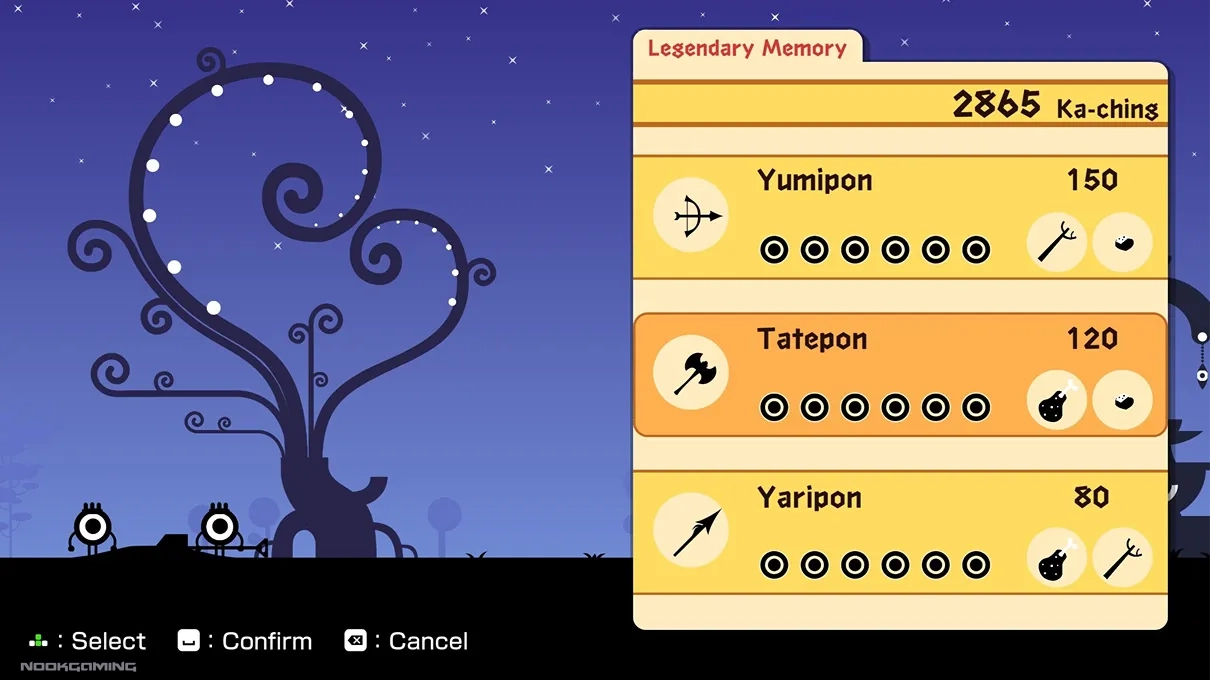
For the army building aspect of the game, the first game limits you to six kinds of classes with six kinds of Rarepons. It’s a pretty sizable amount of customization given the short length of the first game, but because of the linear nature of the materials’ tiers and the lack of sophisticated stage gimmicks, you can pretty much just bruteforce through anything by using Rarepons that have stronger offensive capabilities.
The bigger problem, however, is this: Patapon makes use of “hats” to indicate unit death within each stage. In Patapon 1, however, these hats drop as items similar to equipment and Rarepon materials, which mean that if you do not recover them before a stage ends, they are permanently lost from your roster. If you invested in the two most expensive Rarepons and could not recover their hats for any reason, you would lose all the resources you grinded for them. It’s a very frustrating outcome for the amount of time it takes to grind them.
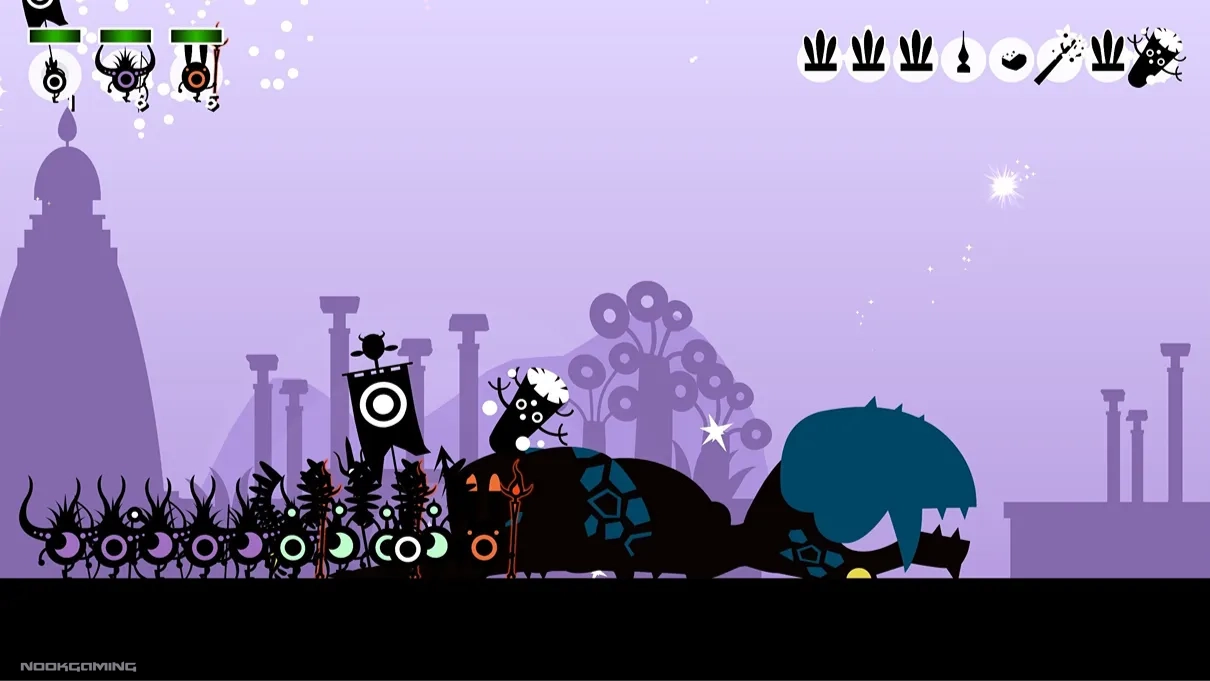
Unfortunately, this problem is made worse by the fact that each boss does not have a specific kind of Rarepon material that they drop. Instead, they have two or three kinds that they cycle through when staggered or defeated, which means that if you want to grind for the highest tier of a specific line of items, you have to contend with the other high (and lower) tier items that are present in the boss’s loot pool. It’s annoying because it randomizes even your intended pathway for improving your army, which is completely unnecessary for a game that offers the amount of customization that Patapon does.
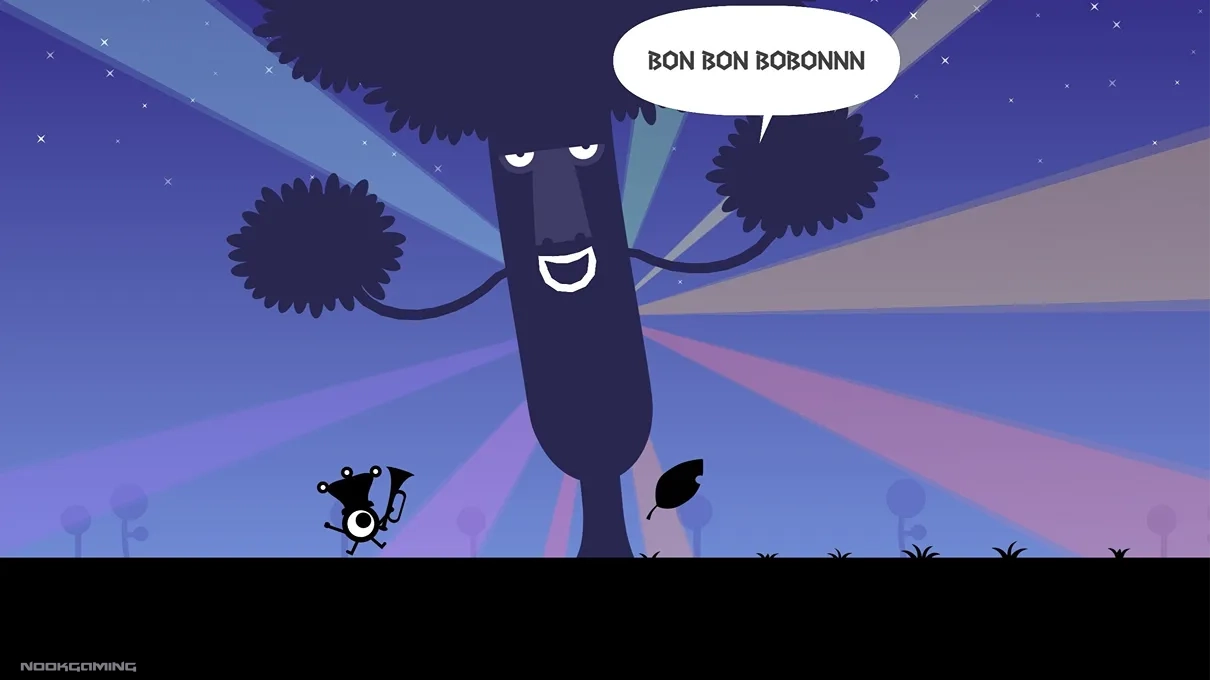
Last but not least, Patapon’s original set of minigames are only relevant for a short period of time. Ubo Bon the Tree and Pop Bean the Legume provide anywhere between a Tier 1 to Tier 3 (supposedly) of the specific material that they cover, but most of the time it’ll only feel like a refund of the Tier 1 material you paid to them because they barely drop anything of worth. Pop Bean’s rewards are even less useful because the game doesn’t tell you what the vegetables are used for until you discover it for yourself! (hint: vegan alternatives). The only real notable ones are Simmer Slurp the Cooking Pot and Fwoosh Famooze the Anvil who both reward you with items that stay relevant until you quit the game.
Patapon 2
Fortunately, Patapon 2 improves upon most of these problems by either making it more user-friendly or actually making them useful for progression. As is standard with most sequels, Patapon 2 improves upon the rhythm game aspect of the first game by introducing two new commands that feel right at home with already existing boss mechanics: a jumping command and a command that clears status effects. It lessens the time that the player spends as a sitting duck and punishes them harder for tanking attacks that could have been avoided by using any of their evasive options. My only gripe with this is that they introduce a bunch of them too late into the game when there have been scenarios that could have used them as appropriate strategic options early on.
Patapon 2 also expands on the player’s options when creating their eyeball army, introducing three new elite Patapon classes and an Evolution Map that serves well as a goal to grind for. The number of available Rarepons ballooned to sixteen, with the game now requiring the player to unlock them in sequence to make stronger, better Rarepons available. Each iteration of a Rarepon can be leveled up to Lv. 10, requiring more materials and higher tiers the further in the Evolution Map you go. And if that’s not enough of a pill to swallow, each Evolution Map is unique to each Patapon unit, meaning that if you wanted to fully upgrade all Rarepon variations for all Patapon units, you’d need to grind thirty-six (36) units’ worth of Evolution Maps to completion. To put it into perspective, at almost twenty hours of playtime, my highest leveled Rarepon was a tier 2 Rarepon at Lv. 5. Thankfully, they’ve taken away the permadeath mechanic of the first game: all hats are now automatically collected the moment a Patapon falls in battle.
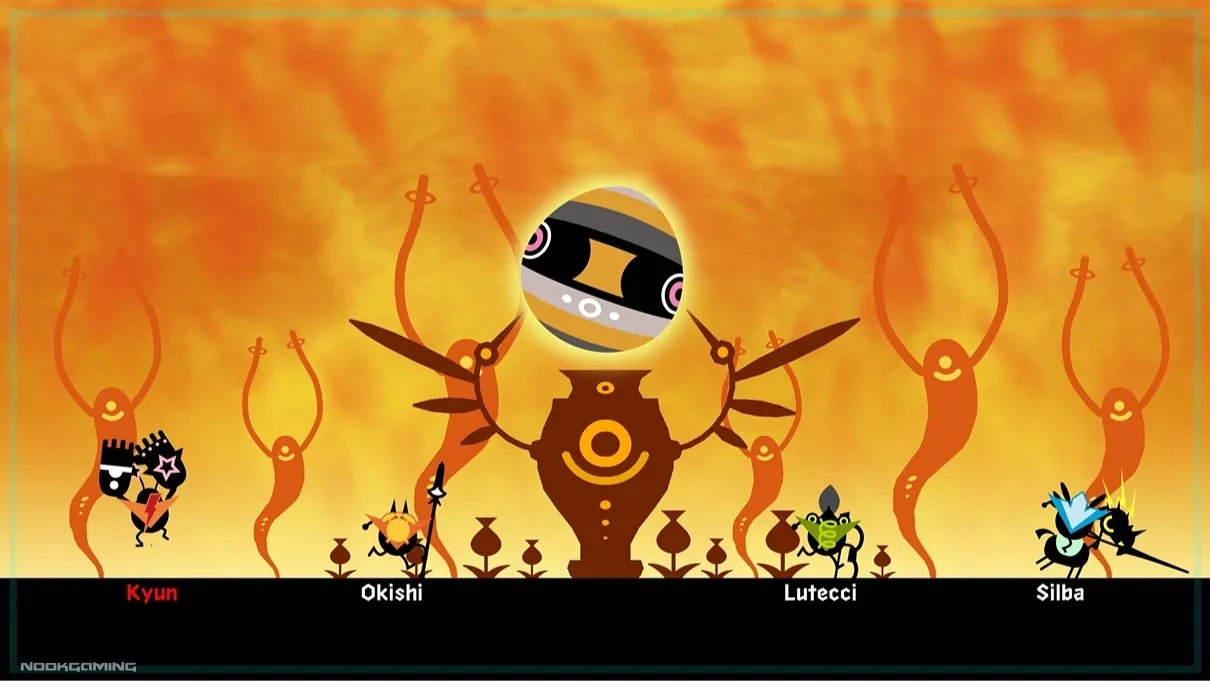
Additionally, Patapon 2 adds a fourth type of unit you can bring to quests: the Hero. This unit can transform into any of your available classes, use any Rarepon you have unlocked for the class, and uses a Mask as equipment to impart special effects onto itself. These Hero units use special attacks depending on their class when you hit perfectly timed commands during Fever, unlocking devastating amounts of damage or defense that you can build the rest of your team around. The Hero’s Masks are unlockable through the Patagate, a Hero-only dungeon that uses three CPU-controlled units to help the player’s Hero through special iterations of the game’s bosses. The Patagate rewards Masks for the hero to use, as well as materials corresponding to the boss’s type.
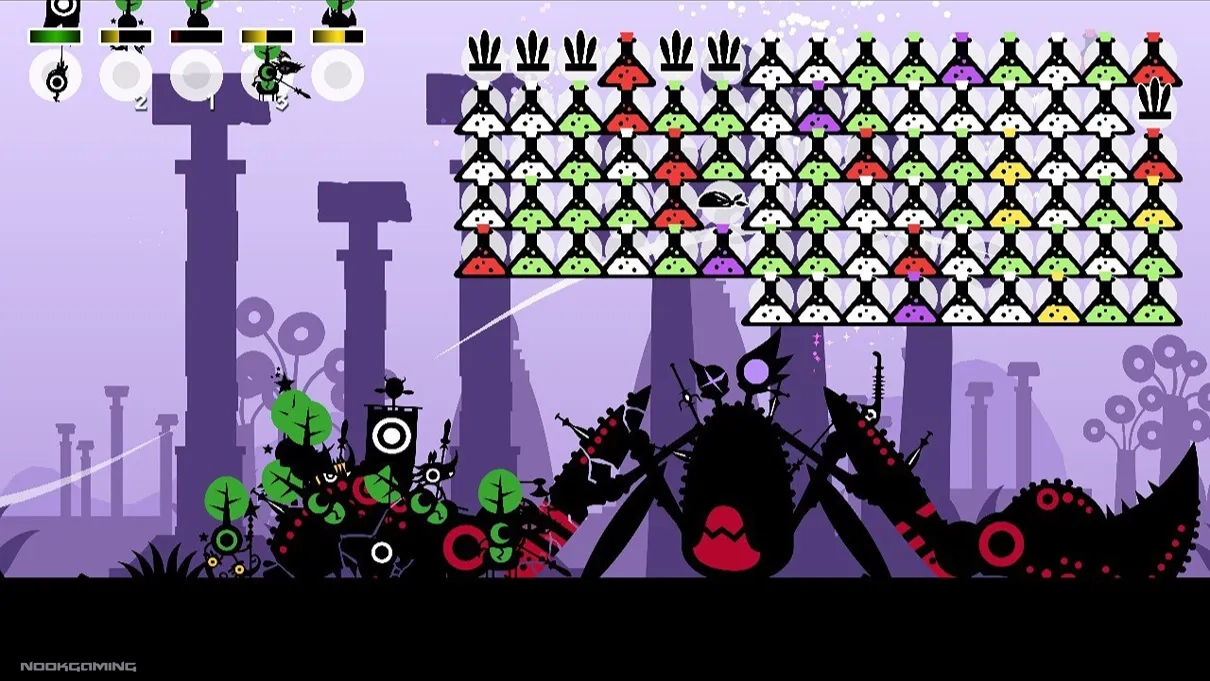
Expanding upon this, a welcome change in the sequel was the consolidation of each type of material under a specific boss type. Depending on the boss, they will now only drop different tiers of the material assigned to their loot pool, which makes farming for a specific material infinitely easier compared to the first game. With new status effects such as staggering now being plausible builds for your army, you can also farm materials in infinitely larger amounts. The unfortunate result of this, however, is that some materials only become available to farm efficiently late into the game because of boss stages only being unlockable through the story. If you want to farm them early, you have to go through the inefficient route of doing hunting quests, which yields more or less random tiers of rewards from a larger loot pool. It’s still an overall improvement though, one that I’d take a thousand times over its previous iteration. Additionally, siege quests, which are unique to Patapon 2, make equipment farming a lot easier, even when considering how random the drops are.
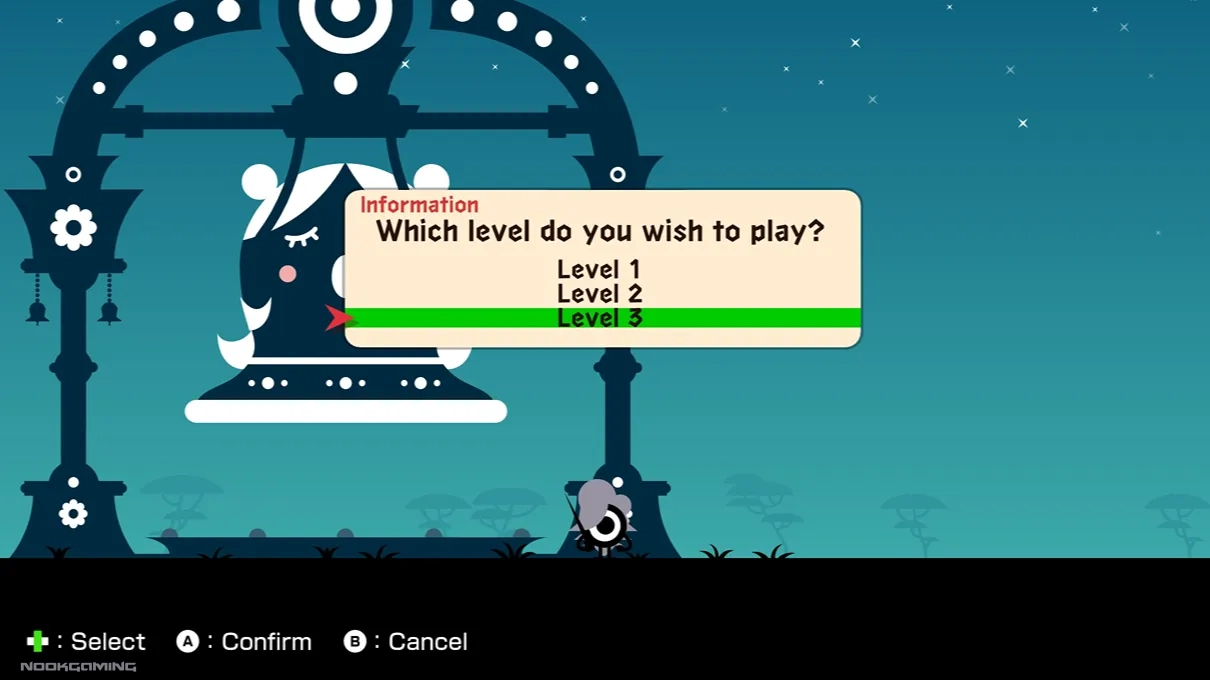
Lastly, the minigames are actually useful now for progress because of how many materials you need to fully upgrade your Patapons. Besides that, they’ve reworked the reward system to three levels, each with increasing Kaching (in-game gold) costs, that give prizes from Tiers 1 to 4 (depending on the minigame level) upon a perfect performance. The catch is that missing one note is now more punishing, with minigames frequently rewarding only one Tier 1 material after.
An Eye for an Eye; A 1 For a 2?
As a bundle that includes the original game and its sequel, Patapon 1+2 Replay just makes sense as a product. By putting together the original with its largely better sequel, the continuity of its story is preserved while giving people uninterested in the plot the option to just skip ahead to the good part. There is no disadvantage in putting both of the games together. Their gameplay mechanics remain largely the same in both installments, just with noticeable improvements that sequels are expected to have. Just don’t play Patapon 2 first if you intend to also play the first Patapon; it will leave you annoyed and dismayed at the original game’s less-than-ideal system for farming loot.
Patapon 1+2 Replay is impressive as well when it comes to being a remaster: the graphics are crisp, and the music and sound effects feel like they’re of similar or even higher quality compared to how they were originally. The presentation has remained largely consistent with their original versions but with noticeable quality of life additions such as displaying your command list, input adjustment, and difficulty options. The only dissatisfaction I have with the game is probably the noticeable input delay when the game has been open for an extended period of time and you try to play a minigame or access a Patagate stage. Sometimes the game won’t register your button input, which screws up the long sequence in its entirety. It wastes precious materials, and more importantly, your time.
As for how it holds up when compared to modern games, surprisingly, it still provides a unique and enjoyable experience. Although it’s a bit too grindy for the amount of gameplay variation and challenge it offers, it’s a good game to just pick up and spend time on when you find yourself wanting to just mindlessly play something and feel good doing it. Because it’s a remaster of a title from the PSP era, it performs spectacularly on current machines as well, including the Steam Deck.
Now if only they remastered Patapon 3 along with the other titles…
Verdict
Patapon 1+2 Replay is a faithful remaster of the rhythm/action games from the PSP era. While simple in its conceived gameplay loop, it rewards skillful play by providing significant bonuses through systems like Fever and good decision making through telegraphed enemy actions. By paying close attention to stage gimmicks and behavior patterns, you can guide your cute anthropomorphic eyeball tribe to success as they journey to the promised land of Earthend.
Because it is a faithful remaster of the original games, Patapon 1+2 Replay retains the same problems and inconveniences that their predecessors had in both its repetitive gameplay, random loot system, and sometimes weirdly timed introduction of progression items. As a series that encourages the player to grind, the lack of variation in its minigames and non-repeatable story stages make for a less than stellar post-game experience. The novelty of the game within the rhythm slash strategy genre, however, makes it a memorable pickup back then and even until now.
For a respectable $30 US price point, Patapon 1+2 Replay delivers with incredible quality for remastered games’ standards that seamlessly runs on modern machines. With quirky, fun backgrounds and creature designs that’ll have your heart hurting with their cuteness, Bandai Namco’s rerelease of this beloved classic is one both new and veteran players can appreciate. Just take note of the possible input delay in some features of the game; it can make or break your overall experience if you get fixated on it.
PATAPON 1+2 REPLAY IS RECOMMENDED

If you are looking for another rhythm game, you might want to check out Metal: Hellsinger VR.
Many thanks go to Bandai Namco for a PC review code for Patapon 1+2 Replay.

Visual novel reader that wishes there were more than 24 hours in a day. Gacha victim, TCG enjoyer, and VTuber simp. Still trying to live happily.