Ninja Gaiden is going all out celebrating this year with Koei Tecmo’s “Year of the Ninja” campaign, which began with the excellent Ninja Gaiden II Black back in January. While we’re still a ways off from the release of Ninja Gaiden 4 at the time of writing this, what we do have is another major release on the 2D Ninja Gaiden side. Brought to you by The Game Kitchen, the developers of games like Blasphemous and its sequel, we now have Ninja Gaiden: Ragebound. It’s the first 2D Ninja Gaiden game since the ‘90s, so how have things evolved and changed since then?
The New Faces in Town
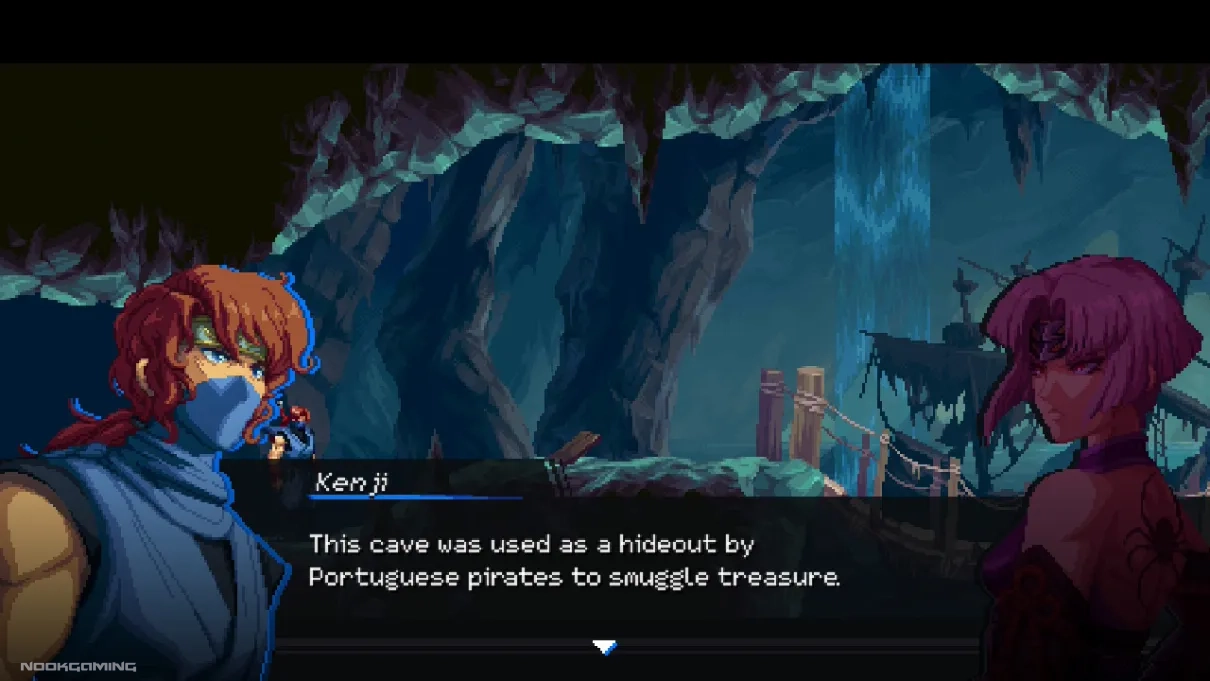
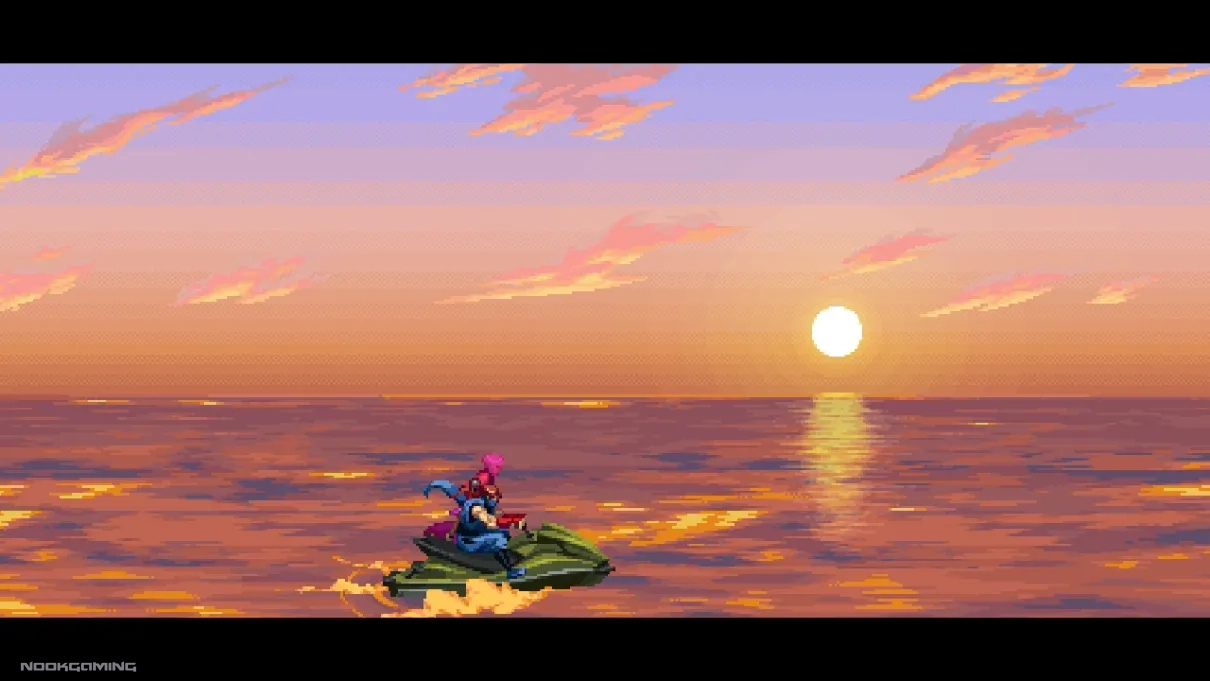
Ninja Gaiden: Ragebound takes place in the original NES continuity, but combines it with many elements from the Team Ninja outings such as the Black Spider Clan, Muramasa, and many visual elements like Ryu Hayabusa’s iconic outfit and his famous Izuna Drop. Ryu himself is off taking care of business in America (which is covered in the plot of the very first Ninja Gaiden game). In the meantime, newcomer Kenji Mozu is left to take care of any domestic problems. It’s not long before the Hayabusa clan is ransacked by Fiends, demons from the underworld who sow chaos wherever they please. After fighting a particularly powerful demon and nearly getting killed, he’s left in a precarious alliance with Black Spider Clan member Kumori. It’s up to them to collect some crystals to seal up the gate which the Fiends are leaking out from.
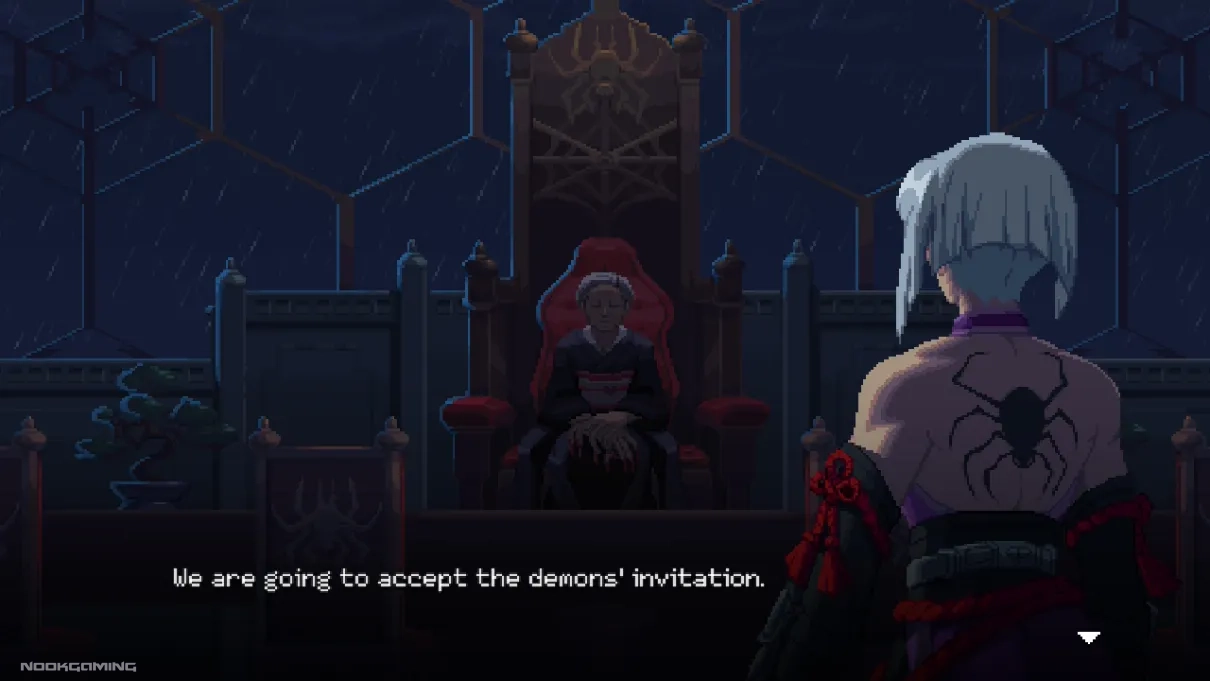
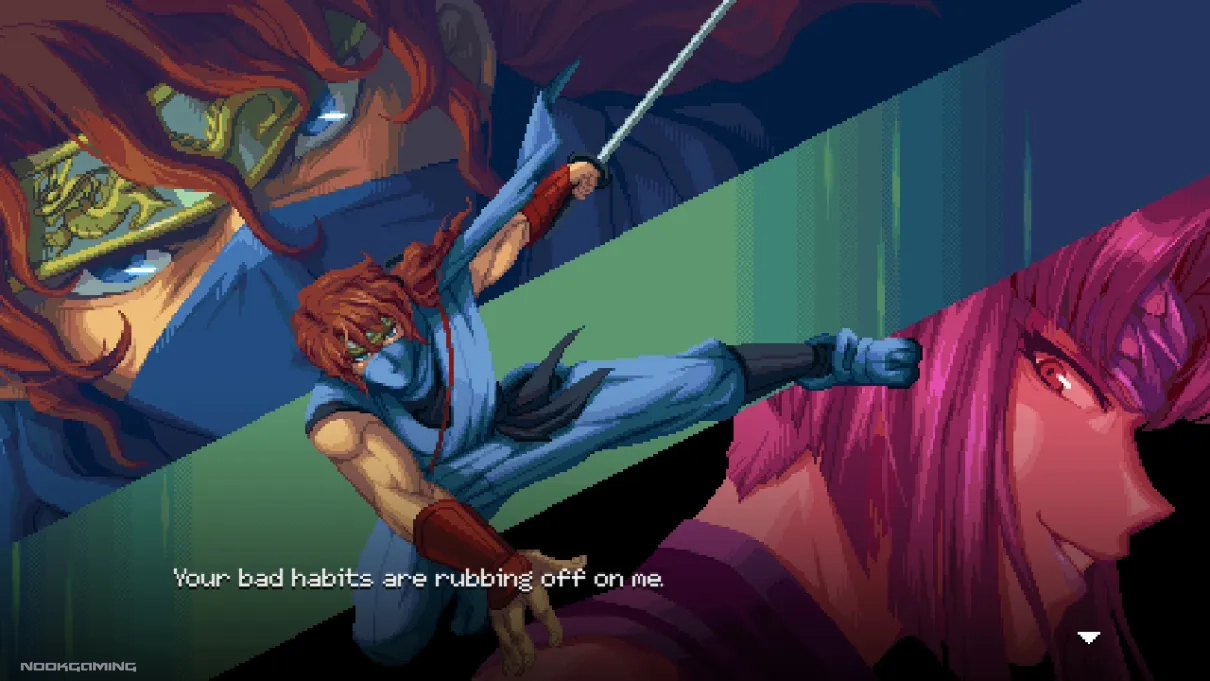
Kenji is the straight-laced, hot-headed sort who wants to follow his duty to the letter. He’s not the sort willing to compromise his values, even if it would mean protecting the bigger picture. Kumori is the opposite, being more playful yet undoubtedly more violent and accepting of the kind of chaos the Black Spider Clan might sow. When brought together, their dynamic manages to have some sparks even in incidental dialogue.
Ninja Gaiden: Ragebound’s plot is undoubtedly simple, but it’s immediately easy to tell how much the creators revere the entire series. You definitely get more out of its cheesy, action-packed and B-movie-like qualities when you’re already a fan of this series. That’s not to say that the writing here isn’t quite solid, as I think the characterization and shared growth between Kenji and Kumori is decent stuff. While I think they grow to trust each other a little too quickly, their bond walks a really nice line between friendship and needing to keep to their respective duties. I also enjoy the way it interweaves some of the political aspects of the story found in games like Ninja Gaiden 3. Again, it’s nothing complex, but it did a good job keeping my interest.
Swords and Shurikens
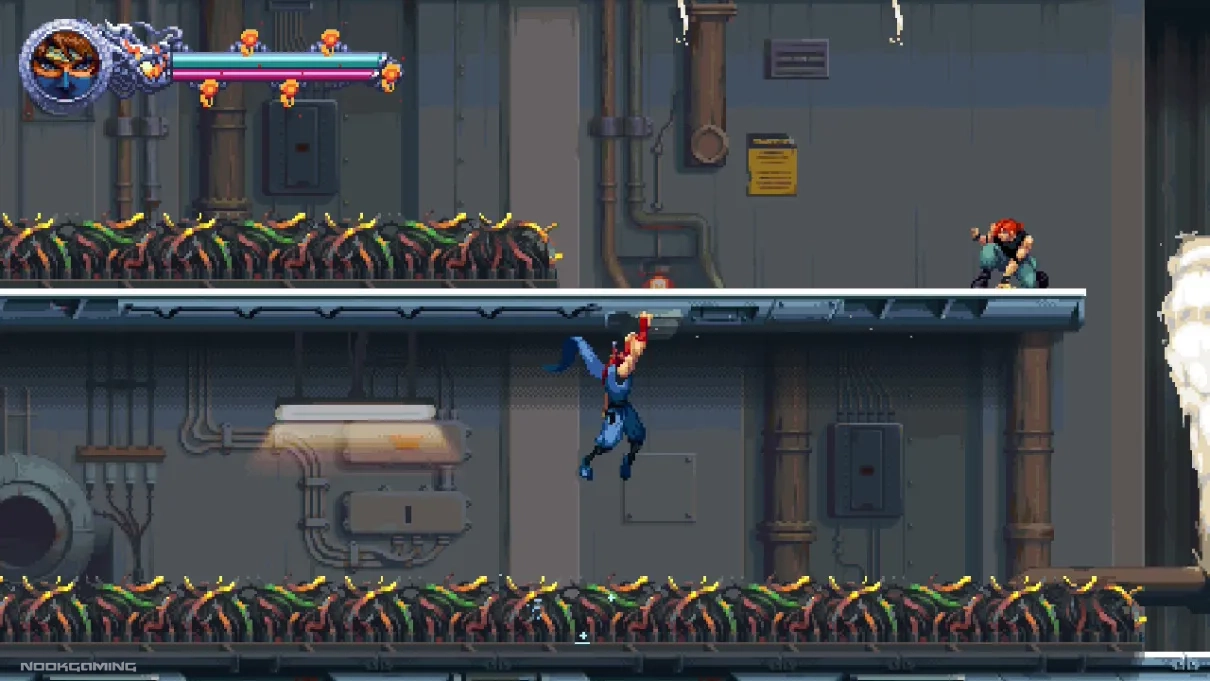
Ninja Gaiden: Ragebound’s gameplay isn’t much like the NES games, save for a few characteristics. You’ve got subweapons, a basic melee sword attack, and the ability to climb up and down walls. On top of that, you also have the Guillotine Boost, where you can do a midair attack and gain extra height from enemies, enemy projectiles, and stage obstacles. There’s also a dodge roll that lets you phase through attacks with good timing, and a lunge attack that you can do out of that. Taking a page from Shinobi, you can also hang from and shimmy across ceilings and ropes. Level design utilizes all of these quite well, and chaining movements together seamlessly can feel nice thanks to phenomenal gamefeel. Kenji and Kumori feel smooth as butter and are as responsive as actual ninja.
You’ll have a surprisingly large variety of enemies to contest with, all of which have their own unique behaviors and patterns. You’ve got demons who shoot fireballs, throw axes at an arc, will harass you by phasing through walls, or will spit acid on the floor. There are also humans equipped with weaponry like grenades, spiked battering rams, and guns that you need to jump over or duck to avoid. While many of them can be defeated in a single hit, there are also far stronger enemies who can’t. The big enemies are tougher, deal more damage, and some may have defenses that negate damage completely unless you attack from a certain angle. This is where one of the new elements of play comes in: Hypercharge.
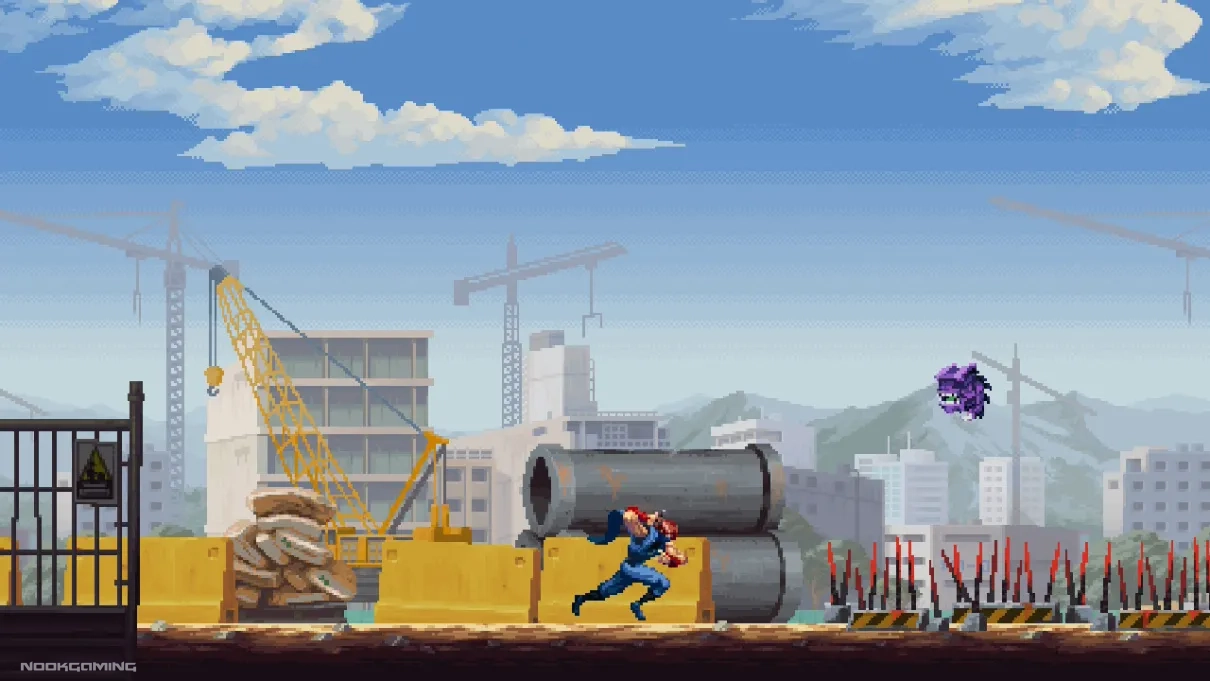
A Hypercharge state can be achieved by defeating enemies in a particular way, depending on what color their aura is. If they’re colored pink, you have to use a projectile or subweapon, and if they’re colored blue, you have to use a melee attack. While in Hypercharge, your next attack will be an instant kill on every enemy type in the game (minus bosses) and instantly destroy all obstacles. If you see an enemy that can’t be killed in one hit, there’s always going to be another enemy around that will give you Hypercharge. Learning level layouts and enemy patterns is absolutely essential to achieving peak performance and getting into a flow state, and that’s all the more vital when accounting for the game’s brutal ranking system.
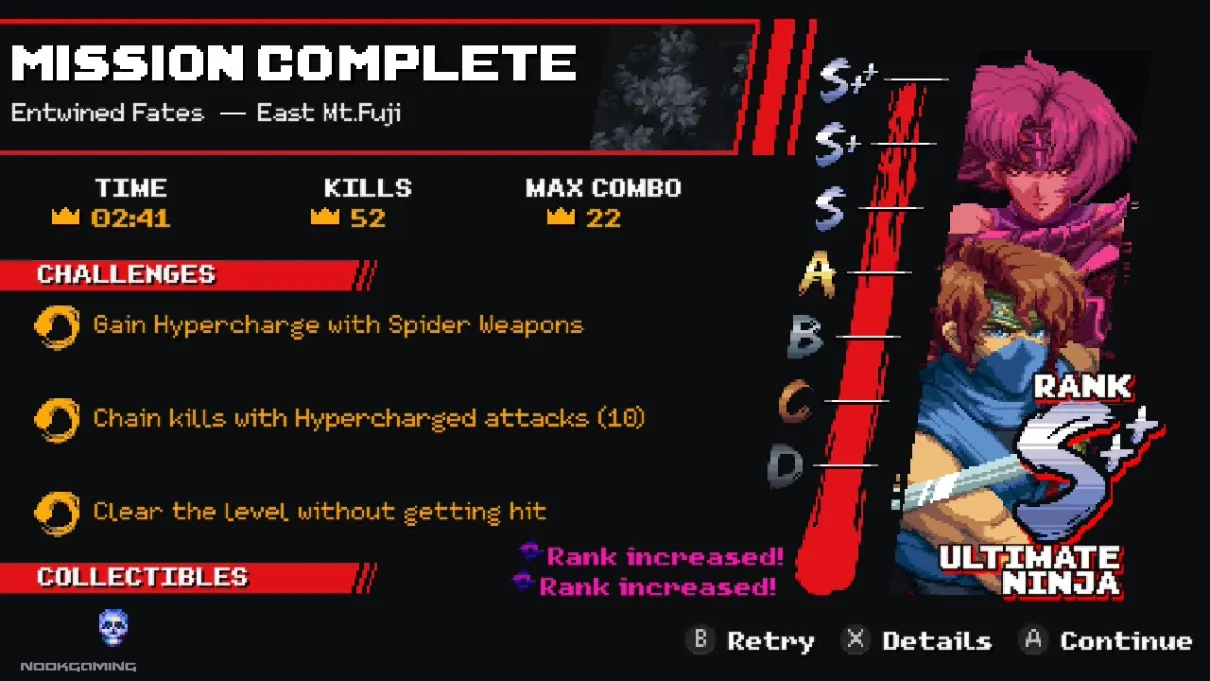
At the end of each level, you’ll be graded on a scale from D to a maximum of S++. This takes into account stage completion times, how many times you died, how often you were hit, and how many enemies you killed in a given run. Each stage also has three unique sub-objectives, all of which have to be cleared to get the highest rank. This can be things like clearing the stage without getting hit, finding a secret passage, or defeating a boss within a certain amount of time. It gives every stage a sort of distinct flow, and it also means I can’t ever fall back on the same old strategies to get high rankings.
High Risk and High Reward
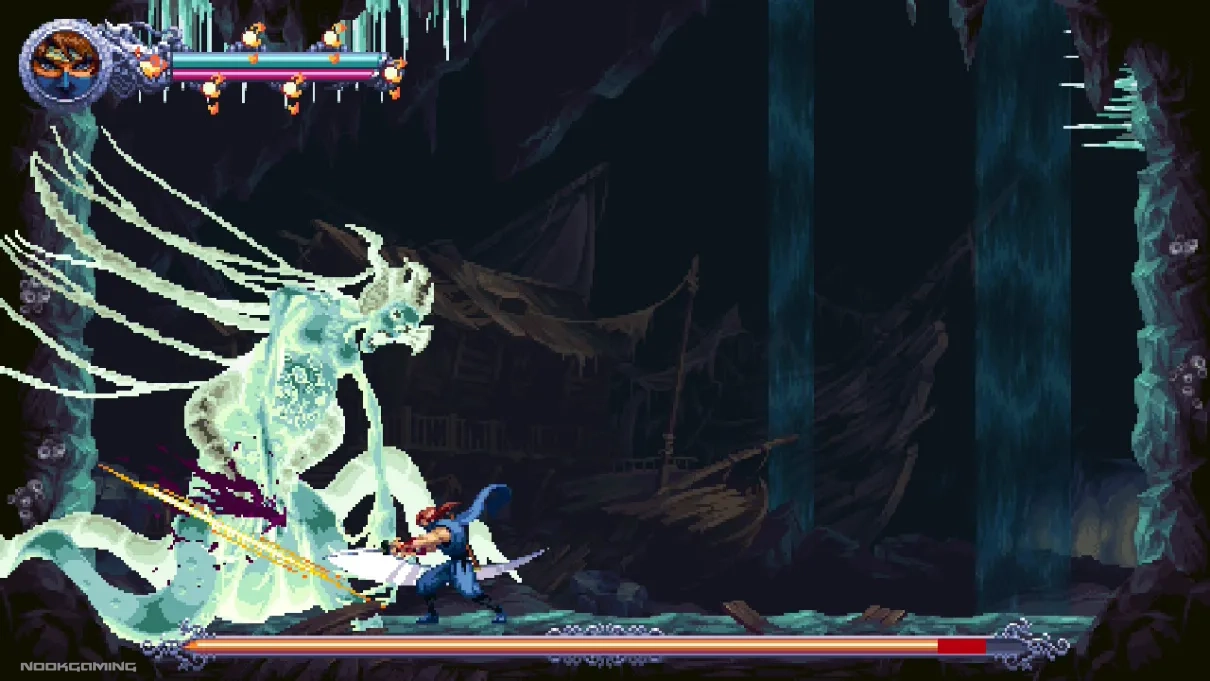
Capping off the end of most levels in Ninja Gaiden: Ragebound are boss fights, and these wound up being some of the highlights of my time with the game. I always did enjoy the bosses in the NES titles, and they’re even better here. They’re fast, feel distinct, and have great presentation whilst also giving all of the game’s core mechanics a great workout. You’ll be utilizing everything from constant Guillotine Charges to Hypercharges and wall-crawling to avoid taking damage. It’s also here where you can flex your capabilities by engaging with some of the riskier gameplay mechanics.
The first big one is the ability to expend some of your own health in exchange for Hypercharge. Hypercharge will deal extra damage to bosses and leave them momentarily stunned, which is extremely useful when grinding out good times needed for higher ranks. Of course, this puts you at risk of losing it all from a stray attack, but it also puts you just that bit closer towards a higher rank. It’s that sweet blend of high risk gameplay that made Ninja Gaiden so famous in the first place, and it’s here and accounted for in Ragebound.
Ragebound applies its own twists to this formula as well, mostly in the form of Talismans bought from Muramasa’s shop between levels. Up to two can be equipped at once, and they grant the player a variety of upgrades that can augment their playstyle in numerous ways. One Talisman might grant you a free Hypercharge after using three consecutive Guillotine Charges, while another might be a one-time shield to protect you from potentially lethal blows. The real challenge comes from the rank-increasing Talismans, which incur penalties mid-level but have massive payouts in your letter grading. You also need to use these penalties to get an S++ Rank. I’ll stress that there are no unlocks or rewards for doing so, and that these ranks are purely for players who want to push themselves to the limit.
What happens here is a really cool system where you have a sort of “choose your own difficulty” approach to its score attack gameplay. While you still have to equip two penalties, which penalties you pick is up to you. For example, on a shorter stage, it might be better to get rid of checkpoints since the level won’t last long anyway. Meanwhile on a stage with a particularly tough boss, it might be best to make sure you still have access to healing orbs so you won’t die prematurely. It’s excellent stuff, feeling like a flavorful blend of fast-paced action games and modern Ninja Gaiden.
The Grind Never Stops
Hidden throughout certain stages are scrolls that unlock Secret Ops, optional bonuses that are particularly tough remixes of levels from the story. While these don’t have bosses at the end, they are significantly more difficult than anything the main story will throw at you. They recontextualize stage gimmicks in ways that will test you like nothing else, and can be outright mean in ways that still feel somewhat fair. Many level gimmicks throughout the main story are one-offs that don’t return, so I’m glad Secret Ops exist as a means to give them more screentime.
I found myself preferring the Secret Ops levels thanks to their sheer replayability. Owing to their lack of story and broadly shorter length, it feels like a single blast of gameplay where I have to be fully engaged for the entire length of the level. Sometimes I would replay sections just because of how good they feel to improve in and eventually master.
There’s also Hard Mode levels, which you’ll unlock after completing the game once. These rearrange obstacles and enemies in levels to be far more unforgiving than before, and demand absolute perfection if you’re vying for an S++ Rank. This also applies to bosses, who will have their attack patterns and AI altered to be much more difficult than before. While I have mixed thoughts on locking this mode behind game completion, I will say that Hard Mode is transformative enough to warrant playing the game a second time. All told, these additions leave Ninja Gaiden: Ragebound with quite a bit of content to leave players entertained for a while.
How Are We Lookin’?
Ninja Gaiden: Ragebound is a great continuation of the visual identity laid out in The Game Kitchen’s previous titles like Blasphemous. It features smooth, highly detailed pixel artwork in both characters and backgrounds. Characters animate in a way that’s bouncy and distinct, and enemies are immediately legible thanks to their distinct silhouettes and outlines. This is huge in how it affects playability, where I often have to make split-second decisions. Hitboxes also properly align with character and obstacle sprites, so I never have to second-guess how I play.
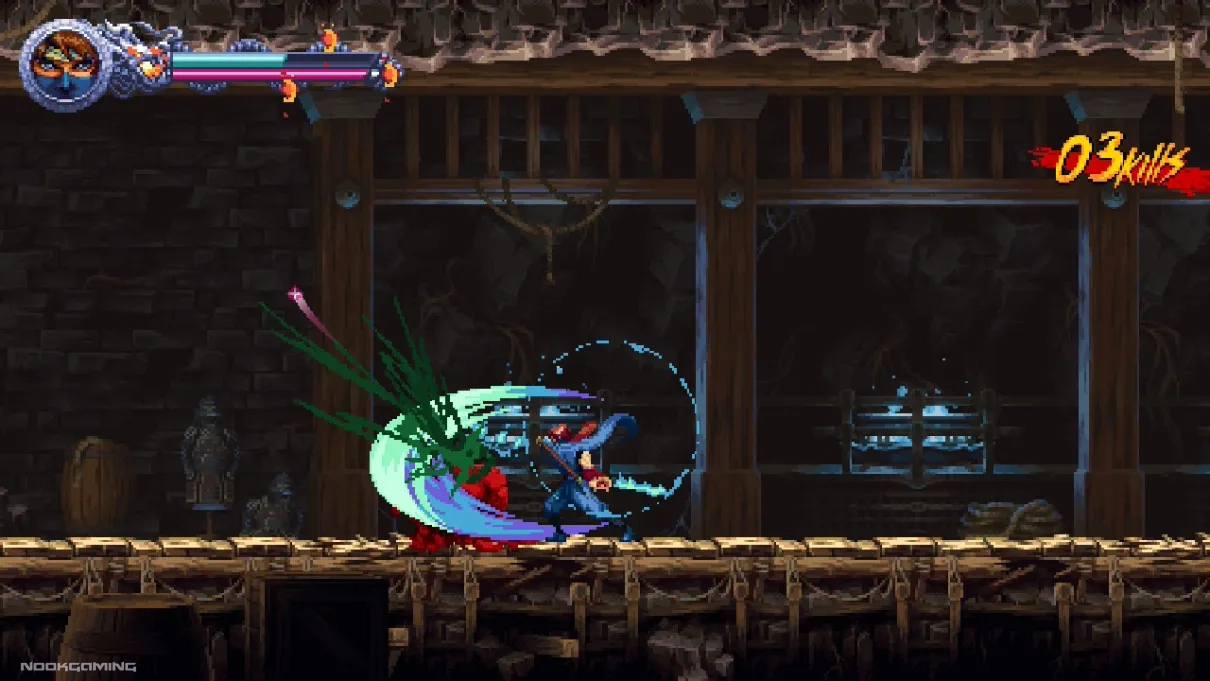
Ninja Gaiden: Ragebound brings the famously bloody spectacle of the 3D titles into the second dimension. Every enemy you slash at will explode into wondrous gore, with most of them having several death animations that change depending on how you kill them. Enemies can be decapitated, bisected, incinerated, or maybe they’ll just pop like a balloon. Combined with the crunchy, immensely satisfying screen shake and hitstop that happens when landing a Hypercharge kill, and it’s deeply gratifying to mow down hordes of enemies in style. There are even some extra details that I appreciate, like enemies staining the walls and nearby environments when they die, and the expressive character portraits that change based on how you kill a boss.
Lastly, the music ties the presentation together beautifully. Full stop, this is easily my favorite soundtrack in the entirety of Ninja Gaiden. It combines synth and live band recordings for an absolutely rocking soundtrack, but it also knows when to pull back and let the atmosphere speak for itself. There are also a lot of homages to the NES trilogy (specifically the first game) sprinkled in some tracks, and it’s always done in a way that feels tasteful. While I have many favorites from its soundtrack, the credits theme in particular really blew me away. As a whole, it feels like the presentation of Ninja Gaiden: Ragebound is as smooth and confident as the gameplay.
Verdict
2D Ninja Gaiden is back, and it’s easily the best it’s ever been. Ninja Gaiden: Ragebound is a statement of love for what feels like the whole series, made by people who’ve clearly loved it for a long time. Gameplay feels smooth, impactful, and fast-paced while also keeping to the high skill ceiling that’s always defined it. I can see myself playing it for a long time simply because I’ve yet to get the coveted S++ Ranks on all stages, and it’s always fun enough that the grind itself is enjoyable. Combine this with a silky smooth aesthetic and one of my favorite soundtracks of 2025, and you’ve got a game that I am confident is the best platformer of the year.
NINJA GAIDEN: RAGEBOUND IS HIGHLY RECOMMENDED

If you like high-intensity action games, you might also want to check out our review of Warriors: Abyss.
Many thanks go to DotEmu for a Nintendo Switch review code for Ninja Gaiden: Ragebound.

A hobbyist who took up the pen to write about their favorite pastime: games. While a lover of many genres, Isaiah Parker specializes in Platformers, RPGs, and competitive multiplayer titles. The easiest way into his heart is to have great core gameplay mechanics. Self-proclaimed world’s biggest Sonic fan. Follow him @ZinogreVolt