Released back in 2022, Kirby and the Forgotten Land was the mainline Kirby’s grand debut in the third dimension. As the second mainline Kirby game on Switch, it was met with much fanfare from fans and critics for its extensive content, creative and detailed level design, and great soundtrack. I certainly loved the game (as did our reviewer back then), and was excited for what I felt was an inevitable DLC expansion. That expansion never came, and nor did the game receive any significant updates like Kirby Star Allies. I had assumed that the Forgotten Land was completed as-is and that the developers had simply moved on from it. Cut to more than three years later, and I’ve been proven wrong with Kirby and the Forgotten Land Nintendo Switch 2 Edition + Star Crossed World, which promises a graphical refresh of the original game alongside brand new content further showcasing the Switch 2’s power.
A Whole New Dimension
Kirby and the Forgotten Land features a bold jump into 3D that still sticks to the conventions that the series is broadly known for. These are games with very simple, approachable platforming and combat elements where you suck things up as Kirby to either spit them back out or swallow them for some added benefit. Environments are densely populated with enemies and stuff to look out for, like hazards or bottomless pits. Kirby’s signature Copy Abilities have also seen some tweaking with the transition to this title, featuring somewhat simplified and smaller movesets for each ability he copies by swallowing nearby enemies, but with moves and abilities being more interactive than before. Rolling Bombs react dynamically to slopes, Ice can interact with more fiery objects than before, and you can roll around with the Needle ability to have all kinds of nearby objects stick to you. These traits are all well-utilized and considered in the game’s excellent level design.
While there are fewer overall levels when compared to past Kirby games, each one here is longer, larger in scope, and explores a different theme or gimmick. You exchange the number of levels for a greater sense of depth, which I think was the best call for a 3D game. There really isn’t a single level I don’t at least like here, and they manage to distinguish themselves in some really fun ways. This is partly thanks to HAL’s years of experience in crafting good levels, but it’s also thanks to the new Mouthful Mode mechanic. At certain points in stages, you’ll find an object too big for Kirby to swallow, and he’ll have his properties completely changed as he latches onto them. Mouthful Mode is, in essence, a transformation mechanic like the sort you would see in games like Yoshi’s Island, completely altering his playstyle for a short while. He’ll turn into a car you can zoom around in, a big staircase you can move around to reach higher places, a broken gate that turns you into a hang glider, a roller coaster, and more. These are all fun to use and provide the levels with what are often their most memorable setpieces.
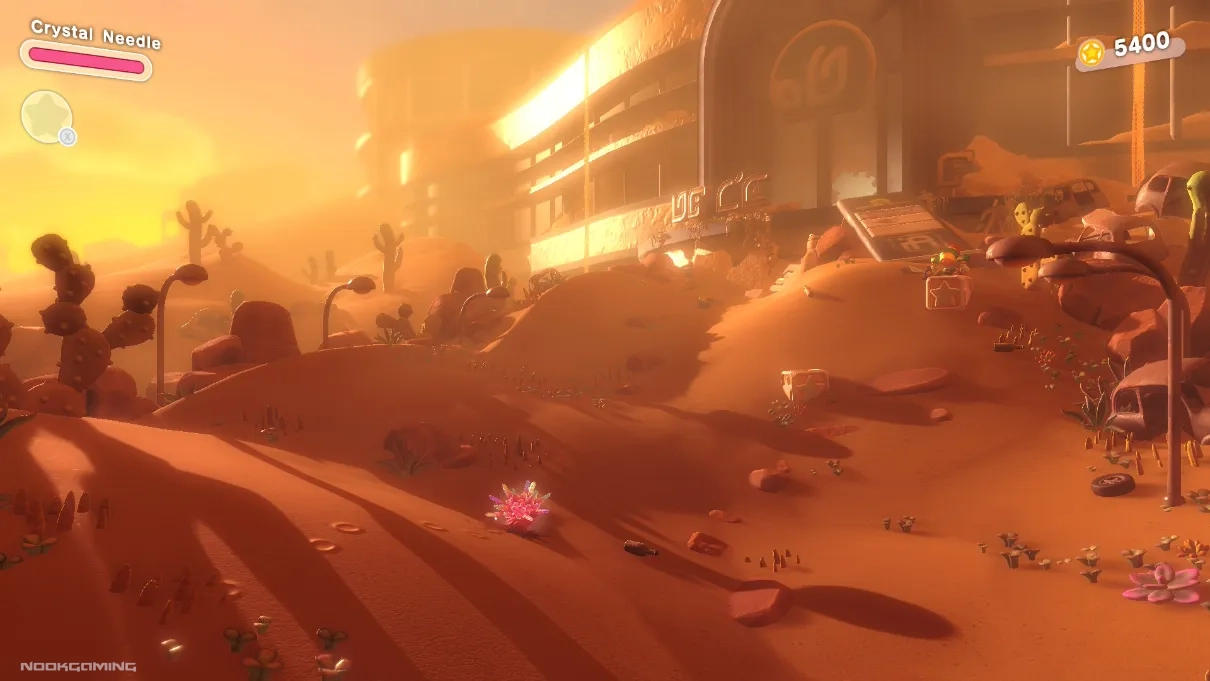
The game’s levels also provide a nice shake-up from how generally formulaic Kirby can get when it comes to theming. While it still adheres to the general theme of things like grasslands, a beachside, a snow area, and a desert area, the post-apocalyptic theming of it all means you’ll go through many areas that work out the mechanics in interesting ways. Although the first world is grasslands, it’s not some typical forest area. You go through old, dilapidated buildings, an abandoned mall, an underground area with faulty lights, and so on. The amusement park world later in the game will likewise feature a rollercoaster, a haunted house, a go-karting track, and so on. It’s got variety in spades, and best of all is that all of these manage to land.
Keep Those Eyes Peeled
The biggest factor in the success of Kirby and the Forgotten Land’s level design is its many secrets and side objectives. Each stage contains a set of captured Waddle Dees for you to find and rescue, and many of them are hidden in paths less traveled or obscured by secrets. Some will have small challenges associated with your Copy Abilities or Mouthful Mode abilities, which can be somewhat obvious, but they’re still fun because they’re like little twists that ensure I have a good understanding of the nuances of each of these abilities. Besides the captured Waddle Dees, you also rescue Waddle Dees by completing the Hidden Missions of each level. There are three unique Hidden Missions for every game, and the game will provide hints for one that you missed upon completing the level.
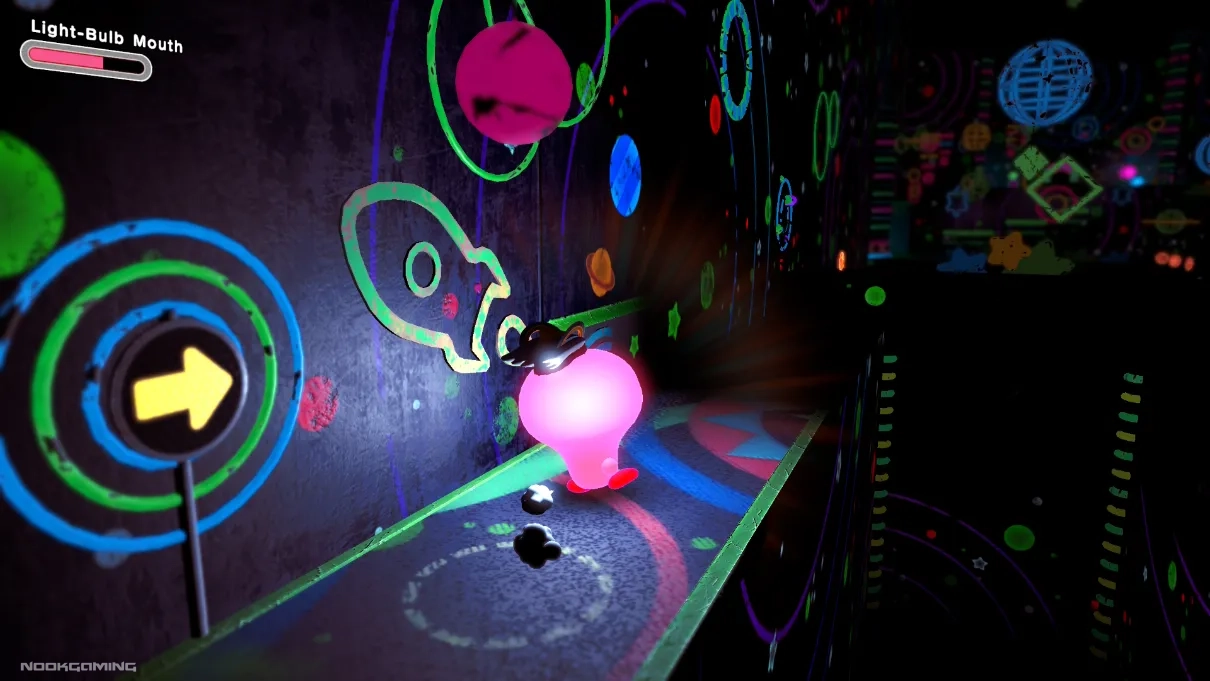
Hidden Missions are… mostly good, and some of them can actually be very charming and fit the atmosphere or setting. They’re mostly innocuous things that you wouldn’t really think about, like finding a secret area or clearing a minigame within a certain requisite. It’s very possible for you to rescue all Waddle Dees and complete every Hidden Mission in your first run of a level by simply being alert to your surroundings and poking at anything that sticks out as conspicuous. When it feels like my curiosity is being unconsciously guided by these things, Hidden Missions are great and it makes me glad that they kept them secret.
However, it becomes frustrating when it comes to certain objectives that are too obtuse or boil down to guesswork to find. The worst of these are the missions associated with minibosses, which will sometimes ask you to either win without getting hit or win with a certain Copy Ability. The Copy Ability-based ones are the worst, because the game will often present several choices of them before a miniboss, yet it still runs with the expectation that you just figure out which one the Hidden Mission wants you to use. Didn’t guess it on your first try? Hope you enjoy playing the entire level again just to complete the one mission you missed. It didn’t come up frequently enough to be a big detractor, but it was something that cropped up enough to be a visible annoyance.

Treasure Road and Bosses
Upon completion of most of the levels in the main story, you’ll unlock around two to three bonus mini levels called Treasure Roads. Here, you’ll be further tested in your aptitude for using certain Copy Abilities, Mouthful Modes, or skills related to Kirby’s inherent moveset. While clearing them and netting the reward, a Rare Stone, is simple enough, they also come with extra challenges involving completing the Treasure Road within a certain amount of time. The speedrunning aspect is surprisingly quite brutal, and requires an airtight understanding of each ability as well as solid execution of your strategies. There’s no real reward for beating the speedrun times, but they are a nice extra challenge for veteran players. On top of those, some Treasure Roads are also hidden on the overworld, asking the player to look for any conspicuous spots between levels.
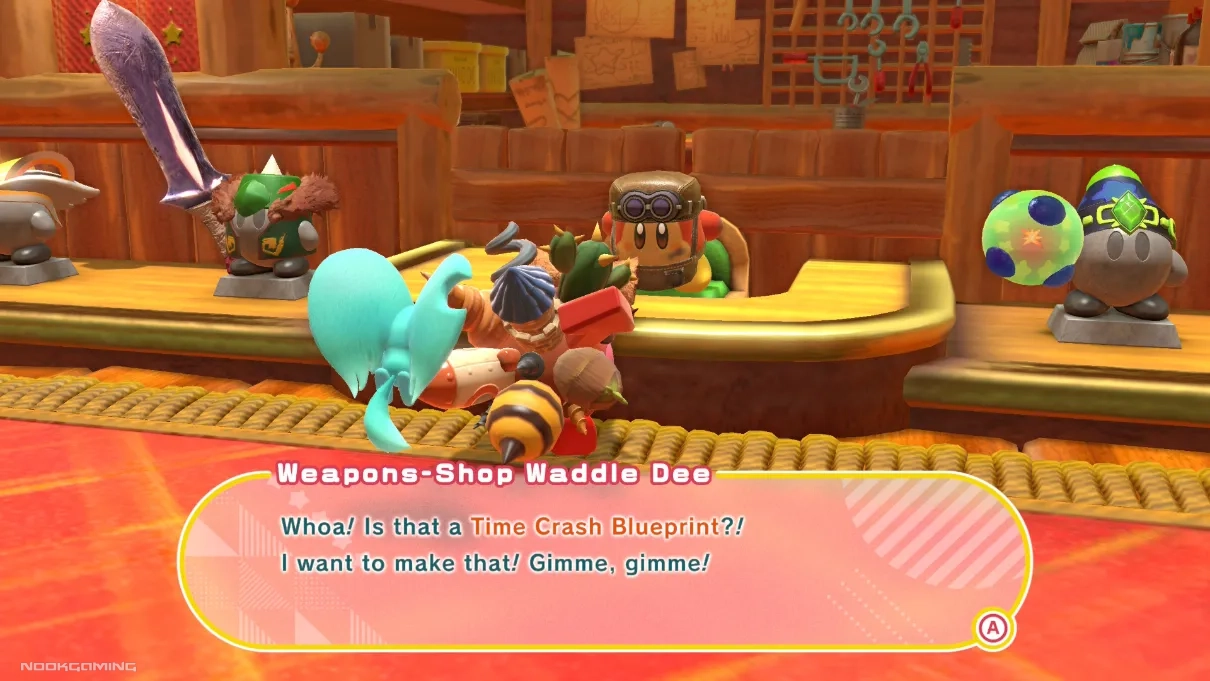
With the Rare Stones obtained from these treasure roads, you can head to a certain shop and permanently upgrade your Copy Abilities to increase their attack powers and broaden their abilities. For example, you can upgrade the Sword ability into the Gigant Sword, which does more damage and grants Kirby a shield that makes him completely impervious to damage for a short period. Then, after defeating Meta Knight in an optional boss battle, you can upgrade it again into the Meta Knight sword, which is faster, lets you shoot projectiles, and does much more damage when using the charge attack. However, it’s not as simple as just having the Rare Stones, you also have to locate the Blueprints needed to upgrade them. These are even more deviously hidden than the Waddle Dees, locked away in places that you might not know are even reachable at first.
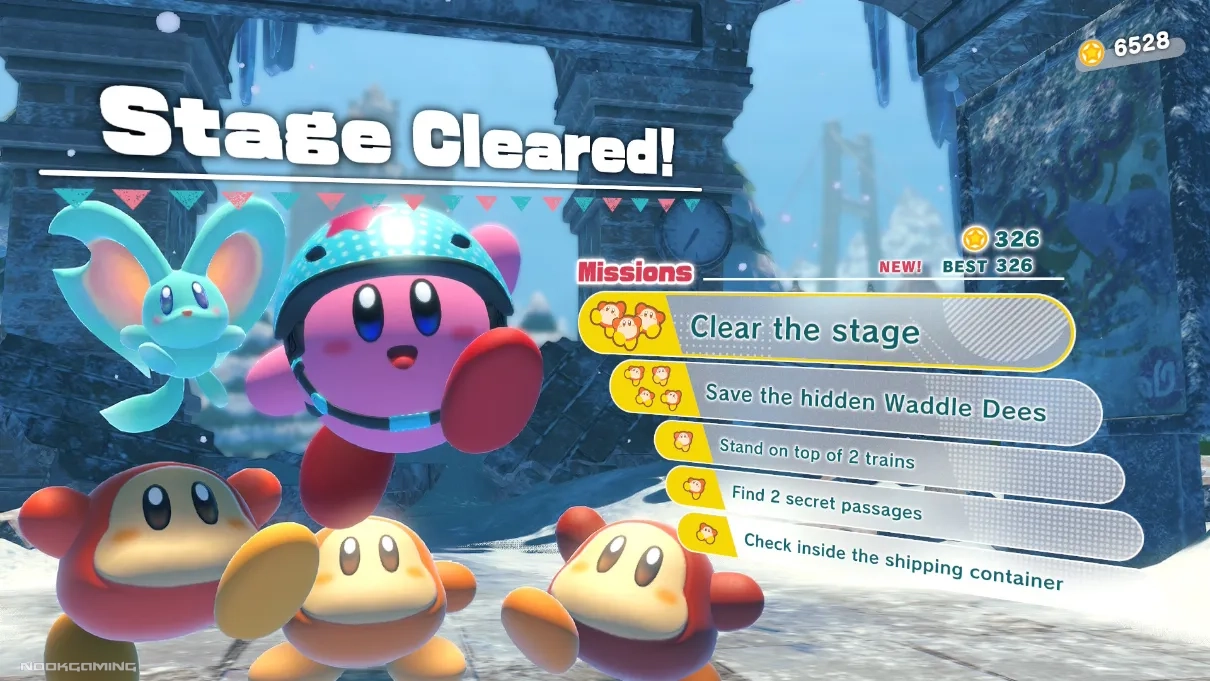
These upgrades will come in handy for the bosses you’ll have to contend with at the end of each world. They’re still pretty easy, in typical Kirby fashion, but they’re made fun thanks to bosses having creative attack patterns and charming presentation that caps off the theming of each of the previous worlds quite nicely. Like the main stages, the bosses also have several Hidden Missions for the player to uncover and beat. These generally include things like doing a no-hit run, beating the boss with a certain Copy Ability, dodging a certain attack, or triggering a special event in the fight. Since bosses are much shorter than the main stages, I never actually minded doing these, and in fact I found the no-hit runs in particular to be an enjoyable challenge.
And Then They Waddle Dee’d Away
One of my favorite parts about Kirby and the Forgotten Land is Waddle Dee Town, your home base and a place that slowly develops with the more Waddle Dees you rescue throughout the main stages. While it starts small and sparse in features, it will eventually grow into a bustling town with lots of things to interact with and extra new features like the series’ staple collection of minigames, a Colosseum (acting as stand-in for the series’ famous boss rush modes), all of which will start small and steadily grow bigger as you make more progress through the main story and during the full completion process. More important characters will move in as you make more progress, and each of them will have something new to say upon hitting certain story beats. I often found myself visiting Waddle Dee Town between the main levels, just to see if there was something new if I hit a certain percentage of progress.
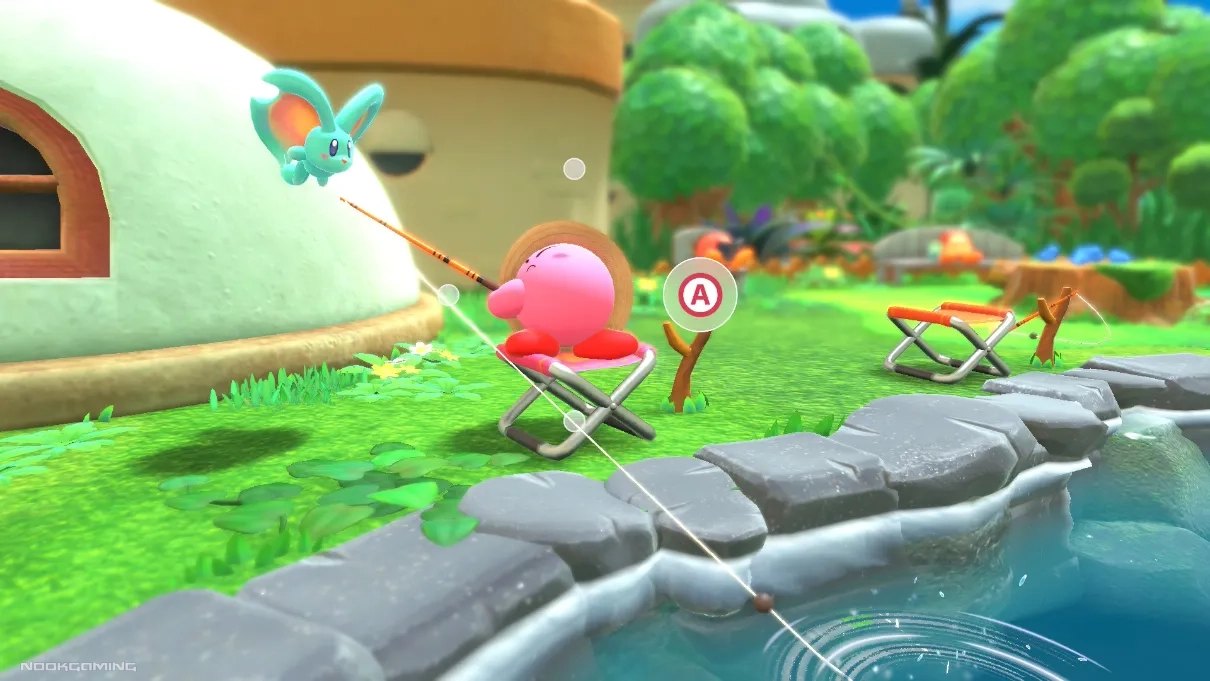
Besides interacting with the townsfolk, they’ll also build minigames for you as you save more of them. These are all nice and silly distractions, as Kirby minigames often are, but I quite enjoy how they’re all built within the context of Waddle Dee Town itself. At the local restaurant, you can help out as an employee and play a surprisingly daunting minigame where you have to serve Waddle Dees in what feels like a sadistic minigame. Get good enough, and you’re rewarded with the Lunch Rush, where suddenly things get much faster and you have to play even more precisely, lest you be hit with a premature Game Over. If you want something more relaxed and low stakes, you can always fish at the nearby pond instead. Here, you’ll fish up critters by timing button presses, with the game tracking your biggest catches and converting them into points you can use at the shop. It’s a neat distraction, and can be pretty fun when playing co-op.
The last minigame is Tilt-and-Roll Kirby, which has you using the Switch 2’s motion control and guiding a marble Kirby ball down a perilous maze where the ball can easily fall off. It’s a cool little homage to Kirby Tilt-and-Tumble, and controls better than before thanks to the Joycon 2’s better gyrometers. Aside from that, you can bet on the nearby Capsule Machines to collect the many figurines that contribute to 100% completion. After rolling the credits once, you’ll also have a decent chunk of content waiting for you in the form of its surprisingly extensive postgame storyline. I won’t spoil the specifics, but I will say that it’s completely worth your time as it clarifies and puts a proper bowtie on many of the story’s mysteries in its latter stages, including the fates of several characters. Overall, I think this game is at its best when you stop and sniff the roses. There’s a lot of detail to take in both in and out of the main stages, and taking it slow and steady is the easiest way to enjoy all of it.
Easy on the Eyes
Kirby and the Forgotten Land was already a pretty nice looking game back on Switch 1 thanks to its evocative art design and imagery that contrasted nicely with the rest of the series. Going from the oftentimes abstract and whimsical sights of Planet Popstar to the “New World”, which features lavishly detailed and creative post-apocalyptic environments was a bold and effective jump. Each level in the game comes with its own distinct theming and progressing through each world feels like strolling through the quiet, forgotten districts of whole countries or settlements. One level in Winter Horns might involve you strolling through the streets of a Kirby-fied London, complete with its own Big Ben, and another may have you navigating its many iced over subways and train cars. Then in one level you may be strolling through an old mall in a desert, while then stumbling upon a resort by that desert in the next level, providing a sense of continuity to these environments. I always like it when platformers are able to combine sensible, fun level design with a strong sense of place, and Forgotten Land is nothing if not a hallmark example of this.
Kirby and the Forgotten Land Nintendo Switch 2 Edition + Star Crossed World comes with several great upgrades that make all of these elements even easier to appreciate. The first thing that fans especially are going to immediately notice is the jump from 30FPS to 60FPS in the Nintendo Switch 2 Edition. You can count on one hand the number of Kirby games that run at 30FPS (out of the mainline titles, only Star Allies and 64: The Crystal Shards run at this), so this upgrade is very much appreciable in how it affects gameplay and the smoothness of things like cutscenes. Kirby games are very bouncy and Forgotten Land in particular utilizes quite a bit of squash and stretch for its expressions, and these are something that always benefit from a higher framerate during gameplay. From my own time playing both the base game and the brand new content, it seems like a totally locked 60FPS as well. It never misses a beat even when there’s a lot happening onscreen.
There are also improvements to image quality, having jumped from 900p at its peak on Switch 1 to roughly 1440p on Switch 2. In handheld mode, it runs at the Switch 2’s native screen resolution of 1080p, though in both docked and handheld it does seem to run at a dynamic resolution based on how busy the gameplay gets. In either case, it’s a big and appreciable upgrade. HDR is also in effect, providing crisper colors to an already colorful world, especially when playing on a 4K-capable display. In a rare case for a Nintendo-published game, it also uses anti-aliasing now, smoothing out some of the fuzzy noise you would see wrapped around character models and environmental details. Lastly, there are also vastly improved loading times, providing a smoother experience when going from one area to another. All in all, while I wish the resolution managed to hit a full 4K, I’m quite happy with the Switch 2 rendition of this game.
Star Crossed World
The brand new content, the Star Crossed World storyline, kicks off as Kirby games typically do. Kirby and his companion Elfilin are enjoying a peaceful day, until the apocalypse rains from above in the form of a giant crystalized meteor that landed in the New World. This meteor, spoken of in legend, is the first sign of an oncoming calamity that must be prevented by re-sealing the giant, evil heart resting inside of the meteorite. Now, it’s time to head off in search of the beings responsible for sealing up the evil heart, called Starries, who scattered across the New World upon impact. Kirby sets off to some familiar locales that have been transformed by other meteorites that have struck them.
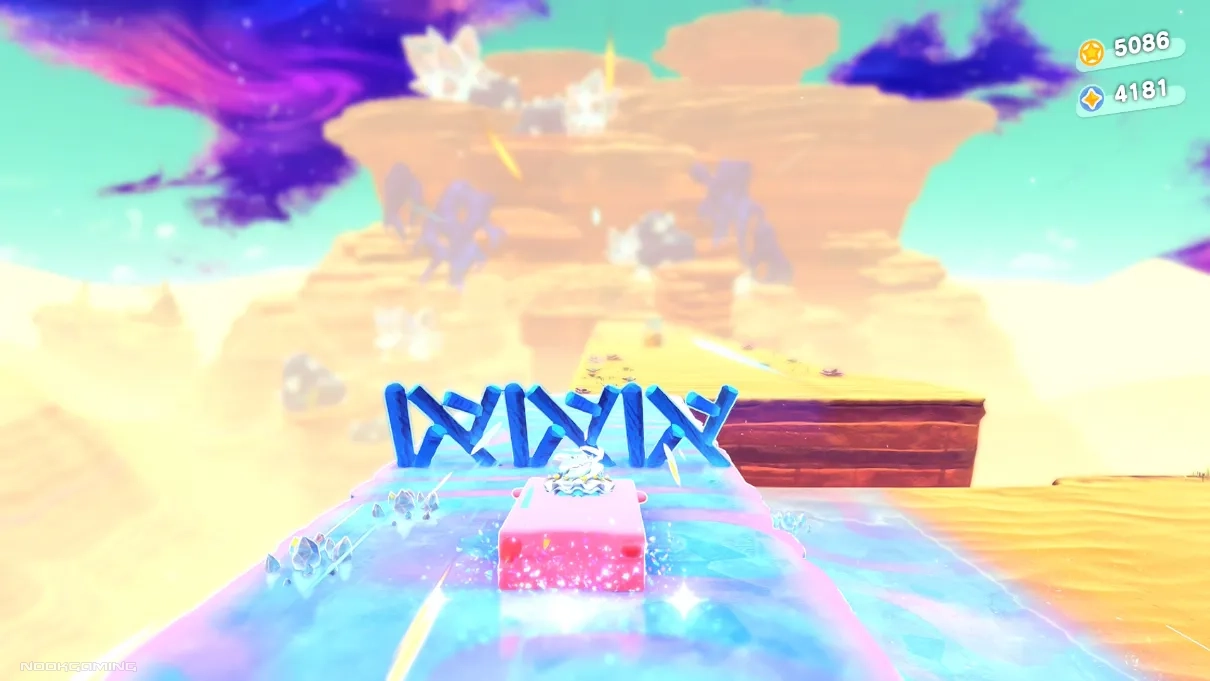
With this new DLC comes extra content called Starry Stages to enjoy, modeled closely after the main game and having some commonalities with the Extra campaigns from previous Kirby titles. While the main game doesn’t need to be cleared to enjoy Star Crossed World (with its levels instead opening up after clearing the bosses of each world), it does feature tougher enemies, trickier level design, and much harder-to-find secrets. This is courtesy of a new gimmick present in every Star Crossed World level, called Starryflowers. Starryflowers come in both a big and small variety, whereupon hitting one, the environment will instantly transform around Kirby. These will often reveal new pathways, secrets, or alter the immediate area in a dramatic way. While many of these need to be broken in order to progress through the level, many don’t and are in fact hidden out of sight. Unlike the main game, which I mostly managed to breeze through in finding everything, the Star Crossed World content actually had me scratching my head at several points.
This is exacerbated by the fact that these new levels actually wind up bearing very little resemblance to the stages they’re built off of, and I mean that in a very good way. While the first Starry Stage of Everbay Coast might seem like a familiar retread, it’s within the first mission where the sea will suddenly split open and crystalize, and you’re instead spending your time searching for treasure on its seafloor. Others are more subtle, like the Alivel Mall Starry Stage, which instead takes place on the upper layers instead of the lower layers like in the base game. But in either case, these are, functionally, brand new levels in a game that already felt rich with content. To sweeten the deal, there are some new Mouthful Mode abilities to help them feel more distinct. There’s a Spring to help you jump up to high places, a Gear that lets you latch onto vertical surfaces, and a Board that flattens Kirby and lets him slide down huge hills at high speeds. Each of these are pretty fun, and the Board in particular is tied to some of my favorite setpieces in the whole game.
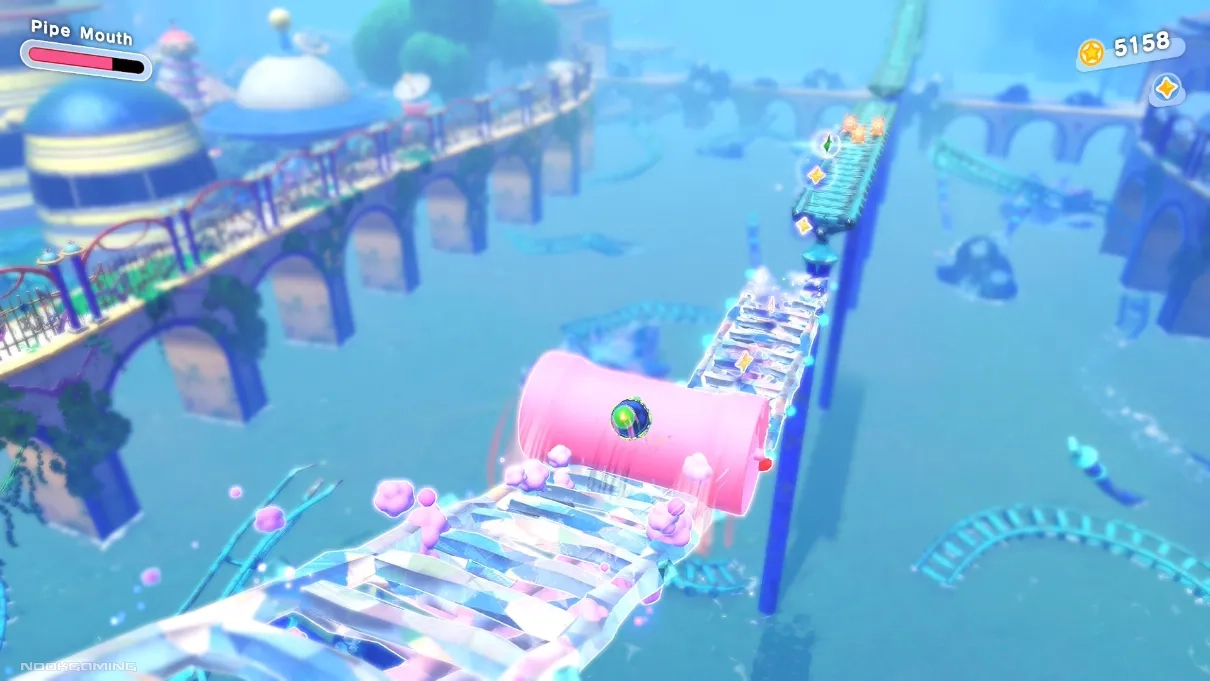
Being the best-looking, best-playing, and especially best-sounding levels in the game makes Star Crossed World more than a worthy expansion to the main game in my eyes. I particularly want to shout out the music, as while the base game has an excellent soundtrack already, the tracks made for Star Crossed World consistently ranked as some of my favorites across the whole series.
Verdict
Kirby and the Forgotten Land Nintendo Switch 2 Edition + Star Crossed World offers up an adventure as charming and well-rounded as Kirby himself. The 2022 game is as good as ever, offering a smooth and compelling transition to 3D for the whole series, whilst also showcasing HAL Laboratory at its best through some inventive level and art design. Its upgrade on Nintendo Switch 2 unshackles those technical and artistic capabilities, with the whole experience made even more delightful by a significantly higher framerate, far faster load times, and a boosted resolution that makes its colors really pop. The Star Crossed World storyline feels like an added cherry on top, boosting the game’s content by a respectable amount while also individually being some of the best levels and art design the game offers up. If you’ve missed Kirby and the Forgotten Land up until now, this is unquestionably the version you should pick up.
KIRBY AND THE FORGOTTEN LAND NINTENDO SWITCH 2 EDITION + STAR CROSSED WORLD IS HIGHLY RECOMMENDED
If you enjoy platformers, then perhaps you’d like our review for Donkey Kong Bananza.
Many thanks go to Nintendo for a Nintendo Switch 2 review code for this title.

A hobbyist who took up the pen to write about their favorite pastime: games. While a lover of many genres, Isaiah Parker specializes in Platformers, RPGs, and competitive multiplayer titles. The easiest way into his heart is to have great core gameplay mechanics. Self-proclaimed world’s biggest Sonic fan. Follow him @ZinogreVolt