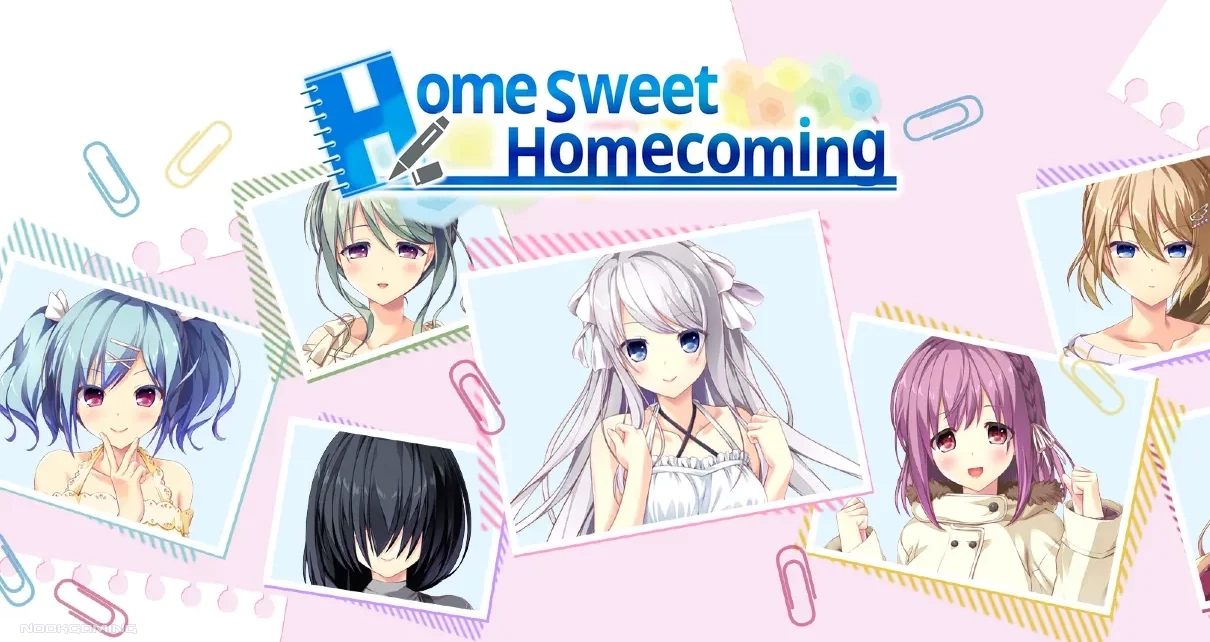
Home Sweet Homecoming, or E School Life as it is known in Japan, is a slice of life visual novel originally released by HOOKSOFT (IxSHE Tell, MeltyMoment) back in 2019. It tells the story of a high school student returning to Japan after being abroad for many years hoping to experience his version of a normal, ideal high school life. The scenario writer for the game is Matsukura Shinji, known for his work in the romantic comedy genre such as in Fureraba ~Friend to Lover~ and IxSHE Tell. Following the two, Home Sweet Homecoming eventually got its own international release under Shiravune.
What constitutes a good, enjoyable school life? People have many ways of imagining an ideal way of spending their teenage years, but I think I speak for most of us when I say that having a sweet, innocent romantic encounter with a special someone is a pretty common scenario within most of them. Noticing small things about each other and finding it strangely endearing, going on first dates even though it makes your stomach turn thousands of degrees around itself the day before the event, experiencing a passionate confession that moves both of you to tears—there’s a reason why romance is one of the most famous genres in different forms of media. As with most things, your first rodeo with it is special in its own way. But because it’s so easy to relate to it, the amount of love stories you can pick up at a whim is also at its highest. What, then, can make the next school romance story stand out?
With new, promising friendships lined up for our very lucky protagonist, what kind of heartfelt tales will he be able to weave for us as he settles down in his beloved hometown again? Let’s witness love blossom in their youthful hearts in this Home Sweet Homecoming!
Longing to Rekindle Old Connections
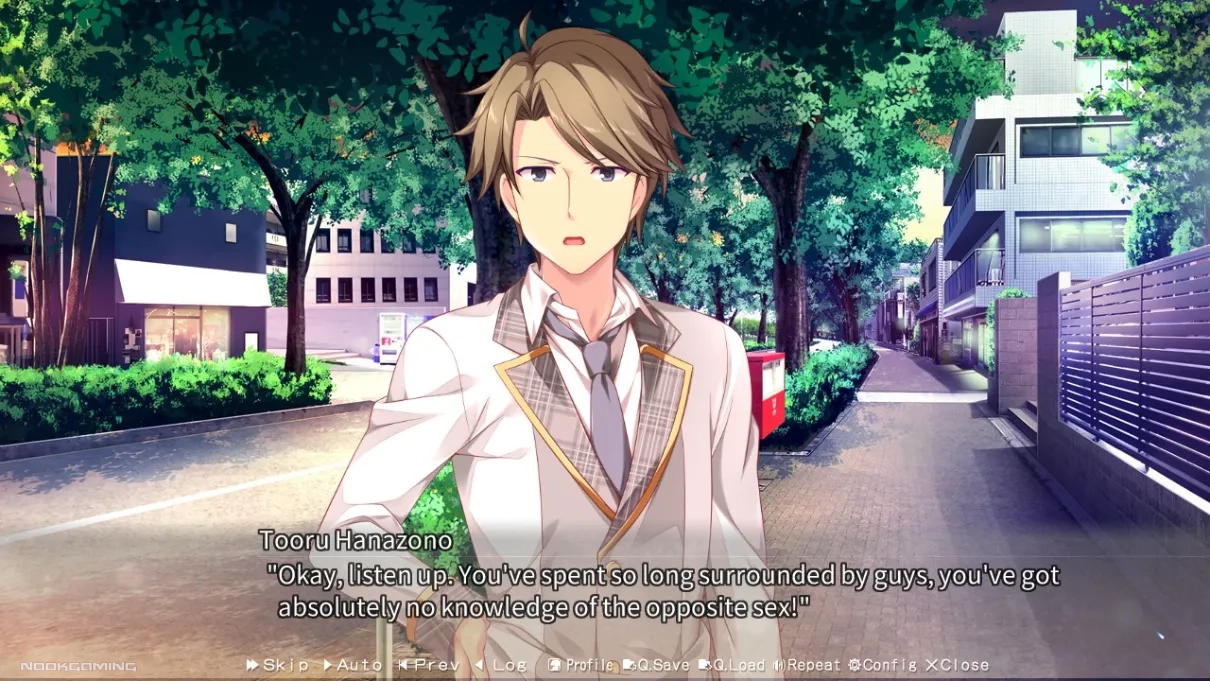
Since he was a kid, Shinozaki Ryoutarou has been travelling across different countries because of the nature of his parents’ jobs. As a result, he feels a lingering loneliness within him as he realizes that he hasn’t really had the chance to make long-lasting, meaningful connections with his peers. Alongside the problem of his frequent relocation, there’s also the language barrier between him and his classmates that prevents him from truly opening up to them. This meant that as much as he wanted to partake in the passions of youth with members of the opposite sex, he ended up being mostly surrounded by men who were bold enough to approach him despite the difficulties that existed in their interactions. Single and possibly vulnerable at his rearside, Ryoutarou began to feel a strong longing to return to where he spent most of his childhood: Hanyuu, Japan.
Luckily for him, his childhood friend Hanazono Tooru is an upstanding guy. Empathetic to his struggles, he set up a plan to bring Ryoutarou back to Japan. By convincing their parents to let Ryoutarou take up residence in the vacant room of their house, Tooru was successfully able to offer him a chance to go back and live the ideal Japanese high school life he’s always dreamt of. Ryoutarou was of course full of gratitude for the help of his good friend, but little did he know that Tooru had set him up for a surprise. As Ryoutarou opened the door, he found a beautiful silver-haired girl standing on the other side with a face full of surprise. Emi, Tooru’s little sister, had grown up to become a very attractive lady. But with all the trouble he had abroad with talking to girls, Ryoutarou froze in place.
How is he going to settle down when a drop-dead gorgeous woman lives under the same roof as him? What is he even supposed to say? Struggling to find the right words to tell each other, the two childhood friends awkwardly celebrate his long-awaited homecoming.
Learn, Laugh, Love – The Three Ls of Student Life!
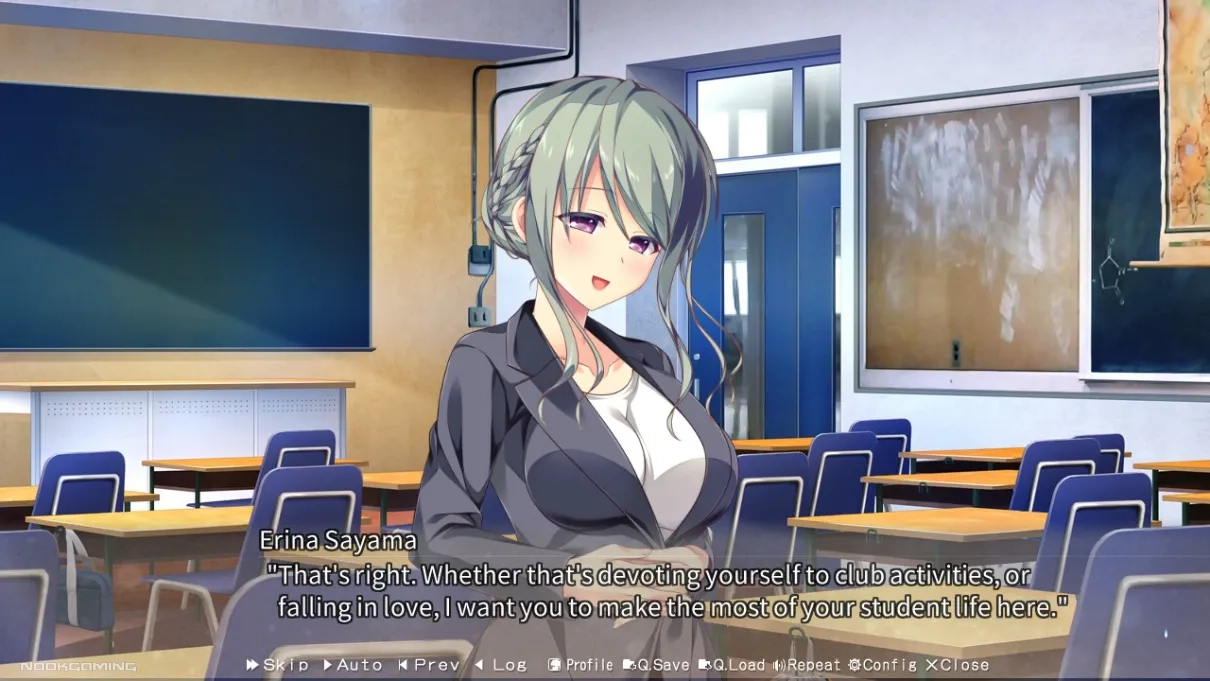
The story of Home Sweet Homecoming follows Ryoutarou as he transfers into his new school and adjusts to his new everyday routine. Along the way, he meets various people that become his friends, and eventually, depending on the decisions he makes, he can even find love with one of the available romantic interests. The story is simple and very straightforward: interact with various students in the academy, discover interesting tidbits of information about the heroines, and then pursue the girl you’re most interested in. It’s a slice of life love story that features no twists and turns; only sweet, innocent, purehearted romance.
In a way, this makes Home Sweet Homecoming the ideal read for someone interested in experiencing a cute, fluffy romance visual novel story. It offers almost nothing in terms of stakes, but it features lots of scenes depicting a couple that’s feeling their way through their new relationship. Instead of drama, it offers scenes that capitalize on its heroines’ cute designs by depicting scenes that make their specific trope shine well, such as frequent comedic references to the memories they share with their childhood friend, displays of gap moe for the dependable yet clumsy class president, and the absurd lack of self-awareness and confidence in the cool and mature-looking star athlete. It gives a sort of youthful feel to the cast, which in hindsight, makes it easy to appreciate and digest for both those familiar with the genre and people interested in trying it out for the first time.
Diary of a Flirty Kid
With seven total heroines available to pursue as romantic interests in a high school setting, there’s no doubt that Home Sweet Homecoming places great emphasis on dating as its overall thematic goal. Heck, even Ryoutarou’s own reasons for coming back to Japan include being able to score some ladies, so there’s no confusion here when it comes to character motivations.
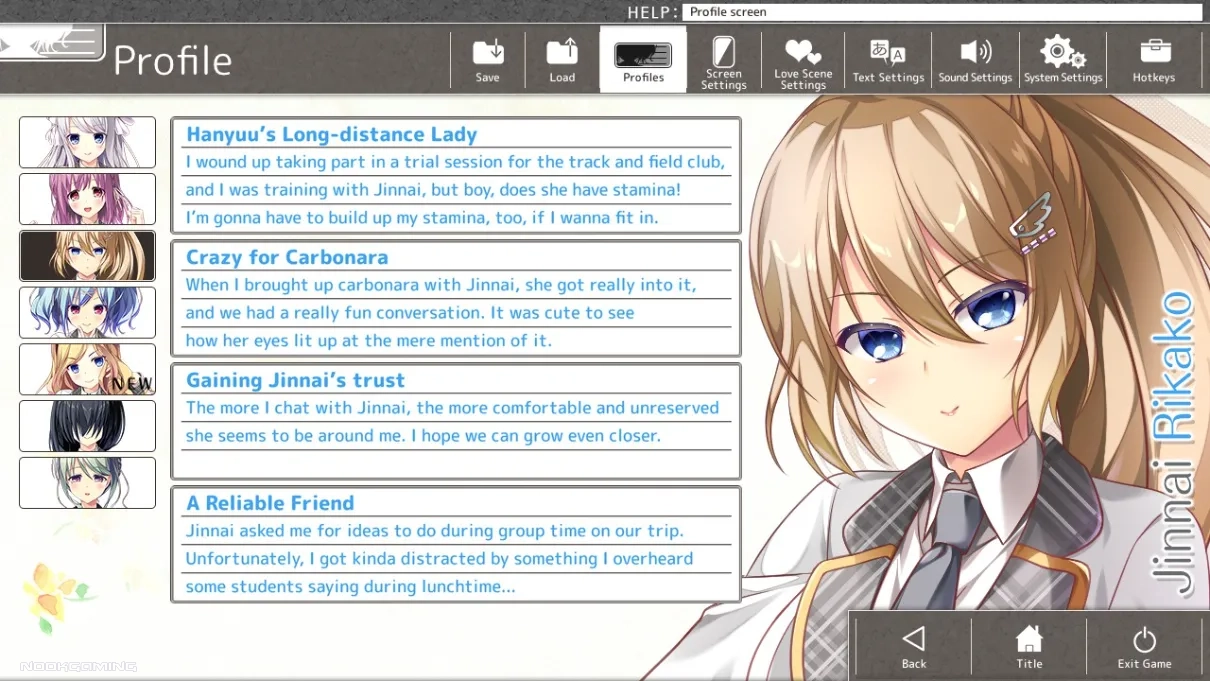
To achieve this very premise, Home Sweet Homecoming makes use of a consistent format to both temper the reader’s expectations and pace its own plot progression. The common route is made up of seven chapters, within which there are three events inserted should the reader pursue one of the four main heroines. After finishing the last common route chapter, a dating and confession scene follow shortly, serving as the prelude to the four or eight chapters dedicated to a heroine’s route (four for side heroines, eight for main ones). Upon finishing these chapters, the credits roll out with an epilogue at the end to cap off the heroine’s story. Additionally, if you ever get lost and want to figure out how far you are to the route’s ending, the game’s window conveniently displays your current chapter, showing something like “Emi Hanazono -01-”, which will also help you keep track of the many choices on the way to each route outlined in our guide/walkthrough.
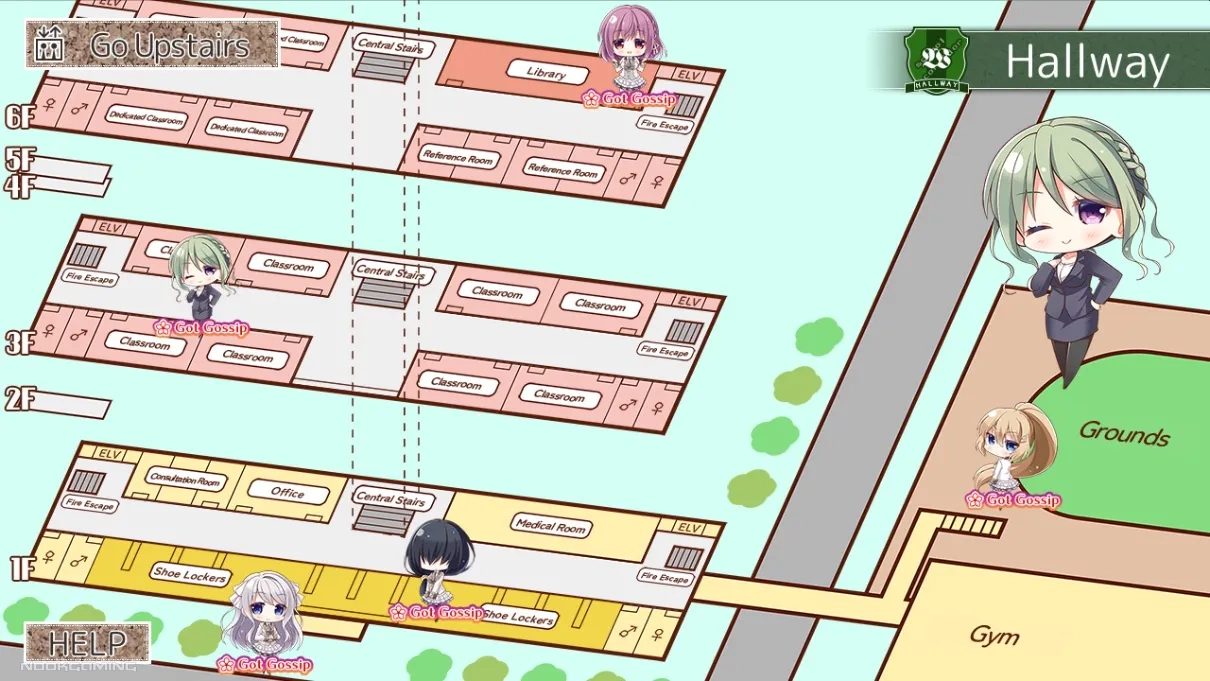
Although inconsequential to the overall plot or story of the visual novel, I felt that this small detail they left for your convenience really helped with managing my own understanding of Home Sweet Homecoming’s scenario writing. The plot is simplistic, yes, but because of how they portion each scene to be bite-sized, the goal for that specific moment is clear, making it easier to follow as a reader. It’s a direct contrast to narrative heavy games, where sometimes the information dump that happens at a pivotal point in the story ends up making the current subject a bit harder to understand. To drive the point about clarity even further, heroines have a specific tab in the settings dedicated to the pieces and bits of rumors that you hear about them (and confirm) throughout the story! The game gives you the ability to reorient yourself about these facts in case you forget them, which is an incredible feature for situations where playing sessions have an incredibly large gap in terms of time in between.
Mapping Someone’s Heart
All that being said, Home Sweet Homecoming does suffer from a similar problem that pure Slice of Life dating stories often share with each other: it gets pretty boring. Looking at it from a technical standpoint, while I love the use of other students in the school as vehicles for conversation topics with Ryoutarou’s romantic interests, the line you need to pursue to actually get to your goal is as simple as it can be: listen to students that have rumors about the heroine of interest, and keep choosing events that feature that very same heroine. There’s no alternative way of doing it such as getting a prerequisite number of flags you have to trigger first; either choose the heroine six times or get one of the two bad ends.
In terms of story, it’s also mostly uninteresting. There are flashes of character motivations here and there that help better substantiate the heroines’ actions and reasons for seeking out Ryoutarou as a partner, but most of them feel irrelevant overall. At most, there will be one or two heroine chapters dedicated to exploring that specific conflict, after which it will be conveniently resolved through a quick talk with the parties of interest. The dialogue between Ryoutarou and his girlfriend on the matter is mostly an exchange of pleasantries and affirmation of their feelings, which makes it feel rather shallow as a fulcrum of their character arcs. The story is definitely not one of the game’s strong suits, which is why as an alternative, it would probably be better to focus on what it actually tries to do: express the experience of dating someone for the first time.
Love and Its Firsts
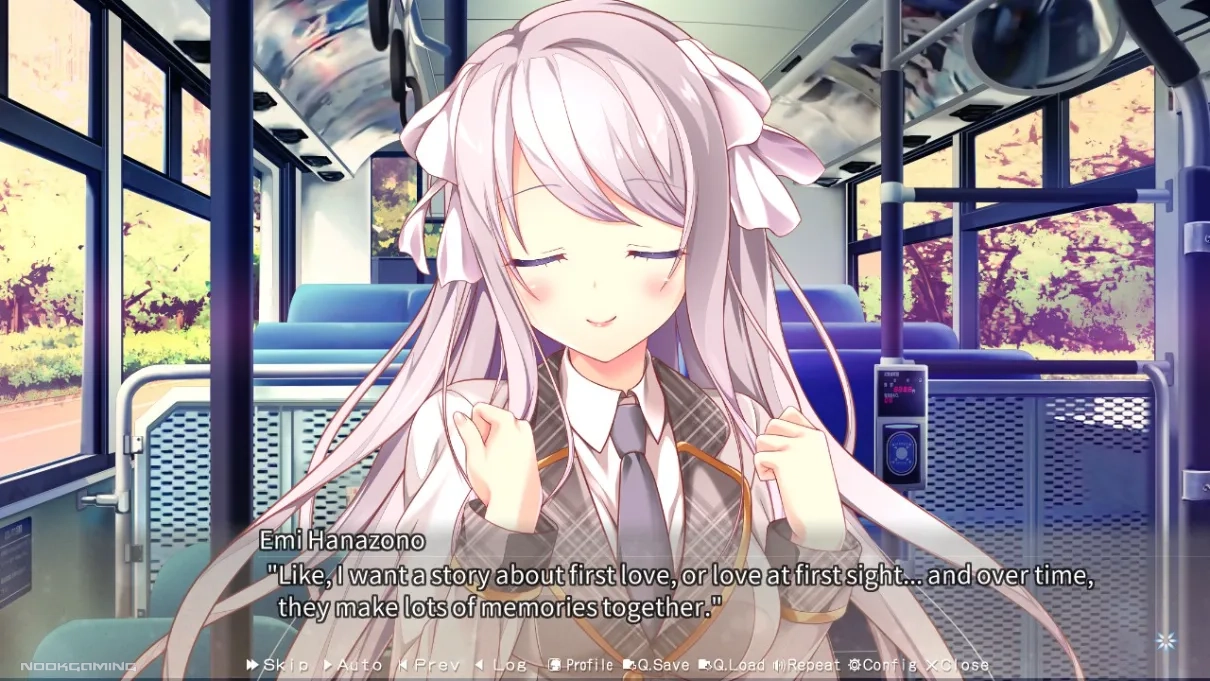
While reading Home Sweet Homecoming, although the overall story was disappointing, I didn’t really end up regretting the amount of time I put into reading it. On the contrary, once I changed how I approached the visual novel, I found myself enjoying its dialogue quite a lot. Common to most dating-focused romance stories, Home Sweet Homecoming offers the readers the front-seat experience of first loves, either through self-inserting or by spectating a young couple’s budding romance. A lot of the game’s strengths are found in the personal and intimate manner the heroines refer to Ryoutarou, who, with his lack of tangible presence, could easily represent the reader themselves. It provides a sense of companionship that warms the heart, a very wholesome feeling that feels unique to visual novels that welcome the idea of self-inserting. In a sense, it’s pretty indulgent of a wide range of fantasies that readers might want to try out.
On the other hand, because the pace of development between Ryoutarou and the heroine is confined to a measly eight chapters (ten if you consider the dating and confession scenes as part of it) that lasts a few hours at most, it also makes the experience feel rather unconvincing in terms of committing to a relationship. They develop feelings for each other abnormally fast, with some of the most mundane things serving as sparks for them to take their relationship to the next level. Yet at the same time, these mundane occurrences are also where high school love can start, making them quite relatable to people familiar with it. In a way, because of its own limited structure and length, it struggles to find that balance between being entertaining enough as a written work and remaining grounded enough to be relatable. It makes it a bit vexing to read because as much as you want to like it, outside of its charming cast members and intimate moments, there’s not much going for its plot to make itself naturally interesting to readers.
Romance Involves (Someone’s) Two Heads
Of course, what kind of youthful romance would a story be depicting if there weren’t fleeting, passionate moments of carnal desire? Following the same vein as a lot of other titles in its genre, Home Sweet Homecoming features a generous amount of adult content that readers are most likely poised to enjoy. With twenty-four H-scenes spread across seven heroines, there’s a lot to appreciate as scenes get increasingly intimate throughout the length of the relationship. The scenes are well-incorporated into the isolated scenarios of the heroine chapters they’re found in, which helps alleviate some of the tedium from having to read so many sex scenes in a short amount of time. The only problem I had with them is that the journey to them felt rather rushed for some routes, especially their first sexual experiences. It makes the occasion feel shallow instead of the momentous kind you’d expect from a major milestone in a relationship.
Interestingly, Home Sweet Homecoming also offers the option to readers to customize the adult content in the game by providing an entire tab in the settings dedicated to tinkering with their personal preferences related to sex. I was very much happy to see an option to keep clothes on during sex or to get fully naked, as I find partial clothing to be more pleasing to the eyes when it comes to adult content in visual novels. This customization also extends to the site of climax; for many visual novels, they will randomly prompt you during an H-scene to either expel the next generation of babies outside or inside the protagonist’s partner/s. This disrupts the flow of the scene for some, and hence, can be very aggravating at times. Having the option to automatically pick one makes the experience of playing the visual novel a lot more personalized and, as a result, a lot more comfortable.

Art and Music
Without considering variations, Home Sweet Homecoming features a total of eighty-five (85) unique CGs, with forty-five (45) of them being HCGs. Most of these CGs are distributed across the four main heroines, who each have sixteen (16) entries in their respective galleries. The main artist of the game is RINKS, who has previously worked on other HOOKSOFT games such as IxSHE Tell, Amenity’s Life, and the Houkago Cinderella series. While I find the art attractive in general, some CGs do feel a bit weird in terms of the perspective used, which makes some body parts (such as the head) feel longer than they should be. There are also some instances where I feel like the sheen on the character makes the texture look similar to that of plastic, which is a little bit off-putting. Regardless, most of these observations are more nitpicks than glaring problems, as the CGs of Home Sweet Homecoming are sufficiently pleasing to the eyes as what you’d expect from a heroine-heavy title.
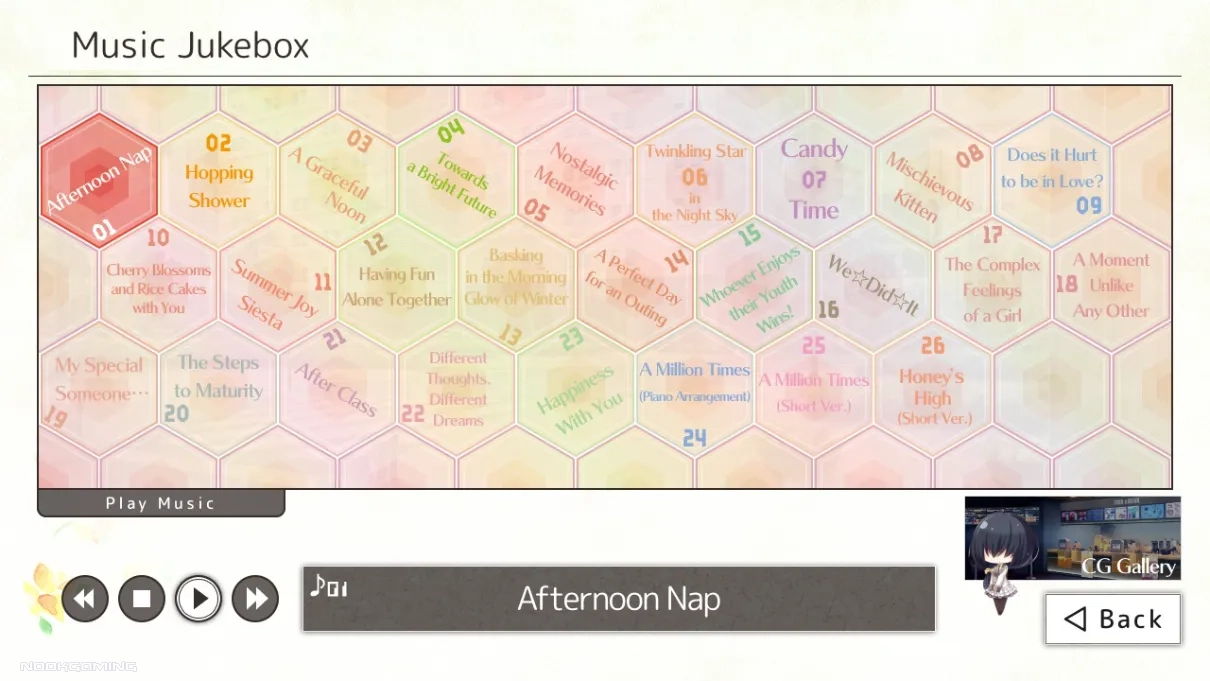
Home Sweet Homecoming also features a respectable twenty-six (26) tracks as part of its music lineup. There’s a healthy assortment of musical instruments used for its tracks, with piano, guitars, and drums being featured in relatively equal amounts. While I like the tracks individually, some of them feel like they were weirdly used, especially considering the context in which they usually appear. For example, A Moment Unlike Any Other feels like something that would be sillier in nature because of its high energy, but it’s present in some events that feature relaxing situations such as strolling through a park. They are still, however, great tracks in their own right. They contribute a lot to establishing the easygoing atmosphere of the visual novel, which honestly, gives it the kind of life that it deserves. For reference, the work on the tracks was done by the SONO MAKERS team, known for handling various HOOKSOFT and SMEE (Making * Lovers, Sugar*Style, and HaremKingdom) titles that fall under the same genre. That means that for the most part, fans of HOOKSOFT and SMEE will be happy to know that Home Sweet Homecoming features a sound experience similar to what they already know and love.
Verdict
Home Sweet Homecoming (E School Life) is a romance visual novel that leads you through the experience of high school love. It lets you peek into common troubles that everyone experiences such as anxiously confessing your feelings, sharing various kinds of firsts, and planning an ideal future with your partner. The way it frames its characters’ interactions is personal and intimate, making it quite an endearing title for those who might wish to try and relive that specific part of their youth.
On the other hand, it is almost a blank slate when it comes to creating a moving and entertaining story. Most of the scenarios depicted in the visual novel are mundane in nature, and hence, are relatively tame in both stakes and possible opportunities for conflicts. While there are glimpses of inner character motivations rooted in their personalities and circumstances, the narrative does the bare minimum to acknowledge this, and as such, keeps them relatively inconsequential for their individual character arcs. This also means that Ryoutarou as a protagonist falls largely flat, having been deprived of big opportunities for character growth or change. Ironically, this makes him an ideal protagonist for self-insert stories, as his presence is largely negligible due to a lack of unique, impressionable traits. Hence, if you’re seeking deeper, meaningful connections and conversations between characters in a story, then this title is not for you. Given the amount of time it takes to finish its story, you’d be better off picking another title from your never-ending backlog.
Should you be craving a small reminder of what was or what could have been, feel free to pick up Home Sweet Homecoming as your next title to read! It’s a light and enjoyable way to spend time without becoming overly invested, as it’s mostly a feel-good story with lots of cliches that help depict the excitement of young love. Don’t work that brain too much though, you might find yourself disappointed once you start seeking out the specifics of their loving relationships.
WAIT FOR SALE ON HOME SWEET HOMECOMING

If you would like to see more comedy Visual Novels, you may be interested in our review of Hold Me Tight All Night, Onii-chan!
Many thanks go to Shiravune for a PC review code for Home Sweet Homecoming.

Visual novel reader that wishes there were more than 24 hours in a day. Gacha victim, TCG enjoyer, and VTuber simp. Still trying to live happily.