No matter where or when, the first three Dragon Quest games are pretty much guaranteed to come in a set of sorts. Every time one gets remade, you can bet that the other two will follow before long. Whether this be on the Game Boy Color, Super Famicom, or its various mobile ports throughout the years, the Erdrick Saga is a close-knit one. After last year’s superb Dragon Quest III HD-2D Remake released, I waited patiently for the follow-up to come out the next year. That time has arrived now with Dragon Quest I & II HD-2D Remake, promising reimaginings and overhauls to genre classics.
Thou Shall Go Alone?
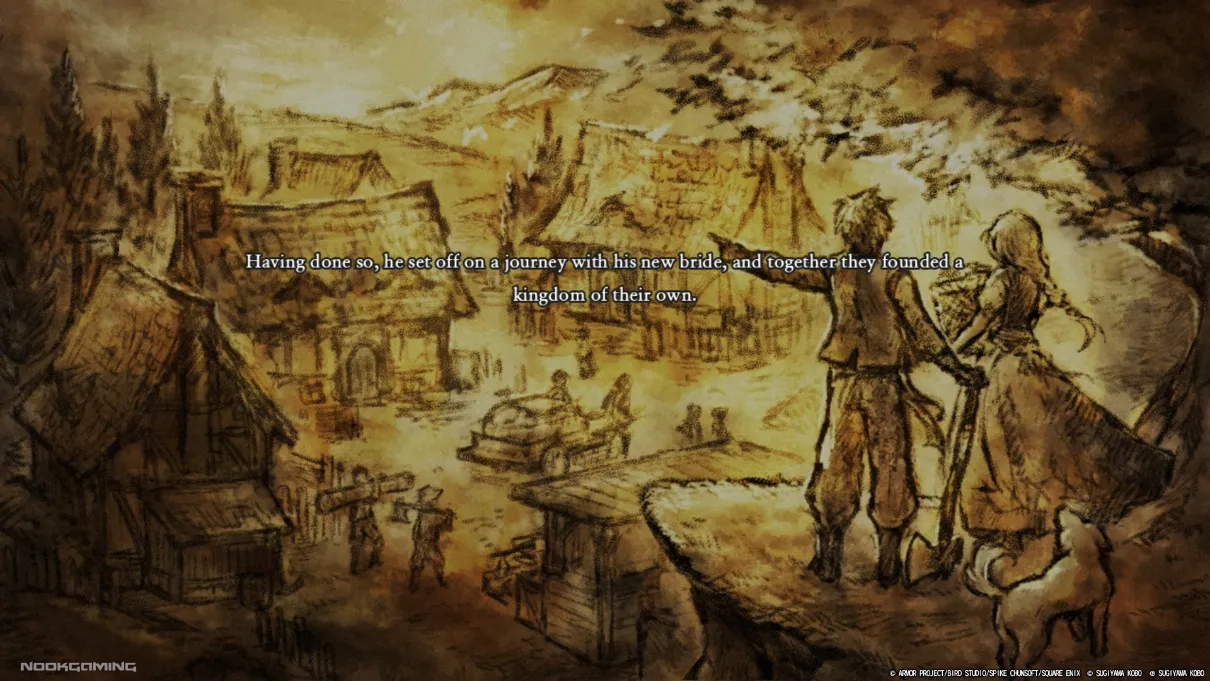
The story of Dragon Quest I was as classic and wonderfully simplistic as it got. The player character is the descendent of an ancient hero, and a big bad named the Dragonlord is out to threaten the land because he got his hands on a powerful plot device MacGuffin that he shouldn’t have. Along the way, you’ll fight all manner of classical creatures and even save a princess along the way. The setup is as simple as that, and back on the Famicom, there were no extra twists or turns to give this much depth. That was fine as it was released during a time where stories in games were expected to mostly be backdrop, an excuse to fight monsters and explore dungeons, but not a whole lot else. Following the tasteful expansions to the narrative of Dragon Quest III’s remake last year, I was excited to see what they would do with this one, and I was surprised at just how dramatically things have been expanded.
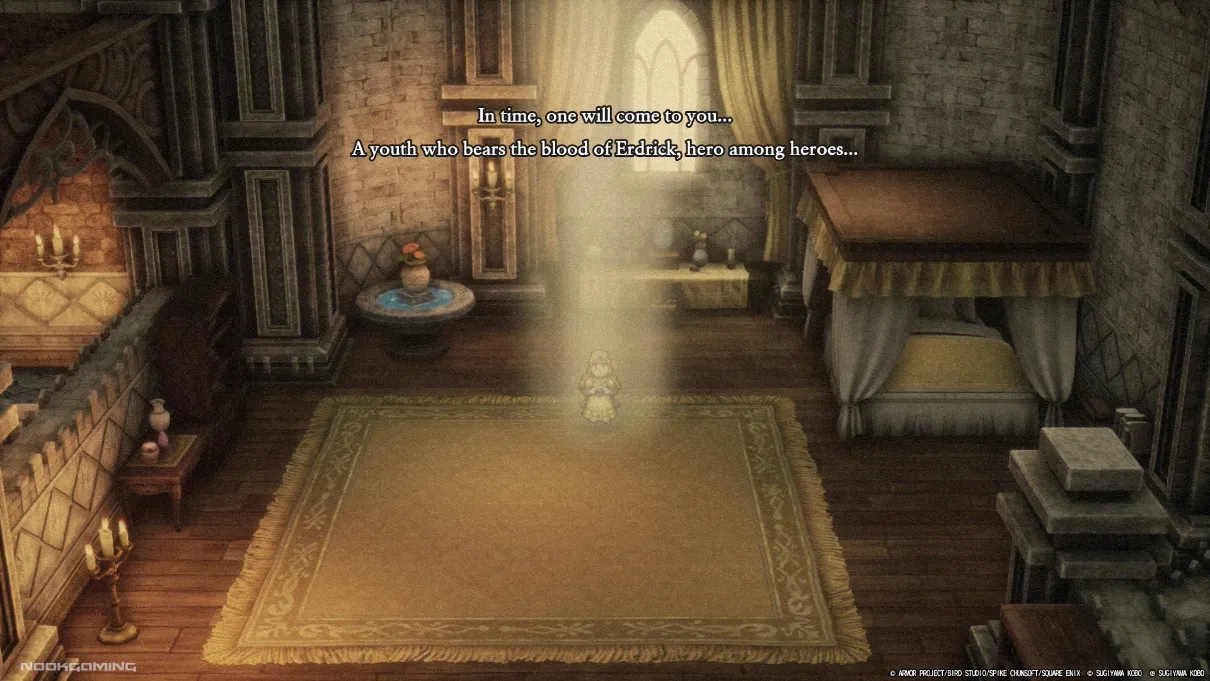
Both the story and scenario design of Dragon Quest I has been busted wide open with this new iteration, with some original material as well as certain plot elements carried over from the rest of the Erdrick Saga. For example, in the original game, where Magic Keys would break after one use, it’s instead made so that you only get one permanent Magic Key in a brand new plotline. Even before that, you also now get the Thief’s Key in a questline involving the descendent of Robbin ‘Ood, a character originating from the third game. Meanwhile, the Sigils and Goddess Rubiss from the second game also now play an important part in the story. This is before accounting for the elements that are effectively brand new to the setting of Alefgard, like the Dwarves and Faeries who have their own original plotlines that are organically integrated into the old story. Princess Gwaelin, main heroine of the story, also gets a good amount of new scenes to strengthen her relationship with the player, and to give her a greater sense of agency.
This even extends to the player themself, who’ve had their background changed to naturally fit the new storyline. Unlike in the original game, where you are told you are the descendent of Erdrick and have to follow in his footsteps, you instead spend the story needing to actively prove this to everyone. Everyone treats the player with the degree of skepticism that they normally are met with in the later Dragon Quest games, which I think does a great job of making story moments where you save the day a lot more satisfying. This is coupled with individual characters, both new and old, having their own storylines that run in parallel with the player’s. It’s still a story about a lone hero, but the writing is balanced in such a way that it feels lively, while still maintaining that feeling of lonely melancholy when it’s needed.
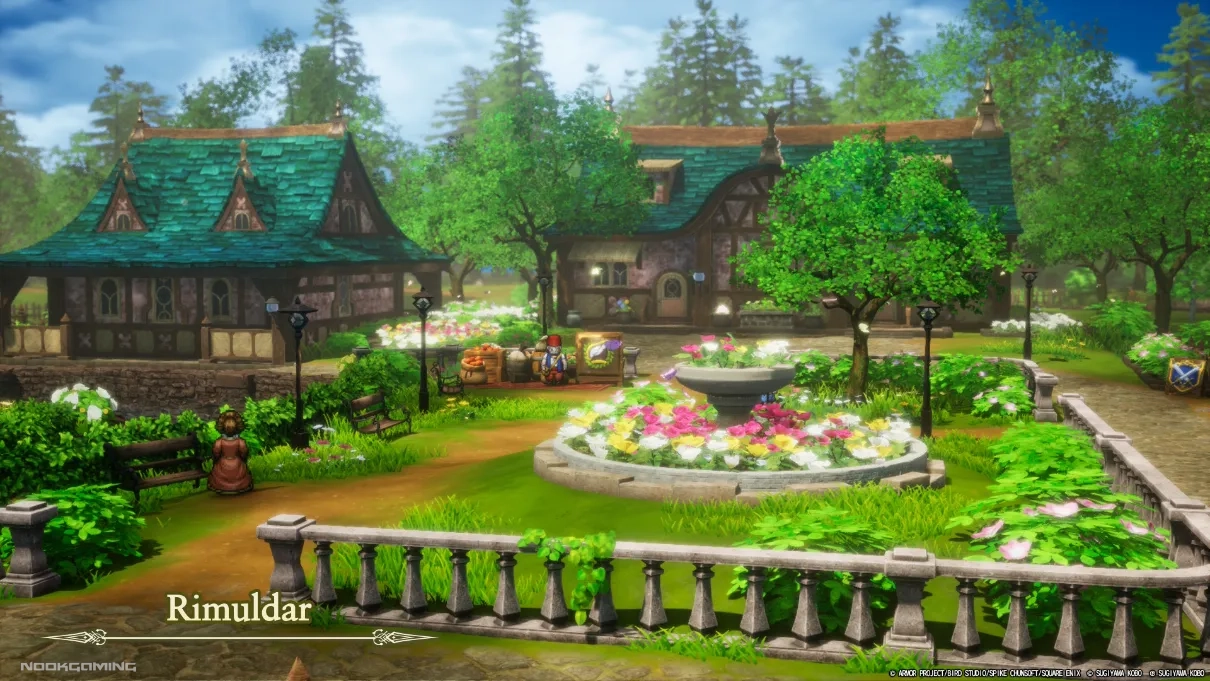
The result of this is a good amount of brand new towns, dungeons, and boss fights to compliment the rearranged storyline. The original game’s playtime of roughly 8 hours has been bumped up to about double that amount. Thanks to how seamlessly crafted a lot of the new content is, it still never once feels any longer than it ought to be. In fact, the pacing across the board is quite superb. Even if I sit and just play for an hour or two, it feels like I do and see a lot. It’s like this game is a version of Dragon Quest I from an alternate universe where the series was made just now, and for the most part I mean that in a positive way. While I think the changes are extensive enough to where it would probably be more accurate to say this is a reimagining instead of a remake (to a point where you should also play one of the prior versions of DQI), there is quite a lot here for both fans and newcomers to enjoy.
One Man is an Army
Dragon Quest I is still distinct in that it’s the only game in the series to feature one lone party member, that being yourself. Rather than have companions who specialize in different things and have their own assortment of strengths and weaknesses, the player is instead a beefed up Swiss Army knife of both Spells and Abilities from across the entire Dragon Quest series. In addition to all of the spells you had in the original Dragon Quest like Sizz, Snooze, or Hocus Pocus, there are also newer abilities like Wild Side (first introduced in Dragon Quest XI) or Dodgy Dance in this version.
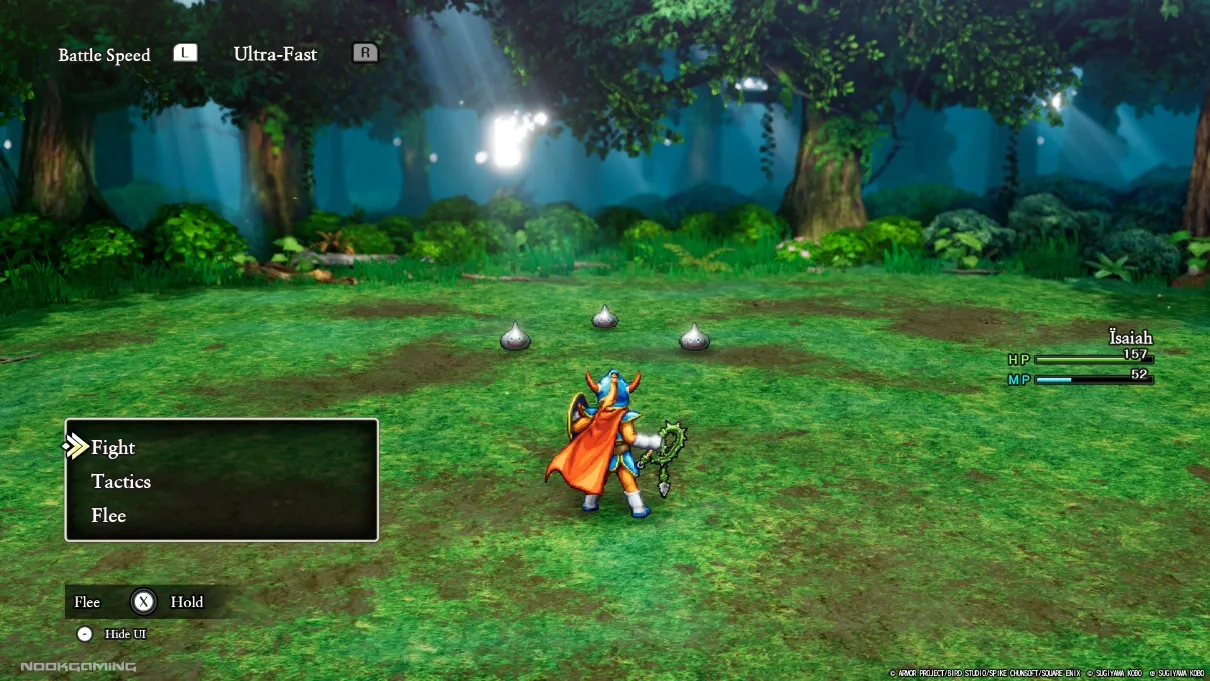
Unlike prior versions of DQI, where you fought enemies in 1-on-1s, you now may fight multiple enemies in a given battle at once. This means that you can attack every enemy simultaneously with the right Spell, Ability, or weapon type, but this also means that every enemy will attack you in a given turn as well. Playing on Draconian difficulty, I oftentimes laughed at how one of my pitiful attacks would swiftly result in me being beaten to death. Conversely, this also made winning battles feel a lot more satisfying. Comparing this to the original game, the difficulty is more of a sidegrade, unlike DQIII HD-2D which I found to be much harder than the original across the board. This is less because things necessarily got any easier or harder, and more because the overhaul in mechanics and scenario design means that it’s difficult in different ways than before. To start with, the level curve is much sharper and you level up more frequently. There’s also a lesser emphasis on powerful attacking equipment, rather this time it’s about careful and considered management of Spells and Abilities.
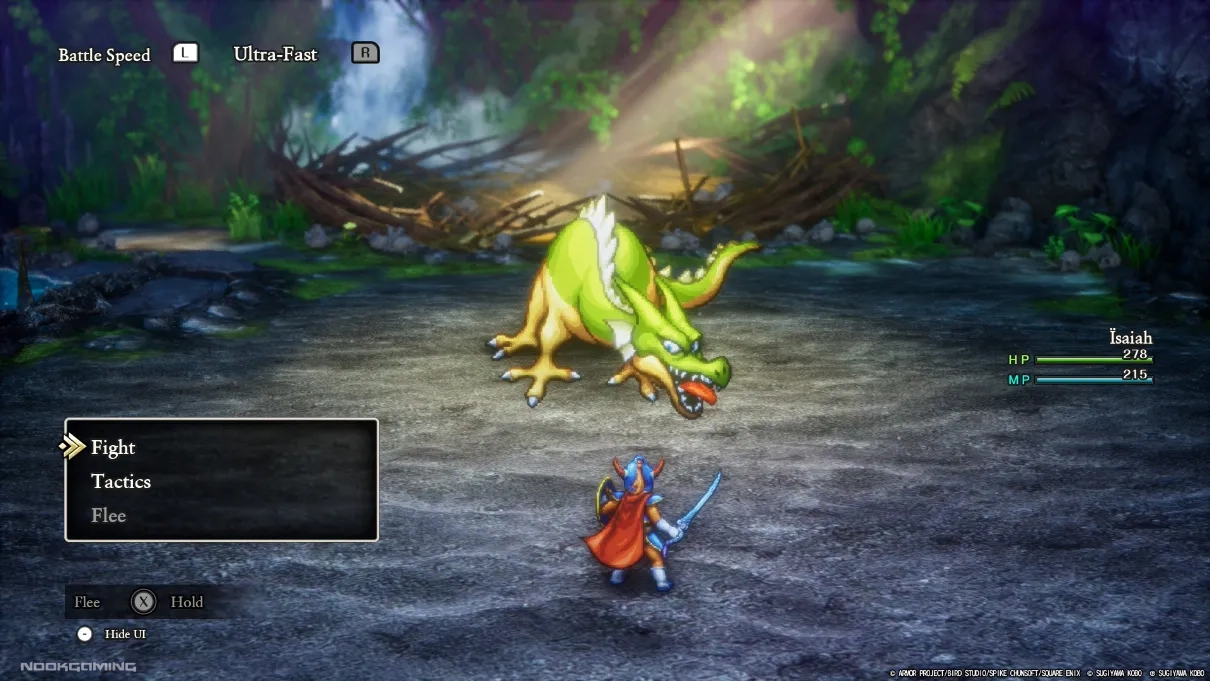
At its best, this works out incredibly well because it puts a lot of weight on wisely using each turn to do something meaningful. While battles with multiple enemies seem threatening, and often are, it can be incredibly gratifying to wipe them out in one stroke because of how much more thoughtful these encounters can be. Many of the one-on-one battles from the original, such as the famous bouts with the Green Dragon or the Golem, see very strong makeovers thanks to these new systems. However, this can occasionally turn some of the more demanding battles into what feels like pure RNG-luckfests. There’s a particularly nasty battle here that I won’t spoil, seeing as its brand new, that I found so bad that I was near-tempted to lower the difficulty just to get past it. It’s unfortunately not the exception, and the handful of bosses like this become extremely irritating and temporarily make me question whether I like DQI’s combat or not.
Combined with the changes made to the story, I love what they did with Dragon Quest I. In many ways, it’s a nice distillation of what makes for a fun old-school RPG. It takes the original game and asks “how can it be made bigger?” while never betraying the core principles of what the original game stood for. It could have been easy to completely rewrite the old story because it “wasn’t any good”, or to just give the player more party members since a lot of people don’t like the 1-person battle system. Instead, it reexamines these elements with the lessons learned from the series’ various remakes and sequels, and uses that to find further depth in these areas. I’m glad it did, since while it isn’t perfect, it’s still a triumphant remake in many regards.
Luminaries of the Legendary Line
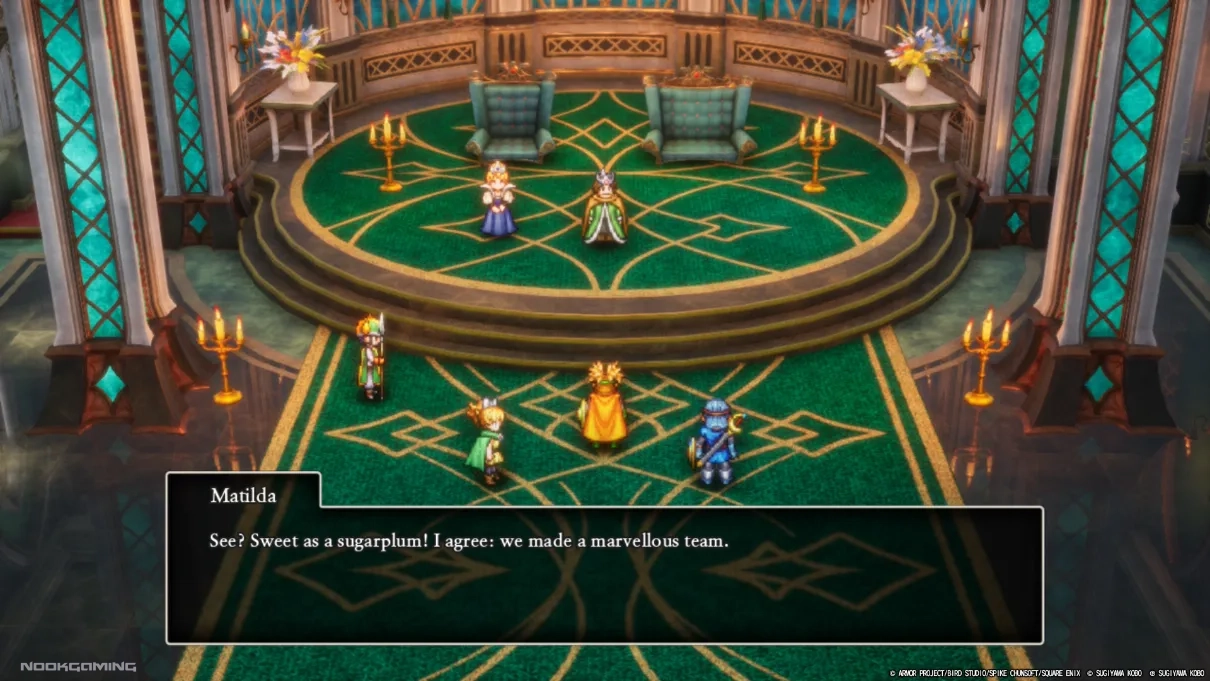
Picking up a few hundred years after the events of the first game, Dragon Quest II’s story takes place in a land faraway from Alefgard. The hero and heroine of the last game had left three kingdoms to their descendents, and a peace was enjoyed for a long time. However, that peace was not to last as one of the kingdoms, Moonbrooke, is annihilated in an assault by the game’s antagonist, Hargon. As descendents of Erdrick, the player and their cousins rally together to venture across the realm and slay Hargon before its too late. This is a marginally more complicated setup than the previous game, but just like its HD-2D remake, this version of Dragon Quest II benefits from a greatly expanded plot and main scenario. Not only are there more characters than before, the ones that are there are given more material and emotion to work with. This even includes the main party members (minus the player character, who remains mute), who acted relatively passively in the original DQII.
Dragon Quest II’s quest design is also expanded to account for the new lore and plot additions. For example, in the original game, you find the Prince of Cannock at an inn in one of the neighboring towns. In this remake, however, you go to one of the shrines where he is said to be praying, with the Princess of Cannock helping you along the way as a guest party member. You go on a wild goose chase looking for him, before ultimately finding him back in the same location he was in the original game. Likewise, you don’t get to simply go to Moonbrooke like in the original game. Instead, the passage towards it is flooded and you’re forced to seek out the Bottomless Pot, an item from the third game, in order to undo it. Along the way, you even encounter a brand new boss to punctuate the tension in this part of the story. It all adds up to a much greater sense of emotional payoff than before, even when it’s just small things like the characters reacting to certain surroundings.
This is before getting into the big new addition, that being Princess of Cannock’s promotion to being the fourth party member. I can’t go into a terrible amount of detail of the when and how of this new addition, but I’ll say that she shook up the story as much as I hoped she might, offering several fun new dynamics to the core of the main party. Though I think this does highlight the noticeable lack of Party Chat, which DQII could have benefitted from since it’s never been in the Erdrick trilogy before now. The oodles of new story content balances this out somewhat, but I wish it was there just to really push this game over the top.
Dragon Quest II has always suffered somewhat from being stuck between giants. It’s neither as groundbreaking as the first game nor as much of a leap in scope and sophistication compared to the third. It is better than Dragon Quest I in many ways, but before now I was always left with the feeling of it being neither as charmingly weird as the first game, nor as overwhelmingly large and inviting as the games that came later. With this remake, I feel like that position has shifted. While II by itself is not anywhere as large as the likes of Dragon Quest VII, VIII, or XI, it’s reached a point where the increased scope allows everything about it to feel a lot more impactful than before. By itself, it’s almost as good as III.
Fight and Journey Together
Dragon Quest II was the first to expand the series’ combat by having multiple enemies to fight at once, as well as having a multi-character party where each member could perform an action in the space of one turn. Each party member this time around could be seen as a splinter of the abilities of DQI’s protagonist. The Prince of Middenhall (that’s you) has high attack power and defenses, but low speed and no magical ability; meanwhile the Princess of Moonbrooke has high magical aptitude but low defenses and low physical attack power, and the siblings of Cannock are a balance between these two. The original Dragon Quest II rather notoriously suffered from terrible game balance, with the Prince of Middenhall becoming dead weight before long. Thankfully that issue has been sorted here, leading to a combat system that feels a lot more considered and fun.
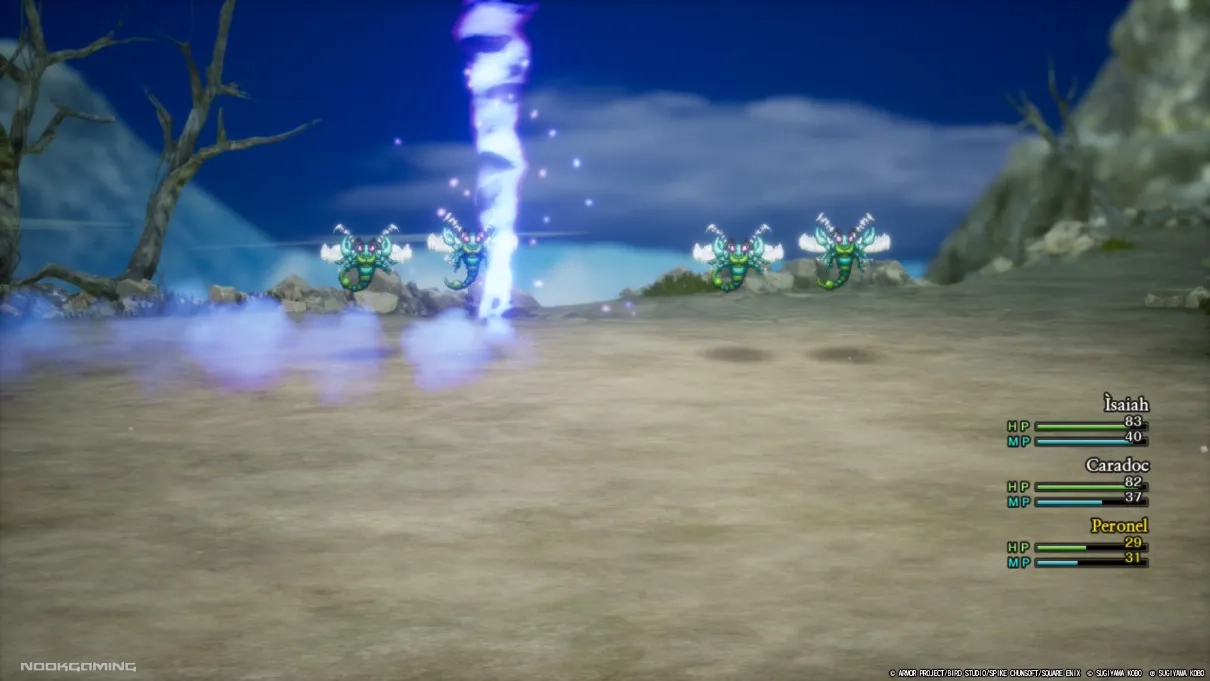
Like with both DQI and DQIII, Dragon Quest II’s HD-2D iteration carries over many of the balance changes and abilities that appeared in later games. These are either learned naturally as characters level up, or they can instead be learned through single-use scrolls hidden around the overworld. Thanks to the wide variety of effects both Spells and Abilities have, it opens up a very strong element of strategy and experimentation to most fights. While I wouldn’t say the game is as consistently mean as the original DQII, bosses in particular feel a lot more rewarding to beat than before thanks to less janky game balance and a greater quantity of challenging fights. In other words, this game feels more like it’s difficult for the right reasons, whereas the original would often fall back on its challenge coming from obtuse systems rather than anything meaningful.
There’s also plenty of quality of life changes across both I and II that are appreciable. Struggling with bosses doesn’t feel as bad thanks to the Boss Rematch feature, allowing you to experiment with different strategies until you find something that works. The excellent Recall feature from the previous remake also returns, allowing you to instantly save and bring up relevant bits of dialogue hints that will help you find the way forward. If you would prefer to enjoy the game for the story, you can also ask for varying degrees of help with things like quest markers, treasure markers, or difficulty options. I found the gameplay to be well-handled when playing in Draconian difficulty and without quest markers in both games, as there’s plenty of help from NPCs for you to always find what you’re looking for.
Another HD-2D Tale
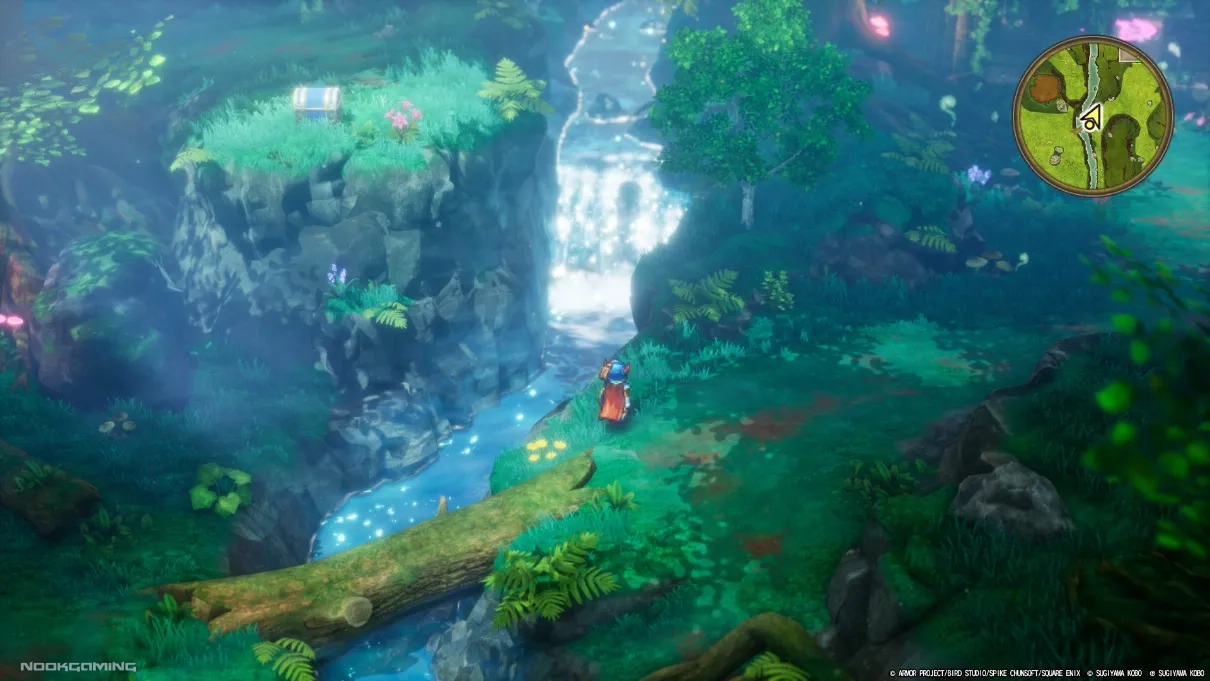
I have all of the same compliments about Dragon Quest I & II HD-2D Remake’s visuals as I did Dragon Quest III’s remake from last year. As is the norm with HD-2D games, these remakes combine pixelated graphics reminiscent of the SNES era with high fidelity effects and realistic light simulation, as well as richly detailed 3D environment design. The result is a high contrast style that works especially well when bringing up old school titles like these. Enemies in battle are very smoothly animated, and towns look lush and distinct with their own little details that are fun to soak in. The Nintendo Switch 2 version, which I played, also sees great enhancements to overall performance and playability. Compared to Dragon Quest III’s Switch 1 iteration, it comes with options to prioritize performance or graphics, and still looks pleasantly sharp even when playing in 60FPS mode. It also has better load times (not that they were particularly long to begin with) and cleaner effects-work in Unreal Engine 4.
Both games also come with big changes to audio, with the addition of the Symphonic Suite variations of both DQI and DQII’s soundtracks. DQII’s Symphonic Suite is my second favorite soundtrack in the series after VIII’s, so I was more than delighted to have a playable version of the game with orchestra. “Traveling With Friends” is one of my very favorite world map themes, so having it here made exploration a constant delight. There’s also voice acting, which is done in the same European style as previous Dragon Quest dubs. It combines a wide array of accents that help to further sell how far from home you’re traveling, and it’s great. I was particularly taken with the English performance of the Dragonlord, who sounded awesome no matter the scene. I never imagined such a goofy-looking villain having such an imposing voice, but it really worked and helped to sell his presence no matter the scene.
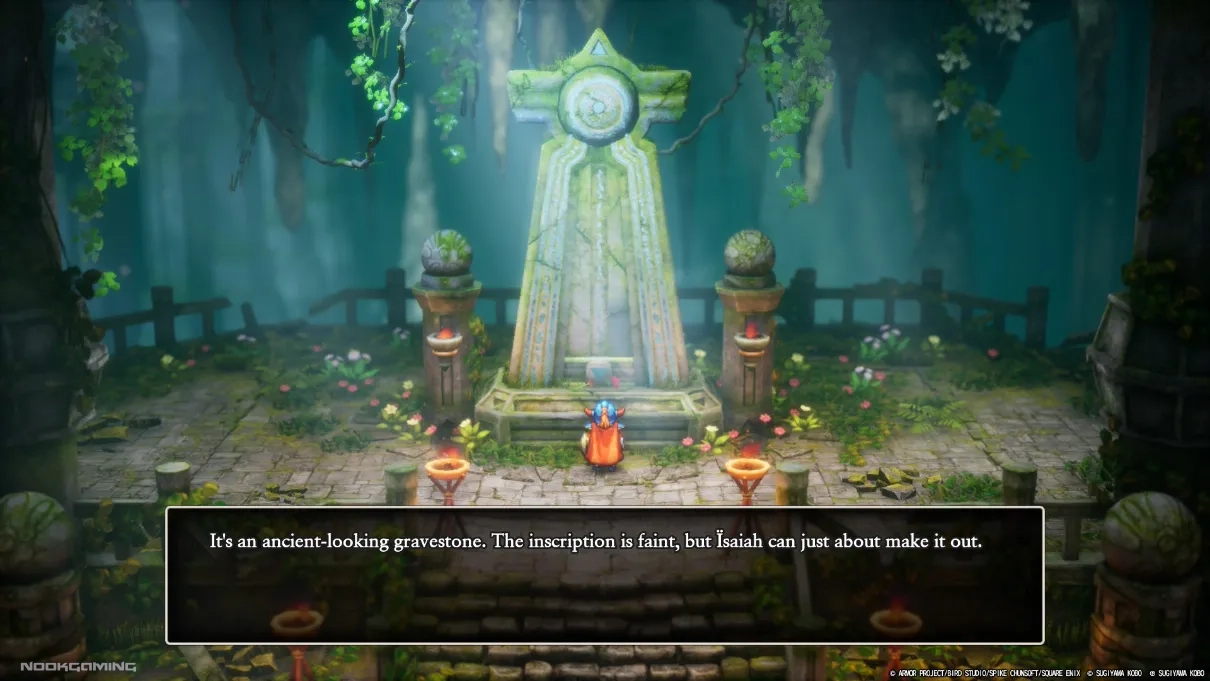
Finally, both games also have excellent localization work, as per the norm for the series. These iterations of Dragon Quest I & II take after the NES versions, back when the series was called Dragon Warrior in the western world. Nearly all of the character and town names are lifted from those versions, with only a few alterations made for the sake of making the story more consistent. Most characters also speak in a flowery, old-fashioned style that III’s remake established is just how the characters from Alefgard talk. It works pretty well, and makes both games feel like fantastical period pieces or theater dramas. When the story heats up and the villains start chewing the scenery, this style of writing really tends to elevate these moments.
Verdict
Dragon Quest I & II HD-2D Remake surprised me with the transformative experiences they offer. While they fall short of the highs of Dragon Quest III’s modern conversion, that’s more in testament to how these games specifically aimed to offer the fullest and most complete-feeling iterations of the first two titles. Dragon Quest I in particular left me very pleasantly surprised, turning an experience many would call antiquated into something fresh and modern, but still dedicated to the old-school roots that defined it. Dragon Quest II’s turns one of the more unremarkable chapters in the series’ history into something to be celebrated. The new map was a lot of fun to explore, and the new party member brings in some considered rebalancing to the entire game that makes it even more enjoyable than before. When combined with III’s remake from last year, I dare say this is my favorite modern RPG trilogy in recent memory.
DRAGON QUEST I & II HD-2D REMAKE IS HIGHLY RECOMMENDED

If you are looking for another Dragon Quest title, check out our review of Dragon Quest Monsters: The Dark Prince. If you’re looking for a different sort of old-school Japanese RPG in a modern style, check out Ys Memoire: The Oath in Felghana.
Many thanks go to Square Enix for a Nintendo Switch 2 review code for Dragon Quest I & II HD-2D Remake.

A hobbyist who took up the pen to write about their favorite pastime: games. While a lover of many genres, Isaiah Parker specializes in Platformers, RPGs, and competitive multiplayer titles. The easiest way into his heart is to have great core gameplay mechanics. Self-proclaimed world’s biggest Sonic fan. Follow him @ZinogreVolt